

In Refs. [29, 30, 53, 54] it has been proposed “ab initio” optimization principle
for construction of the relativistic orbital basis’s. The minimization condition of the
gauge dependent multielectron contribution of the lowest QED PT corrections to
the radiation widths of the atomic levels is used. The details of procedure can be
found in Refs. [53, 54].
Here we briefly describe the key moments. In the fourth order of QED PT there
appear diagrams, whose contribution into the Im d E accounts for the exchangepolarization effects. This contribution describes the collective effects and it is
dependent upon the electromagnetic potentials gauge (the gauge non-invariant
contribution).
Let us examine the multi-electron atom with 1QP in the first excited state,
connected with the ground state by the electric dipole radiation transition. In the
zeroth order of QED PT we use the 1-electron bare potential V N (r) + V C (r). The
mean field potential V C (r) is related to the electron density q C (r) in a standard way
[45–47]. Moreover, all the results of the approximate calculations are the functionals of the density ρ C (r).
Further one may treat the lowest order multi-electron effects, in particular, the
gauge dependent radiative contribution for a certain class of the photon propagator
calibration. This value is considered to the typical electron correlation effect, whose
minimization is a reasonable criterion in searching the optimal one-electron basis of
PT. All the gauge non-invariant terms are multi-electron by their nature (the particular case of the gauge non-invariance manifestation is the non-coincidence of the
oscillator strengths values, obtained in the approximate calculations with the
“length” and “velocity” transition operator forms). Quite complicated calculation of
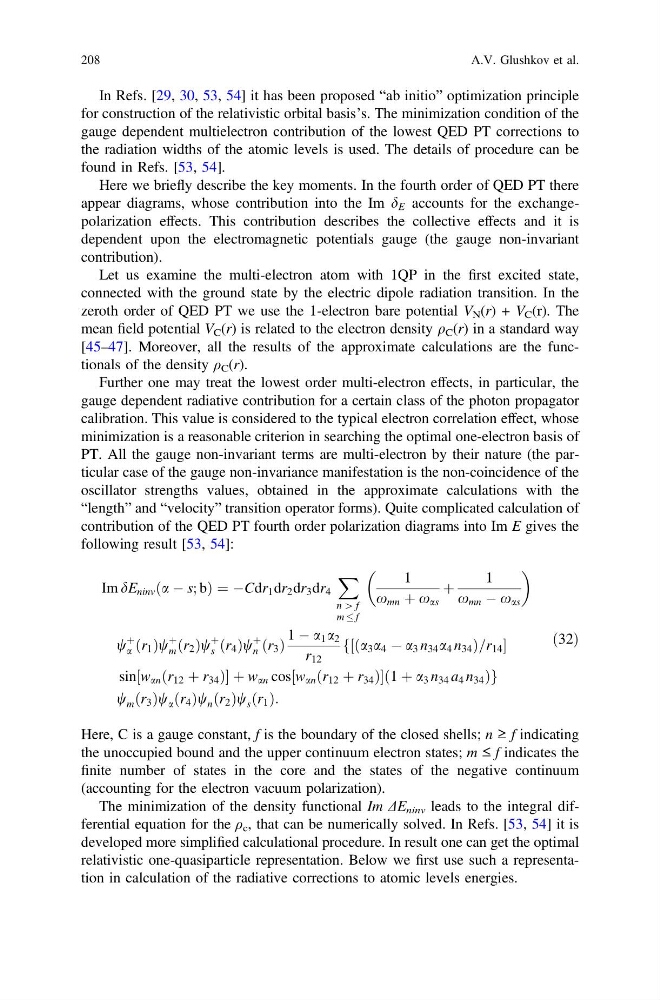
contribution of the QED PT fourth order polarization diagrams into Im E gives the
following result [53, 54]:
Im dE ninv ða À s; bÞ ¼ ÀCdr 1 dr 2 dr 3 dr 4
X
n [ f
m f
1
x mn þ x as
þ
1
x mn À x as
w
þ
a r 1
ð Þw
þ
m r 2
ð Þw
þ
s r 4
ð Þw
þ
n r 3
ð Þ
1 À a 1 a 2
r 12
f½ða 3 a 4 À a 3 n 34 a 4 n 34 Þ=r 14
sin½w an r 12 þ r 34
ð
Þ þw an cos½w an r 12 þ r 34
ð
Þð1 þ a 3 n 34 a 4 n 34 Þg
w m r 3
ð Þw a r 4
ð Þw n r 2
ð Þw s r 1
ð Þ:
ð32Þ
Here, C is a gauge constant, f is the boundary of the closed shells; n ≥ f indicating
the unoccupied bound and the upper continuum electron states; m ≤ f indicates the
finite number of states in the core and the states of the negative continuum
(accounting for the electron vacuum polarization).
The minimization of the density functional Im ΔE ninv leads to the integral differential equation for the ρ c , that can be numerically solved. In Refs. [53, 54] it is
developed more simplified calculational procedure. In result one can get the optimal
relativistic one-quasiparticle representation. Below we first use such a representation in calculation of the radiative corrections to atomic levels energies.
208
A.V. Glushkov et al.
for construction of the relativistic orbital basis’s. The minimization condition of the
gauge dependent multielectron contribution of the lowest QED PT corrections to
the radiation widths of the atomic levels is used. The details of procedure can be
found in Refs. [53, 54].
Here we briefly describe the key moments. In the fourth order of QED PT there
appear diagrams, whose contribution into the Im d E accounts for the exchangepolarization effects. This contribution describes the collective effects and it is
dependent upon the electromagnetic potentials gauge (the gauge non-invariant
contribution).
Let us examine the multi-electron atom with 1QP in the first excited state,
connected with the ground state by the electric dipole radiation transition. In the
zeroth order of QED PT we use the 1-electron bare potential V N (r) + V C (r). The
mean field potential V C (r) is related to the electron density q C (r) in a standard way
[45–47]. Moreover, all the results of the approximate calculations are the functionals of the density ρ C (r).
Further one may treat the lowest order multi-electron effects, in particular, the
gauge dependent radiative contribution for a certain class of the photon propagator
calibration. This value is considered to the typical electron correlation effect, whose
minimization is a reasonable criterion in searching the optimal one-electron basis of
PT. All the gauge non-invariant terms are multi-electron by their nature (the particular case of the gauge non-invariance manifestation is the non-coincidence of the
oscillator strengths values, obtained in the approximate calculations with the
“length” and “velocity” transition operator forms). Quite complicated calculation of
contribution of the QED PT fourth order polarization diagrams into Im E gives the
following result [53, 54]:
Im dE ninv ða À s; bÞ ¼ ÀCdr 1 dr 2 dr 3 dr 4
X
n [ f
m f
1
x mn þ x as
þ
1
x mn À x as
w
þ
a r 1
ð Þw
þ
m r 2
ð Þw
þ
s r 4
ð Þw
þ
n r 3
ð Þ
1 À a 1 a 2
r 12
f½ða 3 a 4 À a 3 n 34 a 4 n 34 Þ=r 14
sin½w an r 12 þ r 34
ð
Þ þw an cos½w an r 12 þ r 34
ð
Þð1 þ a 3 n 34 a 4 n 34 Þg
w m r 3
ð Þw a r 4
ð Þw n r 2
ð Þw s r 1
ð Þ:
ð32Þ
Here, C is a gauge constant, f is the boundary of the closed shells; n ≥ f indicating
the unoccupied bound and the upper continuum electron states; m ≤ f indicates the
finite number of states in the core and the states of the negative continuum
(accounting for the electron vacuum polarization).
The minimization of the density functional Im ΔE ninv leads to the integral differential equation for the ρ c , that can be numerically solved. In Refs. [53, 54] it is
developed more simplified calculational procedure. In result one can get the optimal
relativistic one-quasiparticle representation. Below we first use such a representation in calculation of the radiative corrections to atomic levels energies.
208
A.V. Glushkov et al.