

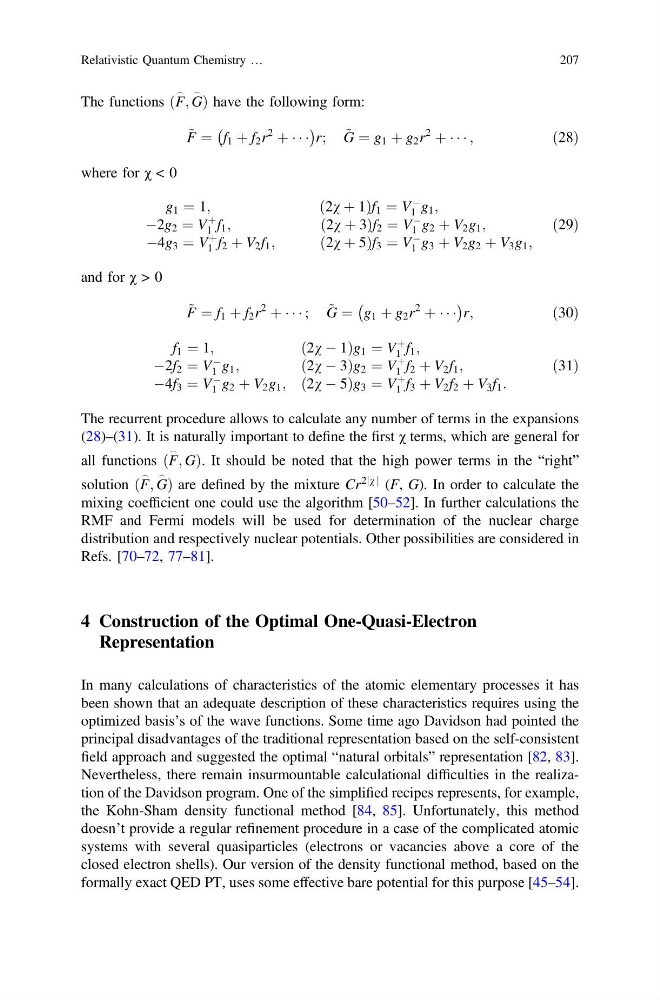
The functions ðF
_ ; G
_ Þ have the following form:
~
F ¼ f 1 þ f 2 r
2
þ Á Á Á
À
Á
r; ~
G ¼ g 1 þ g 2 r
2
þ Á Á Á ;
ð28Þ
where for χ < 0
g 1 ¼ 1;
2v þ 1
ð
Þf 1 ¼ V
À
1 g 1 ;
À2g 2 ¼ V
þ
1 f 1 ;
2v þ 3
ð
Þf 2 ¼ V
À
1 g 2 þ V 2 g 1 ;
À4g 3 ¼ V
þ
1 f 2 þ V 2 f 1 ;
2v þ 5
ð
Þf 3 ¼ V
À
1 g 3 þ V 2 g 2 þ V 3 g 1 ;
ð29Þ
and for χ > 0
~
F ¼ f 1 þ f 2 r
2
þ Á Á Á ; ~
G ¼ g 1 þ g 2 r
2
þ Á Á Á
À
Á
r;
ð30Þ
f 1 ¼ 1;
2v À 1
ð
Þg 1 ¼ V
þ
1 f 1 ;
À2f 2 ¼ V
À
1 g 1 ;
2v À 3
ð
Þg 2 ¼ V
þ
1 f 2 þ V 2 f 1 ;
À4f 3 ¼ V
À
1 g 2 þ V 2 g 1 ; 2v À 5
ð
Þg 3 ¼ V
þ
1 f 3 þ V 2 f 2 þ V 3 f 1 :
ð31Þ
The recurrent procedure allows to calculate any number of terms in the expansions
(28)–(31). It is naturally important to define the first χ terms, which are general for
all functions ðF
_ ; GÞ. It should be noted that the high power terms in the “right”
solution ðF
_ ; G
_ Þ are defined by the mixture Cr
2 v
j j (F, G). In order to calculate the
mixing coefficient one could use the algorithm [50–52]. In further calculations the
RMF and Fermi models will be used for determination of the nuclear charge
distribution and respectively nuclear potentials. Other possibilities are considered in
Refs. [70–72, 77–81].
4 Construction of the Optimal One-Quasi-Electron
Representation
In many calculations of characteristics of the atomic elementary processes it has
been shown that an adequate description of these characteristics requires using the
optimized basis’s of the wave functions. Some time ago Davidson had pointed the
principal disadvantages of the traditional representation based on the self-consistent
field approach and suggested the optimal “natural orbitals” representation [82, 83].
Nevertheless, there remain insurmountable calculational difficulties in the realization of the Davidson program. One of the simplified recipes represents, for example,
the Kohn-Sham density functional method [84, 85]. Unfortunately, this method
doesn’t provide a regular refinement procedure in a case of the complicated atomic
systems with several quasiparticles (electrons or vacancies above a core of the
closed electron shells). Our version of the density functional method, based on the
formally exact QED PT, uses some effective bare potential for this purpose [45–54].
Relativistic Quantum Chemistry …
207
_ ; G
_ Þ have the following form:
~
F ¼ f 1 þ f 2 r
2
þ Á Á Á
À
Á
r; ~
G ¼ g 1 þ g 2 r
2
þ Á Á Á ;
ð28Þ
where for χ < 0
g 1 ¼ 1;
2v þ 1
ð
Þf 1 ¼ V
À
1 g 1 ;
À2g 2 ¼ V
þ
1 f 1 ;
2v þ 3
ð
Þf 2 ¼ V
À
1 g 2 þ V 2 g 1 ;
À4g 3 ¼ V
þ
1 f 2 þ V 2 f 1 ;
2v þ 5
ð
Þf 3 ¼ V
À
1 g 3 þ V 2 g 2 þ V 3 g 1 ;
ð29Þ
and for χ > 0
~
F ¼ f 1 þ f 2 r
2
þ Á Á Á ; ~
G ¼ g 1 þ g 2 r
2
þ Á Á Á
À
Á
r;
ð30Þ
f 1 ¼ 1;
2v À 1
ð
Þg 1 ¼ V
þ
1 f 1 ;
À2f 2 ¼ V
À
1 g 1 ;
2v À 3
ð
Þg 2 ¼ V
þ
1 f 2 þ V 2 f 1 ;
À4f 3 ¼ V
À
1 g 2 þ V 2 g 1 ; 2v À 5
ð
Þg 3 ¼ V
þ
1 f 3 þ V 2 f 2 þ V 3 f 1 :
ð31Þ
The recurrent procedure allows to calculate any number of terms in the expansions
(28)–(31). It is naturally important to define the first χ terms, which are general for
all functions ðF
_ ; GÞ. It should be noted that the high power terms in the “right”
solution ðF
_ ; G
_ Þ are defined by the mixture Cr
2 v
j j (F, G). In order to calculate the
mixing coefficient one could use the algorithm [50–52]. In further calculations the
RMF and Fermi models will be used for determination of the nuclear charge
distribution and respectively nuclear potentials. Other possibilities are considered in
Refs. [70–72, 77–81].
4 Construction of the Optimal One-Quasi-Electron
Representation
In many calculations of characteristics of the atomic elementary processes it has
been shown that an adequate description of these characteristics requires using the
optimized basis’s of the wave functions. Some time ago Davidson had pointed the
principal disadvantages of the traditional representation based on the self-consistent
field approach and suggested the optimal “natural orbitals” representation [82, 83].
Nevertheless, there remain insurmountable calculational difficulties in the realization of the Davidson program. One of the simplified recipes represents, for example,
the Kohn-Sham density functional method [84, 85]. Unfortunately, this method
doesn’t provide a regular refinement procedure in a case of the complicated atomic
systems with several quasiparticles (electrons or vacancies above a core of the
closed electron shells). Our version of the density functional method, based on the
formally exact QED PT, uses some effective bare potential for this purpose [45–54].
Relativistic Quantum Chemistry …
207