

W rjR
ð Þ ¼ W r
ð Þ
Z r
0
dr r
2
q rjR
ð Þþ
Z 1
r
dr r
2 W r
ð Þq rjR
ð Þ
ð16Þ
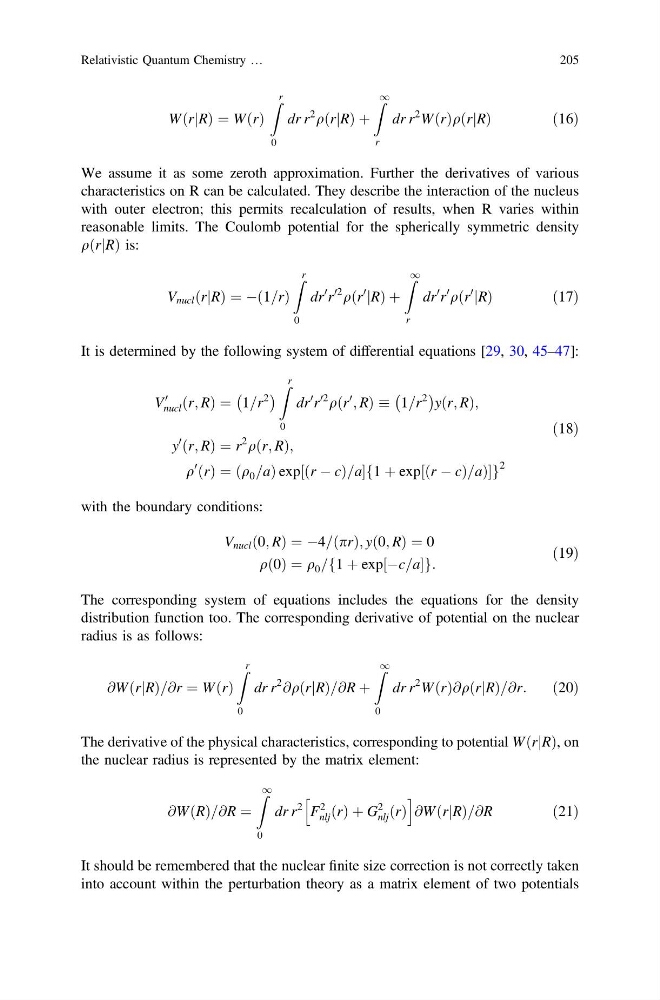
We assume it as some zeroth approximation. Further the derivatives of various
characteristics on R can be calculated. They describe the interaction of the nucleus
with outer electron; this permits recalculation of results, when R varies within
reasonable limits. The Coulomb potential for the spherically symmetric density
q rjR
ð Þ is:
V nucl rjR
ð Þ ¼ À 1=r
ð Þ
Z r
0
dr
0 r
02
q r
0
jR
ð
Þþ
Z 1
r
dr
0 r
0
q r
0
jR
ð
Þ
ð17Þ
It is determined by the following system of differential equations [29, 30, 45–47]:
V
0
nucl r; R
ð Þ ¼ 1=r
2
À
Á
Z r
0
dr
0 r
02
q r
0
; R
ð
Þ 1=r
2
À
Á
y r; R
ð Þ;
y
0 r; R
ð Þ ¼ r
2
q r; R
ð Þ;
q
0
ðrÞ ¼ ðq 0 =aÞ exp½ðr À cÞ=af1 þ exp½ðr À cÞ=aÞg
2
ð18Þ
with the boundary conditions:
V nucl 0; R
ð
Þ ¼ À4= pr
ð Þ; y 0; R
ð
Þ ¼ 0
qð0Þ ¼ q 0 =f1 þ exp½Àc=ag:
ð19Þ
The corresponding system of equations includes the equations for the density
distribution function too. The corresponding derivative of potential on the nuclear
radius is as follows:
@W rjR
ð Þ=@r ¼ W r
ð Þ
Z r
0
dr r
2
@q rjR
ð Þ=@R þ
Z 1
0
dr r
2 W r
ð Þ@q rjR
ð Þ=@r:
ð20Þ
The derivative of the physical characteristics, corresponding to potential W rjR
ð Þ, on
the nuclear radius is represented by the matrix element:
@W R
ð Þ=@R ¼
Z 1
0
dr r
2 F
2
nlj r
ð Þ þ G
2
nlj r
ð Þ
h
i
@W rjR
ð Þ=@R
ð21Þ
It should be remembered that the nuclear finite size correction is not correctly taken
into account within the perturbation theory as a matrix element of two potentials
Relativistic Quantum Chemistry …
205
ð Þ ¼ W r
ð Þ
Z r
0
dr r
2
q rjR
ð Þþ
Z 1
r
dr r
2 W r
ð Þq rjR
ð Þ
ð16Þ
We assume it as some zeroth approximation. Further the derivatives of various
characteristics on R can be calculated. They describe the interaction of the nucleus
with outer electron; this permits recalculation of results, when R varies within
reasonable limits. The Coulomb potential for the spherically symmetric density
q rjR
ð Þ is:
V nucl rjR
ð Þ ¼ À 1=r
ð Þ
Z r
0
dr
0 r
02
q r
0
jR
ð
Þþ
Z 1
r
dr
0 r
0
q r
0
jR
ð
Þ
ð17Þ
It is determined by the following system of differential equations [29, 30, 45–47]:
V
0
nucl r; R
ð Þ ¼ 1=r
2
À
Á
Z r
0
dr
0 r
02
q r
0
; R
ð
Þ 1=r
2
À
Á
y r; R
ð Þ;
y
0 r; R
ð Þ ¼ r
2
q r; R
ð Þ;
q
0
ðrÞ ¼ ðq 0 =aÞ exp½ðr À cÞ=af1 þ exp½ðr À cÞ=aÞg
2
ð18Þ
with the boundary conditions:
V nucl 0; R
ð
Þ ¼ À4= pr
ð Þ; y 0; R
ð
Þ ¼ 0
qð0Þ ¼ q 0 =f1 þ exp½Àc=ag:
ð19Þ
The corresponding system of equations includes the equations for the density
distribution function too. The corresponding derivative of potential on the nuclear
radius is as follows:
@W rjR
ð Þ=@r ¼ W r
ð Þ
Z r
0
dr r
2
@q rjR
ð Þ=@R þ
Z 1
0
dr r
2 W r
ð Þ@q rjR
ð Þ=@r:
ð20Þ
The derivative of the physical characteristics, corresponding to potential W rjR
ð Þ, on
the nuclear radius is represented by the matrix element:
@W R
ð Þ=@R ¼
Z 1
0
dr r
2 F
2
nlj r
ð Þ þ G
2
nlj r
ð Þ
h
i
@W rjR
ð Þ=@R
ð21Þ
It should be remembered that the nuclear finite size correction is not correctly taken
into account within the perturbation theory as a matrix element of two potentials
Relativistic Quantum Chemistry …
205