

chemistry (atomic and molecular physics). The formulation and application of the
RMF theory has been the most striking development in the field of nuclear structure.
The RMF (c.f. [73, 74]) is now established to be one of the most successful and
satisfactory theory for the description of the nuclear structure properties. The RMF
models are effective field theories for nuclei below an energy scale of 1 GeV, separating the long- and intermediate-range nuclear physics from short-distance physics,
involving, i.e., short-range correlations, nucleon form factors, vacuum polarization
etc., which is absorbed into the various terms and coupling constants. Let us firstly
describe the RMF model, which is used here. Usually one starts with a Lagrangian
density describing Dirac spinor nucleons interacting via meson and photon fields.
This leads then to the Dirac equation with the potential terms describing the nucleon
dynamics and the Klein-Gordon-type equations involving nucleonic currents and
densities as source terms for mesons and the photon. This set of coupled, nonlinear
differential equations (the RMF equations) is required to be solved self-consistently.
In our approach we have adapted so called NL3-NLC (see details in Refs. [70–76]),
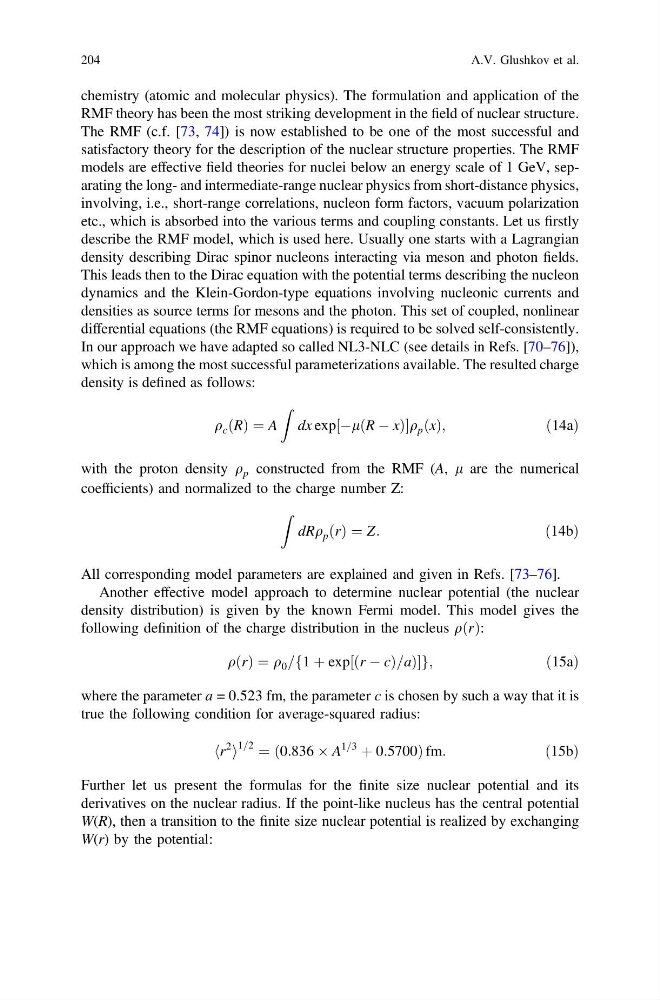
which is among the most successful parameterizations available. The resulted charge
density is defined as follows:
q c ðRÞ ¼ A
Z
dx exp½ÀlðR À xÞq p ðxÞ;
ð14aÞ
with the proton density q p constructed from the RMF (A, l are the numerical
coefficients) and normalized to the charge number Z:
Z
dRq p ðrÞ ¼ Z:
ð14bÞ
All corresponding model parameters are explained and given in Refs. [73–76].
Another effective model approach to determine nuclear potential (the nuclear
density distribution) is given by the known Fermi model. This model gives the
following definition of the charge distribution in the nucleus q r
ð Þ:
qðrÞ ¼ q 0 =f1 þ exp½ðr À cÞ=aÞg;
ð15aÞ
where the parameter a = 0.523 fm, the parameter c is chosen by such a way that it is
true the following condition for average-squared radius:
hr
2
i
1=2 ¼ ð0:836 Â A
1=3
þ 0:5700Þ fm:
ð15bÞ
Further let us present the formulas for the finite size nuclear potential and its
derivatives on the nuclear radius. If the point-like nucleus has the central potential
W(R), then a transition to the finite size nuclear potential is realized by exchanging
W(r) by the potential:
204
A.V. Glushkov et al.
RMF theory has been the most striking development in the field of nuclear structure.
The RMF (c.f. [73, 74]) is now established to be one of the most successful and
satisfactory theory for the description of the nuclear structure properties. The RMF
models are effective field theories for nuclei below an energy scale of 1 GeV, separating the long- and intermediate-range nuclear physics from short-distance physics,
involving, i.e., short-range correlations, nucleon form factors, vacuum polarization
etc., which is absorbed into the various terms and coupling constants. Let us firstly
describe the RMF model, which is used here. Usually one starts with a Lagrangian
density describing Dirac spinor nucleons interacting via meson and photon fields.
This leads then to the Dirac equation with the potential terms describing the nucleon
dynamics and the Klein-Gordon-type equations involving nucleonic currents and
densities as source terms for mesons and the photon. This set of coupled, nonlinear
differential equations (the RMF equations) is required to be solved self-consistently.
In our approach we have adapted so called NL3-NLC (see details in Refs. [70–76]),
which is among the most successful parameterizations available. The resulted charge
density is defined as follows:
q c ðRÞ ¼ A
Z
dx exp½ÀlðR À xÞq p ðxÞ;
ð14aÞ
with the proton density q p constructed from the RMF (A, l are the numerical
coefficients) and normalized to the charge number Z:
Z
dRq p ðrÞ ¼ Z:
ð14bÞ
All corresponding model parameters are explained and given in Refs. [73–76].
Another effective model approach to determine nuclear potential (the nuclear
density distribution) is given by the known Fermi model. This model gives the
following definition of the charge distribution in the nucleus q r
ð Þ:
qðrÞ ¼ q 0 =f1 þ exp½ðr À cÞ=aÞg;
ð15aÞ
where the parameter a = 0.523 fm, the parameter c is chosen by such a way that it is
true the following condition for average-squared radius:
hr
2
i
1=2 ¼ ð0:836 Â A
1=3
þ 0:5700Þ fm:
ð15bÞ
Further let us present the formulas for the finite size nuclear potential and its
derivatives on the nuclear radius. If the point-like nucleus has the central potential
W(R), then a transition to the finite size nuclear potential is realized by exchanging
W(r) by the potential:
204
A.V. Glushkov et al.