

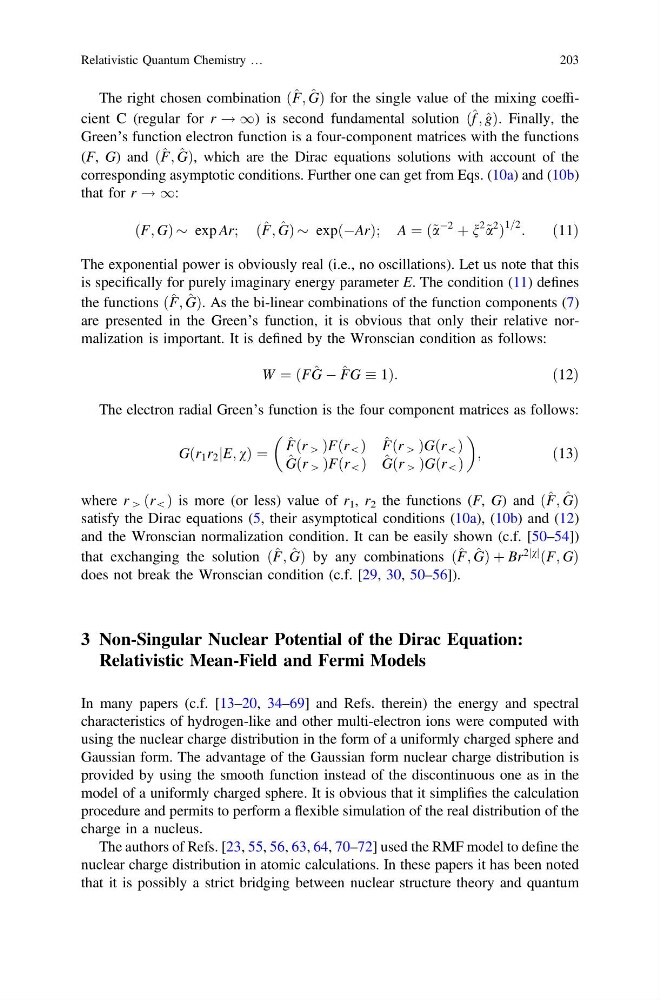
The right chosen combination ð ^
F; ^
GÞ for the single value of the mixing coefficient C (regular for r ! 1) is second fundamental solution ð ^ f ; ^ gÞ. Finally, the
Green’s function electron function is a four-component matrices with the functions
(F, G) and ð ^
F; ^
GÞ, which are the Dirac equations solutions with account of the
corresponding asymptotic conditions. Further one can get from Eqs. (10a) and (10b)
that for r ! 1:
ðF; GÞ $ exp Ar; ð ^
F; ^
GÞ $ expðÀArÞ; A ¼ ð~ a
À2
þ n
2
~ a
2
Þ
1=2 :
ð11Þ
The exponential power is obviously real (i.e., no oscillations). Let us note that this
is specifically for purely imaginary energy parameter E. The condition (11) defines
the functions ð ^
F; ^
GÞ. As the bi-linear combinations of the function components (7)
are presented in the Green’s function, it is obvious that only their relative normalization is important. It is defined by the Wronscian condition as follows:
W ¼ ðF ^
G À ^
FG 1Þ:
ð12Þ
The electron radial Green’s function is the four component matrices as follows:
Gðr 1 r 2 jE; vÞ ¼
^
Fðr [ ÞFðr \ Þ ^
Fðr [ ÞGðr \ Þ
^
Gðr [ ÞFðr \ Þ ^
Gðr [ ÞGðr \ Þ
;
ð13Þ
where r [ ðr \ Þ is more (or less) value of r 1 , r 2 the functions (F, G) and ð ^
F; ^
GÞ
satisfy the Dirac equations (5, their asymptotical conditions (10a), (10b) and (12)
and the Wronscian normalization condition. It can be easily shown (c.f. [50–54])
that exchanging the solution ð ^
F; ^
GÞ by any combinations ð ^
F; ^
GÞ þ Br
2 v
j j
ðF; GÞ
does not break the Wronscian condition (c.f. [29, 30, 50–56]).
3 Non-Singular Nuclear Potential of the Dirac Equation:
Relativistic Mean-Field and Fermi Models
In many papers (c.f. [13–20, 34–69] and Refs. therein) the energy and spectral
characteristics of hydrogen-like and other multi-electron ions were computed with
using the nuclear charge distribution in the form of a uniformly charged sphere and
Gaussian form. The advantage of the Gaussian form nuclear charge distribution is
provided by using the smooth function instead of the discontinuous one as in the
model of a uniformly charged sphere. It is obvious that it simplifies the calculation
procedure and permits to perform a flexible simulation of the real distribution of the
charge in a nucleus.
The authors of Refs. [23, 55, 56, 63, 64, 70–72] used the RMF model to define the
nuclear charge distribution in atomic calculations. In these papers it has been noted
that it is possibly a strict bridging between nuclear structure theory and quantum
Relativistic Quantum Chemistry …
203
F; ^
GÞ for the single value of the mixing coefficient C (regular for r ! 1) is second fundamental solution ð ^ f ; ^ gÞ. Finally, the
Green’s function electron function is a four-component matrices with the functions
(F, G) and ð ^
F; ^
GÞ, which are the Dirac equations solutions with account of the
corresponding asymptotic conditions. Further one can get from Eqs. (10a) and (10b)
that for r ! 1:
ðF; GÞ $ exp Ar; ð ^
F; ^
GÞ $ expðÀArÞ; A ¼ ð~ a
À2
þ n
2
~ a
2
Þ
1=2 :
ð11Þ
The exponential power is obviously real (i.e., no oscillations). Let us note that this
is specifically for purely imaginary energy parameter E. The condition (11) defines
the functions ð ^
F; ^
GÞ. As the bi-linear combinations of the function components (7)
are presented in the Green’s function, it is obvious that only their relative normalization is important. It is defined by the Wronscian condition as follows:
W ¼ ðF ^
G À ^
FG 1Þ:
ð12Þ
The electron radial Green’s function is the four component matrices as follows:
Gðr 1 r 2 jE; vÞ ¼
^
Fðr [ ÞFðr \ Þ ^
Fðr [ ÞGðr \ Þ
^
Gðr [ ÞFðr \ Þ ^
Gðr [ ÞGðr \ Þ
;
ð13Þ
where r [ ðr \ Þ is more (or less) value of r 1 , r 2 the functions (F, G) and ð ^
F; ^
GÞ
satisfy the Dirac equations (5, their asymptotical conditions (10a), (10b) and (12)
and the Wronscian normalization condition. It can be easily shown (c.f. [50–54])
that exchanging the solution ð ^
F; ^
GÞ by any combinations ð ^
F; ^
GÞ þ Br
2 v
j j
ðF; GÞ
does not break the Wronscian condition (c.f. [29, 30, 50–56]).
3 Non-Singular Nuclear Potential of the Dirac Equation:
Relativistic Mean-Field and Fermi Models
In many papers (c.f. [13–20, 34–69] and Refs. therein) the energy and spectral
characteristics of hydrogen-like and other multi-electron ions were computed with
using the nuclear charge distribution in the form of a uniformly charged sphere and
Gaussian form. The advantage of the Gaussian form nuclear charge distribution is
provided by using the smooth function instead of the discontinuous one as in the
model of a uniformly charged sphere. It is obvious that it simplifies the calculation
procedure and permits to perform a flexible simulation of the real distribution of the
charge in a nucleus.
The authors of Refs. [23, 55, 56, 63, 64, 70–72] used the RMF model to define the
nuclear charge distribution in atomic calculations. In these papers it has been noted
that it is possibly a strict bridging between nuclear structure theory and quantum
Relativistic Quantum Chemistry …
203