

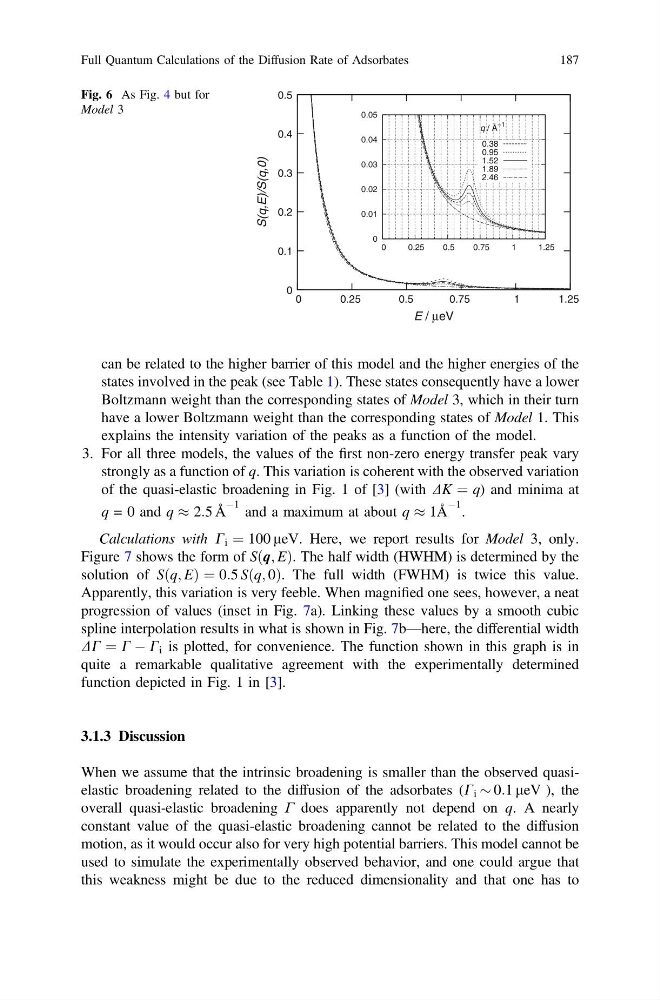
can be related to the higher barrier of this model and the higher energies of the
states involved in the peak (see Table 1). These states consequently have a lower
Boltzmann weight than the corresponding states of Model 3, which in their turn
have a lower Boltzmann weight than the corresponding states of Model 1. This
explains the intensity variation of the peaks as a function of the model.
3. For all three models, the values of the first non-zero energy transfer peak vary
strongly as a function of q. This variation is coherent with the observed variation
of the quasi-elastic broadening in Fig. 1 of [3] (with DK ¼ q) and minima at
q = 0 and q % 2:5 ˚
A
À1 and a maximum at about q % 1 ˚
A
À1 .
Calculations with C i ¼ 100 leV. Here, we report results for Model 3, only.
Figure 7 shows the form of Sðq; EÞ. The half width (HWHM) is determined by the
solution of Sðq; EÞ ¼ 0:5 Sðq; 0Þ. The full width (FWHM) is twice this value.
Apparently, this variation is very feeble. When magnified one sees, however, a neat
progression of values (inset in Fig. 7a). Linking these values by a smooth cubic
spline interpolation results in what is shown in Fig. 7b—here, the differential width
DC ¼ C À C i is plotted, for convenience. The function shown in this graph is in
quite a remarkable qualitative agreement with the experimentally determined
function depicted in Fig. 1 in [3].
3.1.3 Discussion
When we assume that the intrinsic broadening is smaller than the observed quasielastic broadening related to the diffusion of the adsorbates (C i $ 0:1 leV ), the
overall quasi-elastic broadening Γ does apparently not depend on q. A nearly
constant value of the quasi-elastic broadening cannot be related to the diffusion
motion, as it would occur also for very high potential barriers. This model cannot be
used to simulate the experimentally observed behavior, and one could argue that
this weakness might be due to the reduced dimensionality and that one has to
0
0.1
0.2
0.3
0.4
0.5
0
0.25
0.5
0.75
1
1.25
S(q,E)/S(q,0)
E / μeV
0
0.01
0.02
0.03
0.04
0.05
0
0.25
0.5
0.75
1
1.25
q / Å
−1
0.38
0.95
1.52
1.89
2.46
Fig. 6 As Fig. 4 but for
Model 3
Full Quantum Calculations of the Diffusion Rate of Adsorbates
187
states involved in the peak (see Table 1). These states consequently have a lower
Boltzmann weight than the corresponding states of Model 3, which in their turn
have a lower Boltzmann weight than the corresponding states of Model 1. This
explains the intensity variation of the peaks as a function of the model.
3. For all three models, the values of the first non-zero energy transfer peak vary
strongly as a function of q. This variation is coherent with the observed variation
of the quasi-elastic broadening in Fig. 1 of [3] (with DK ¼ q) and minima at
q = 0 and q % 2:5 ˚
A
À1 and a maximum at about q % 1 ˚
A
À1 .
Calculations with C i ¼ 100 leV. Here, we report results for Model 3, only.
Figure 7 shows the form of Sðq; EÞ. The half width (HWHM) is determined by the
solution of Sðq; EÞ ¼ 0:5 Sðq; 0Þ. The full width (FWHM) is twice this value.
Apparently, this variation is very feeble. When magnified one sees, however, a neat
progression of values (inset in Fig. 7a). Linking these values by a smooth cubic
spline interpolation results in what is shown in Fig. 7b—here, the differential width
DC ¼ C À C i is plotted, for convenience. The function shown in this graph is in
quite a remarkable qualitative agreement with the experimentally determined
function depicted in Fig. 1 in [3].
3.1.3 Discussion
When we assume that the intrinsic broadening is smaller than the observed quasielastic broadening related to the diffusion of the adsorbates (C i $ 0:1 leV ), the
overall quasi-elastic broadening Γ does apparently not depend on q. A nearly
constant value of the quasi-elastic broadening cannot be related to the diffusion
motion, as it would occur also for very high potential barriers. This model cannot be
used to simulate the experimentally observed behavior, and one could argue that
this weakness might be due to the reduced dimensionality and that one has to
0
0.1
0.2
0.3
0.4
0.5
0
0.25
0.5
0.75
1
1.25
S(q,E)/S(q,0)
E / μeV
0
0.01
0.02
0.03
0.04
0.05
0
0.25
0.5
0.75
1
1.25
q / Å
−1
0.38
0.95
1.52
1.89
2.46
Fig. 6 As Fig. 4 but for
Model 3
Full Quantum Calculations of the Diffusion Rate of Adsorbates
187