

extend the study to the full 6D treatment of the adsorbate’s dynamics. Such studies
are currently being carried out and will be presented elsewhere.
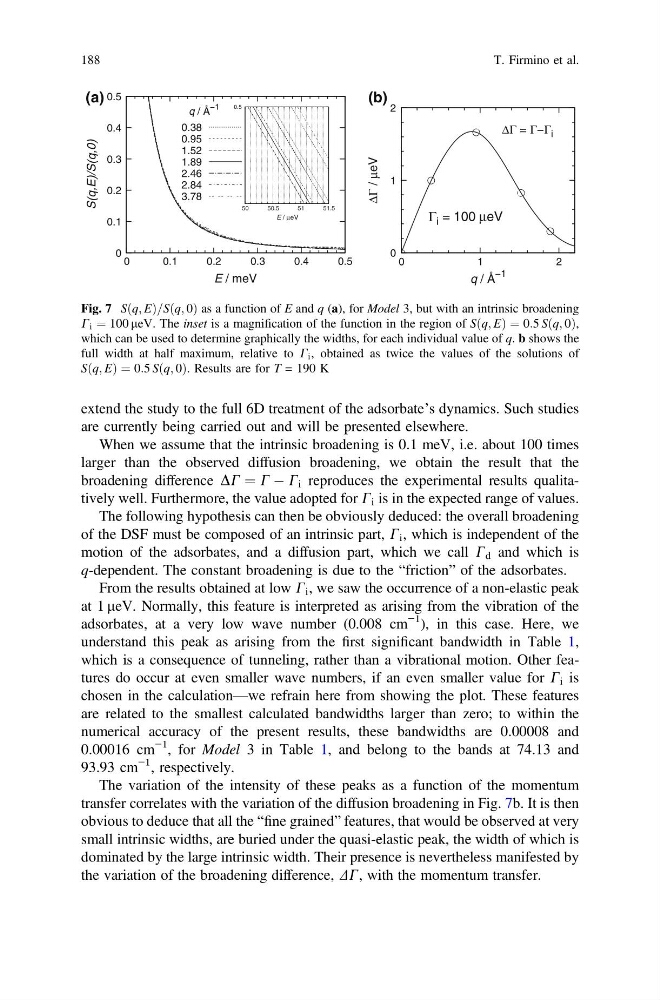
When we assume that the intrinsic broadening is 0.1 meV, i.e. about 100 times
larger than the observed diffusion broadening, we obtain the result that the
broadening difference DC ¼ C À C i reproduces the experimental results qualitatively well. Furthermore, the value adopted for C i is in the expected range of values.
The following hypothesis can then be obviously deduced: the overall broadening
of the DSF must be composed of an intrinsic part, C i , which is independent of the
motion of the adsorbates, and a diffusion part, which we call C d and which is
q-dependent. The constant broadening is due to the “friction” of the adsorbates.
From the results obtained at low C i , we saw the occurrence of a non-elastic peak
at 1 leV. Normally, this feature is interpreted as arising from the vibration of the
adsorbates, at a very low wave number (0.008 cm
−1 ), in this case. Here, we
understand this peak as arising from the first significant bandwidth in Table 1,
which is a consequence of tunneling, rather than a vibrational motion. Other features do occur at even smaller wave numbers, if an even smaller value for C i is
chosen in the calculation—we refrain here from showing the plot. These features
are related to the smallest calculated bandwidths larger than zero; to within the
numerical accuracy of the present results, these bandwidths are 0.00008 and
0.00016 cm
−1
, for Model 3 in Table 1, and belong to the bands at 74.13 and
93.93 cm
−1 , respectively.
The variation of the intensity of these peaks as a function of the momentum
transfer correlates with the variation of the diffusion broadening in Fig. 7b. It is then
obvious to deduce that all the “fine grained” features, that would be observed at very
small intrinsic widths, are buried under the quasi-elastic peak, the width of which is
dominated by the large intrinsic width. Their presence is nevertheless manifested by
the variation of the broadening difference, DC, with the momentum transfer.
0
0.1
0.2
0.3
0.4
0.5
0
0.1
0.2
0.3
0.4
0.5
S(q,E)/S(q,0)
E / meV
q / Å
−1
0.38
0.95
1.52
1.89
2.46
2.84
3.78
0
1
2
0
1
2
ΔΓ /
μeV
q / Å
−1
ΔΓ = Γ−Γ i
Γ i = 100 μeV
0.5
50
50.5
51
51.5
E / μeV
(a)
(b)
Fig. 7 Sðq; EÞ=Sðq; 0Þ as a function of E and q (a), for Model 3, but with an intrinsic broadening
C i ¼ 100 leV. The inset is a magnification of the function in the region of Sðq; EÞ ¼ 0:5 Sðq; 0Þ,
which can be used to determine graphically the widths, for each individual value of q. b shows the
full width at half maximum, relative to C i , obtained as twice the values of the solutions of
Sðq; EÞ ¼ 0:5 Sðq; 0Þ. Results are for T = 190 K
188
T. Firmino et al.
are currently being carried out and will be presented elsewhere.
When we assume that the intrinsic broadening is 0.1 meV, i.e. about 100 times
larger than the observed diffusion broadening, we obtain the result that the
broadening difference DC ¼ C À C i reproduces the experimental results qualitatively well. Furthermore, the value adopted for C i is in the expected range of values.
The following hypothesis can then be obviously deduced: the overall broadening
of the DSF must be composed of an intrinsic part, C i , which is independent of the
motion of the adsorbates, and a diffusion part, which we call C d and which is
q-dependent. The constant broadening is due to the “friction” of the adsorbates.
From the results obtained at low C i , we saw the occurrence of a non-elastic peak
at 1 leV. Normally, this feature is interpreted as arising from the vibration of the
adsorbates, at a very low wave number (0.008 cm
−1 ), in this case. Here, we
understand this peak as arising from the first significant bandwidth in Table 1,
which is a consequence of tunneling, rather than a vibrational motion. Other features do occur at even smaller wave numbers, if an even smaller value for C i is
chosen in the calculation—we refrain here from showing the plot. These features
are related to the smallest calculated bandwidths larger than zero; to within the
numerical accuracy of the present results, these bandwidths are 0.00008 and
0.00016 cm
−1
, for Model 3 in Table 1, and belong to the bands at 74.13 and
93.93 cm
−1 , respectively.
The variation of the intensity of these peaks as a function of the momentum
transfer correlates with the variation of the diffusion broadening in Fig. 7b. It is then
obvious to deduce that all the “fine grained” features, that would be observed at very
small intrinsic widths, are buried under the quasi-elastic peak, the width of which is
dominated by the large intrinsic width. Their presence is nevertheless manifested by
the variation of the broadening difference, DC, with the momentum transfer.
0
0.1
0.2
0.3
0.4
0.5
0
0.1
0.2
0.3
0.4
0.5
S(q,E)/S(q,0)
E / meV
q / Å
−1
0.38
0.95
1.52
1.89
2.46
2.84
3.78
0
1
2
0
1
2
ΔΓ /
μeV
q / Å
−1
ΔΓ = Γ−Γ i
Γ i = 100 μeV
0.5
50
50.5
51
51.5
E / μeV
(a)
(b)
Fig. 7 Sðq; EÞ=Sðq; 0Þ as a function of E and q (a), for Model 3, but with an intrinsic broadening
C i ¼ 100 leV. The inset is a magnification of the function in the region of Sðq; EÞ ¼ 0:5 Sðq; 0Þ,
which can be used to determine graphically the widths, for each individual value of q. b shows the
full width at half maximum, relative to C i , obtained as twice the values of the solutions of
Sðq; EÞ ¼ 0:5 Sðq; 0Þ. Results are for T = 190 K
188
T. Firmino et al.