

3.2 Creation of Coherent Two Electronic Excited States
by the Linearly Polarized UV Laser Pulses
Coherent two electronic excited states ða Æ b 1 Þ, ða Æ b 2 Þ and ðb 1 Æ b 2 Þ are generated by applying a UV laser pulse with a properly selected polarization direction.
Here ða þ bÞ, ða À bÞ represents a phase between two electronic excited states is inphase (out-phase). For example, for ða Æ b 2 Þ electronic coherence, the condition for
a linearly polarized UV laser pulse with polarization vector ~ e
ðÆÞ
ab2 is given as
~ l ga Á~ e
ðÆÞ
ab2 ¼ Æ~ l gb2 Á~ e
ðÆÞ
ab2 and ~ l gb1 Á~ e
ðÆÞ
ab2 ¼ 0;
ð20aÞ
or equivalently,
119.3
120.5
119.9
120.66
118.2
121.4
120.3
117.2
122.2
ga
1
gb
2
gb
Dihedral angle=108.8
X
J B
J L
J R
L
R
b1 B
a A
b2 B
6.78 eV
6.84 eV
6.67 eV
ground
C point group
2
μ
μ
μ
∈
∈
∈
(a)
(b)
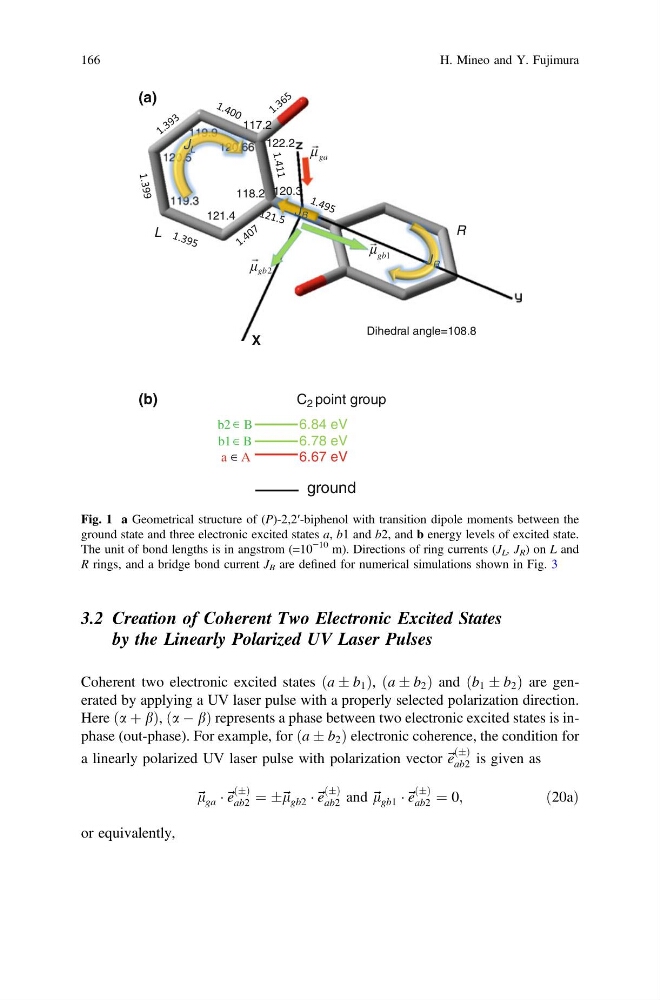
Fig. 1 a Geometrical structure of (P)-2,2′-biphenol with transition dipole moments between the
ground state and three electronic excited states a, b1 and b2, and b energy levels of excited state.
The unit of bond lengths is in angstrom (=10
−10 m). Directions of ring currents (J L , J R ) on L and
R rings, and a bridge bond current J B are defined for numerical simulations shown in Fig. 3
166
H. Mineo and Y. Fujimura
by the Linearly Polarized UV Laser Pulses
Coherent two electronic excited states ða Æ b 1 Þ, ða Æ b 2 Þ and ðb 1 Æ b 2 Þ are generated by applying a UV laser pulse with a properly selected polarization direction.
Here ða þ bÞ, ða À bÞ represents a phase between two electronic excited states is inphase (out-phase). For example, for ða Æ b 2 Þ electronic coherence, the condition for
a linearly polarized UV laser pulse with polarization vector ~ e
ðÆÞ
ab2 is given as
~ l ga Á~ e
ðÆÞ
ab2 ¼ Æ~ l gb2 Á~ e
ðÆÞ
ab2 and ~ l gb1 Á~ e
ðÆÞ
ab2 ¼ 0;
ð20aÞ
or equivalently,
119.3
120.5
119.9
120.66
118.2
121.4
120.3
117.2
122.2
ga
1
gb
2
gb
Dihedral angle=108.8
X
J B
J L
J R
L
R
b1 B
a A
b2 B
6.78 eV
6.84 eV
6.67 eV
ground
C point group
2
μ
μ
μ
∈
∈
∈
(a)
(b)
Fig. 1 a Geometrical structure of (P)-2,2′-biphenol with transition dipole moments between the
ground state and three electronic excited states a, b1 and b2, and b energy levels of excited state.
The unit of bond lengths is in angstrom (=10
−10 m). Directions of ring currents (J L , J R ) on L and
R rings, and a bridge bond current J B are defined for numerical simulations shown in Fig. 3
166
H. Mineo and Y. Fujimura