

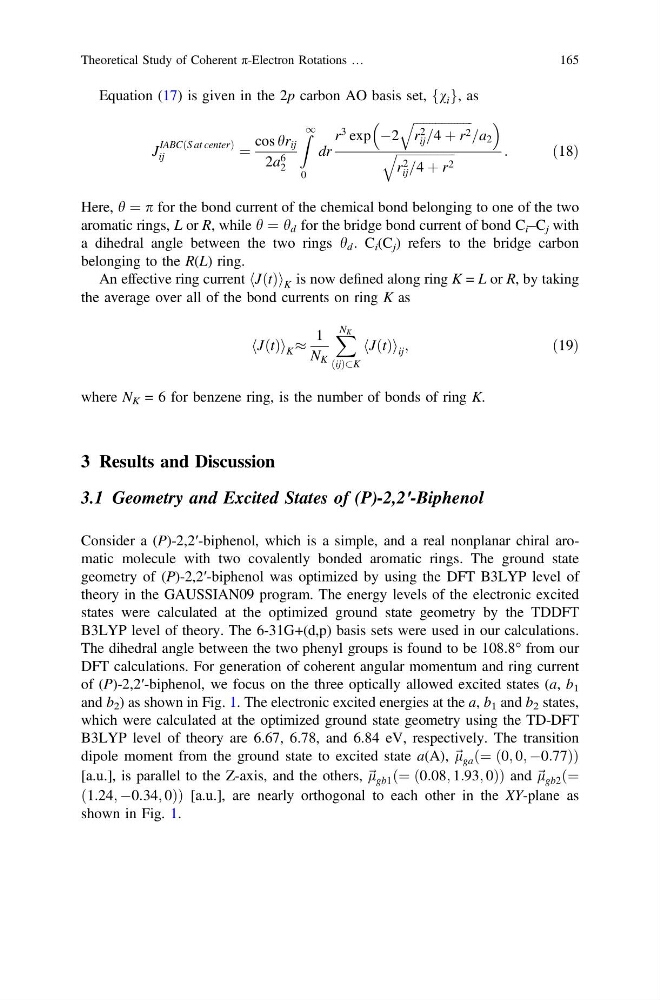
Equation (17) is given in the 2p carbon AO basis set, v i
f g, as
J
IABCðS at centerÞ
ij
¼
cos hr ij
2a
6
2
Z 1
0
dr
r
3 exp À2
ffiffiffiffiffiffiffiffiffiffiffiffiffiffiffiffiffiffi ffi
r 2
ij =4 þ r 2
q
=a 2
ffiffiffiffiffiffiffiffiffiffiffiffiffiffiffiffiffiffiffi
r 2
ij =4 þ r 2
q
:
ð18Þ
Here, h ¼ p for the bond current of the chemical bond belonging to one of the two
aromatic rings, L or R, while h ¼ h d for the bridge bond current of bond C i –C j with
a dihedral angle between the two rings h d . C i (C j ) refers to the bridge carbon
belonging to the R(L) ring.
An effective ring current JðtÞ
h
i K is now defined along ring K = L or R, by taking
the average over all of the bond currents on ring K as
JðtÞ
h
i K %
1
N K
X N K
ðijÞ&K
JðtÞ
h
i ij ;
ð19Þ
where N K = 6 for benzene ring, is the number of bonds of ring K.
3 Results and Discussion
3.1 Geometry and Excited States of (P)-2,2′-Biphenol
Consider a (P)-2,2′-biphenol, which is a simple, and a real nonplanar chiral aromatic molecule with two covalently bonded aromatic rings. The ground state
geometry of (P)-2,2′-biphenol was optimized by using the DFT B3LYP level of
theory in the GAUSSIAN09 program. The energy levels of the electronic excited
states were calculated at the optimized ground state geometry by the TDDFT
B3LYP level of theory. The 6-31G+(d,p) basis sets were used in our calculations.
The dihedral angle between the two phenyl groups is found to be 108.8° from our
DFT calculations. For generation of coherent angular momentum and ring current
of (P)-2,2′-biphenol, we focus on the three optically allowed excited states (a, b 1
and b 2 ) as shown in Fig. 1. The electronic excited energies at the a, b 1 and b 2 states,
which were calculated at the optimized ground state geometry using the TD-DFT
B3LYP level of theory are 6.67, 6.78, and 6.84 eV, respectively. The transition
dipole moment from the ground state to excited state a(A), ~ l ga ð¼ ð0; 0; À0:77ÞÞ
[a.u.], is parallel to the Z-axis, and the others, ~ l gb1 ð¼ ð0:08; 1:93; 0ÞÞ and ~ l gb2 ð¼
ð1:24; À0:34; 0ÞÞ [a.u.], are nearly orthogonal to each other in the XY-plane as
shown in Fig. 1.
Theoretical Study of Coherent π-Electron Rotations …
165
f g, as
J
IABCðS at centerÞ
ij
¼
cos hr ij
2a
6
2
Z 1
0
dr
r
3 exp À2
ffiffiffiffiffiffiffiffiffiffiffiffiffiffiffiffiffiffi ffi
r 2
ij =4 þ r 2
q
=a 2
ffiffiffiffiffiffiffiffiffiffiffiffiffiffiffiffiffiffiffi
r 2
ij =4 þ r 2
q
:
ð18Þ
Here, h ¼ p for the bond current of the chemical bond belonging to one of the two
aromatic rings, L or R, while h ¼ h d for the bridge bond current of bond C i –C j with
a dihedral angle between the two rings h d . C i (C j ) refers to the bridge carbon
belonging to the R(L) ring.
An effective ring current JðtÞ
h
i K is now defined along ring K = L or R, by taking
the average over all of the bond currents on ring K as
JðtÞ
h
i K %
1
N K
X N K
ðijÞ&K
JðtÞ
h
i ij ;
ð19Þ
where N K = 6 for benzene ring, is the number of bonds of ring K.
3 Results and Discussion
3.1 Geometry and Excited States of (P)-2,2′-Biphenol
Consider a (P)-2,2′-biphenol, which is a simple, and a real nonplanar chiral aromatic molecule with two covalently bonded aromatic rings. The ground state
geometry of (P)-2,2′-biphenol was optimized by using the DFT B3LYP level of
theory in the GAUSSIAN09 program. The energy levels of the electronic excited
states were calculated at the optimized ground state geometry by the TDDFT
B3LYP level of theory. The 6-31G+(d,p) basis sets were used in our calculations.
The dihedral angle between the two phenyl groups is found to be 108.8° from our
DFT calculations. For generation of coherent angular momentum and ring current
of (P)-2,2′-biphenol, we focus on the three optically allowed excited states (a, b 1
and b 2 ) as shown in Fig. 1. The electronic excited energies at the a, b 1 and b 2 states,
which were calculated at the optimized ground state geometry using the TD-DFT
B3LYP level of theory are 6.67, 6.78, and 6.84 eV, respectively. The transition
dipole moment from the ground state to excited state a(A), ~ l ga ð¼ ð0; 0; À0:77ÞÞ
[a.u.], is parallel to the Z-axis, and the others, ~ l gb1 ð¼ ð0:08; 1:93; 0ÞÞ and ~ l gb2 ð¼
ð1:24; À0:34; 0ÞÞ [a.u.], are nearly orthogonal to each other in the XY-plane as
shown in Fig. 1.
Theoretical Study of Coherent π-Electron Rotations …
165