

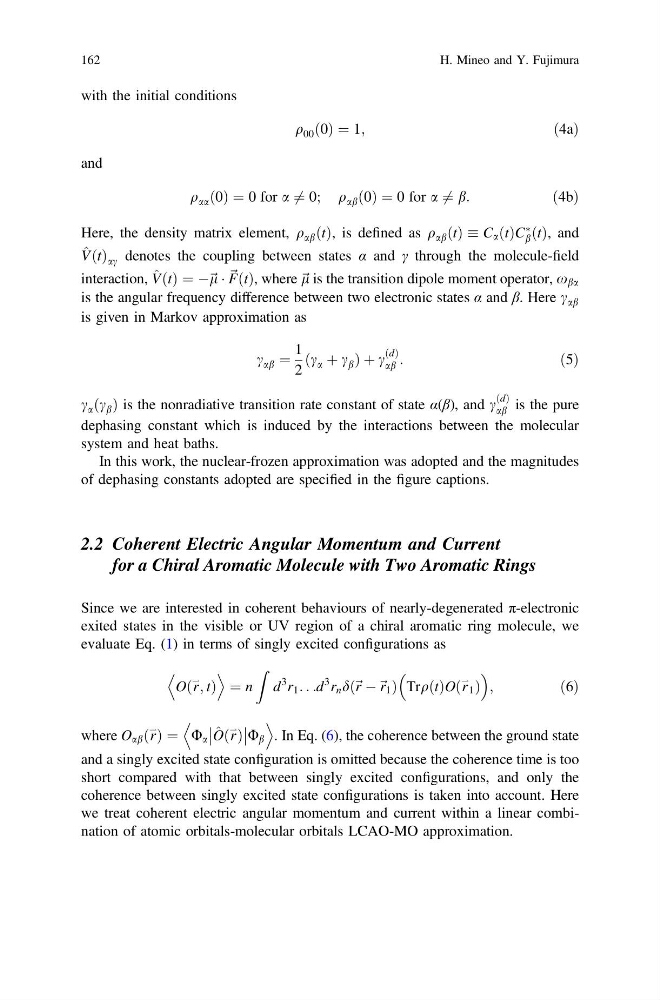
with the initial conditions
q 00 ð0Þ ¼ 1;
ð4aÞ
and
q aa ð0Þ ¼ 0 for a 6 ¼ 0; q ab ð0Þ ¼ 0 for a 6 ¼ b:
ð4bÞ
Here, the density matrix element, q ab ðtÞ, is defined as q ab ðtÞ C a ðtÞC
Ã
b ðtÞ, and
^
VðtÞ ac denotes the coupling between states α and γ through the molecule-field
interaction, ^
VðtÞ ¼ À~ l Á ~ FðtÞ, where ~ l is the transition dipole moment operator, x ba
is the angular frequency difference between two electronic states α and β. Here c ab
is given in Markov approximation as
c ab ¼
1
2
ðc a þ c b Þ þ c
ðdÞ
ab :
ð5Þ
c a ðc b Þ is the nonradiative transition rate constant of state α(β), and c
ðdÞ
ab is the pure
dephasing constant which is induced by the interactions between the molecular
system and heat baths.
In this work, the nuclear-frozen approximation was adopted and the magnitudes
of dephasing constants adopted are specified in the figure captions.
2.2 Coherent Electric Angular Momentum and Current
for a Chiral Aromatic Molecule with Two Aromatic Rings
Since we are interested in coherent behaviours of nearly-degenerated π-electronic
exited states in the visible or UV region of a chiral aromatic ring molecule, we
evaluate Eq. (1) in terms of singly excited configurations as
Oðr
* ; tÞ
D
E
¼ n
Z
d
3 r 1 . . .d
3 r n d ~ r À~ r 1
ð
Þ TrqðtÞOðr
*
1 Þ
;
ð6Þ
where O ab ðr
* Þ ¼ U a ^
Oðr
* Þ
U b
D
E
. In Eq. (6), the coherence between the ground state
and a singly excited state configuration is omitted because the coherence time is too
short compared with that between singly excited configurations, and only the
coherence between singly excited state configurations is taken into account. Here
we treat coherent electric angular momentum and current within a linear combination of atomic orbitals-molecular orbitals LCAO-MO approximation.
162
H. Mineo and Y. Fujimura
q 00 ð0Þ ¼ 1;
ð4aÞ
and
q aa ð0Þ ¼ 0 for a 6 ¼ 0; q ab ð0Þ ¼ 0 for a 6 ¼ b:
ð4bÞ
Here, the density matrix element, q ab ðtÞ, is defined as q ab ðtÞ C a ðtÞC
Ã
b ðtÞ, and
^
VðtÞ ac denotes the coupling between states α and γ through the molecule-field
interaction, ^
VðtÞ ¼ À~ l Á ~ FðtÞ, where ~ l is the transition dipole moment operator, x ba
is the angular frequency difference between two electronic states α and β. Here c ab
is given in Markov approximation as
c ab ¼
1
2
ðc a þ c b Þ þ c
ðdÞ
ab :
ð5Þ
c a ðc b Þ is the nonradiative transition rate constant of state α(β), and c
ðdÞ
ab is the pure
dephasing constant which is induced by the interactions between the molecular
system and heat baths.
In this work, the nuclear-frozen approximation was adopted and the magnitudes
of dephasing constants adopted are specified in the figure captions.
2.2 Coherent Electric Angular Momentum and Current
for a Chiral Aromatic Molecule with Two Aromatic Rings
Since we are interested in coherent behaviours of nearly-degenerated π-electronic
exited states in the visible or UV region of a chiral aromatic ring molecule, we
evaluate Eq. (1) in terms of singly excited configurations as
Oðr
* ; tÞ
D
E
¼ n
Z
d
3 r 1 . . .d
3 r n d ~ r À~ r 1
ð
Þ TrqðtÞOðr
*
1 Þ
;
ð6Þ
where O ab ðr
* Þ ¼ U a ^
Oðr
* Þ
U b
D
E
. In Eq. (6), the coherence between the ground state
and a singly excited state configuration is omitted because the coherence time is too
short compared with that between singly excited configurations, and only the
coherence between singly excited state configurations is taken into account. Here
we treat coherent electric angular momentum and current within a linear combination of atomic orbitals-molecular orbitals LCAO-MO approximation.
162
H. Mineo and Y. Fujimura