

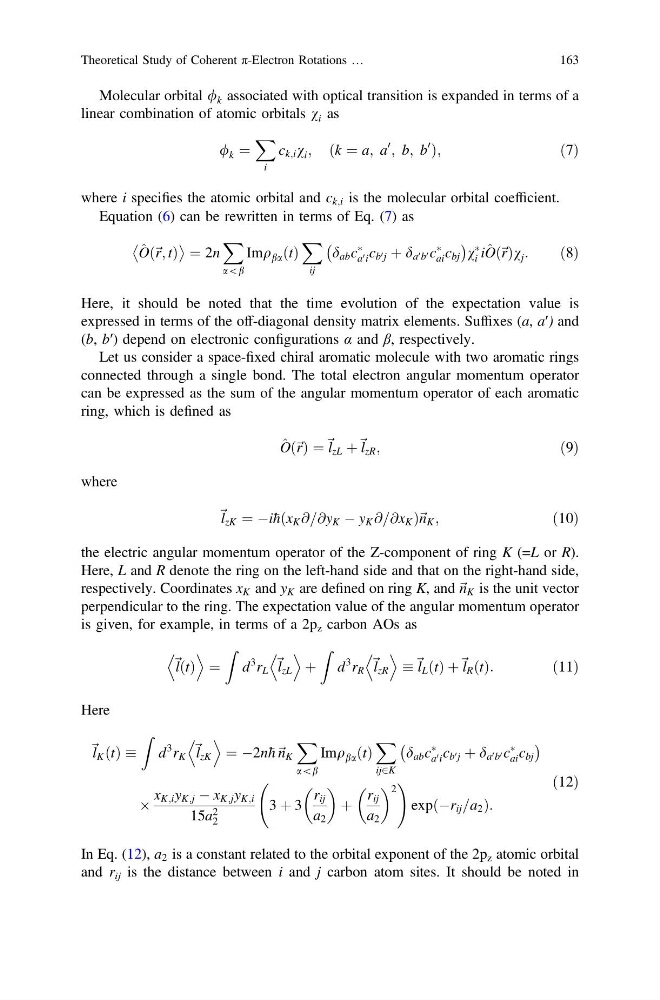
Molecular orbital / k associated with optical transition is expanded in terms of a
linear combination of atomic orbitals v i as
/ k ¼
X
i
c k;i v i ;
k ¼ a; a
0
; b; b
0
ð
Þ ;
ð7Þ
where i specifies the atomic orbital and c k;i is the molecular orbital coefficient.
Equation (6) can be rewritten in terms of Eq. (7) as
^
Oð~ r; tÞ
¼ 2n
X
a\b
Imq ba ðtÞ
X
ij
d ab c
Ã
a 0 i c b 0 j þ d a 0 b 0 c
Ã
ai c bj
À
Á v
Ã
i i ^
Oð~ rÞv j :
ð8Þ
Here, it should be noted that the time evolution of the expectation value is
expressed in terms of the off-diagonal density matrix elements. Suffixes (a, a′) and
(b, b′) depend on electronic configurations α and β, respectively.
Let us consider a space-fixed chiral aromatic molecule with two aromatic rings
connected through a single bond. The total electron angular momentum operator
can be expressed as the sum of the angular momentum operator of each aromatic
ring, which is defined as
^
Oð~ rÞ ¼ ~ l zL þ ~ l zR ;
ð9Þ
where
~ l zK ¼ Ài h x K @=@y K À y K @=@x K
ð
Þ ~ n K ;
ð10Þ
the electric angular momentum operator of the Z-component of ring K (=L or R).
Here, L and R denote the ring on the left-hand side and that on the right-hand side,
respectively. Coordinates x K and y K are defined on ring K, and ~ n K is the unit vector
perpendicular to the ring. The expectation value of the angular momentum operator
is given, for example, in terms of a 2p z carbon AOs as
~ lðtÞ
D E
¼
Z
d
3 r L ~ l zL
D E
þ
Z
d
3 r R ~ l zR
D E
~ l L ðtÞ þ ~ l R ðtÞ:
ð11Þ
Here
~ l K ðtÞ
Z
d
3 r K ~ l zK
D E
¼ À2n h~ n K
X
a\b
Imq ba ðtÞ
X
ij2K
d ab c
Ã
a 0 i c b 0 j þ d a 0 b 0 c
Ã
ai c bj
À
Á
Â
x K;i y K;j À x K;j y K;i
15a 2
2
3 þ 3
r ij
a 2
þ
r ij
a 2
2
!
expðÀr ij =a 2 Þ:
ð12Þ
In Eq. (12), a 2 is a constant related to the orbital exponent of the 2p z atomic orbital
and r ij is the distance between i and j carbon atom sites. It should be noted in
Theoretical Study of Coherent π-Electron Rotations …
163
linear combination of atomic orbitals v i as
/ k ¼
X
i
c k;i v i ;
k ¼ a; a
0
; b; b
0
ð
Þ ;
ð7Þ
where i specifies the atomic orbital and c k;i is the molecular orbital coefficient.
Equation (6) can be rewritten in terms of Eq. (7) as
^
Oð~ r; tÞ
¼ 2n
X
a\b
Imq ba ðtÞ
X
ij
d ab c
Ã
a 0 i c b 0 j þ d a 0 b 0 c
Ã
ai c bj
À
Á v
Ã
i i ^
Oð~ rÞv j :
ð8Þ
Here, it should be noted that the time evolution of the expectation value is
expressed in terms of the off-diagonal density matrix elements. Suffixes (a, a′) and
(b, b′) depend on electronic configurations α and β, respectively.
Let us consider a space-fixed chiral aromatic molecule with two aromatic rings
connected through a single bond. The total electron angular momentum operator
can be expressed as the sum of the angular momentum operator of each aromatic
ring, which is defined as
^
Oð~ rÞ ¼ ~ l zL þ ~ l zR ;
ð9Þ
where
~ l zK ¼ Ài h x K @=@y K À y K @=@x K
ð
Þ ~ n K ;
ð10Þ
the electric angular momentum operator of the Z-component of ring K (=L or R).
Here, L and R denote the ring on the left-hand side and that on the right-hand side,
respectively. Coordinates x K and y K are defined on ring K, and ~ n K is the unit vector
perpendicular to the ring. The expectation value of the angular momentum operator
is given, for example, in terms of a 2p z carbon AOs as
~ lðtÞ
D E
¼
Z
d
3 r L ~ l zL
D E
þ
Z
d
3 r R ~ l zR
D E
~ l L ðtÞ þ ~ l R ðtÞ:
ð11Þ
Here
~ l K ðtÞ
Z
d
3 r K ~ l zK
D E
¼ À2n h~ n K
X
a\b
Imq ba ðtÞ
X
ij2K
d ab c
Ã
a 0 i c b 0 j þ d a 0 b 0 c
Ã
ai c bj
À
Á
Â
x K;i y K;j À x K;j y K;i
15a 2
2
3 þ 3
r ij
a 2
þ
r ij
a 2
2
!
expðÀr ij =a 2 Þ:
ð12Þ
In Eq. (12), a 2 is a constant related to the orbital exponent of the 2p z atomic orbital
and r ij is the distance between i and j carbon atom sites. It should be noted in
Theoretical Study of Coherent π-Electron Rotations …
163