

which is the initial step for coherent π-electron rotations. The four directional
patterns of the ring currents and angular momentum on each ring L and R are
presented. We also demonstrate an ultrafast two-dimensional quantum switching of
π-electron ring currents and angular momentum. Finally we describe an outline of
an extension of the theoretical treatment to aromatic molecules in nano-scale with
covalently linked N aromatic rings (N ≥ 3). The summary and conclusion are given
in Sect. 4.
2 Coherent π-Electron Angular Momentum and Current
2.1 Equations of Motion for π-Electrons in a Pulsed
Laser Field
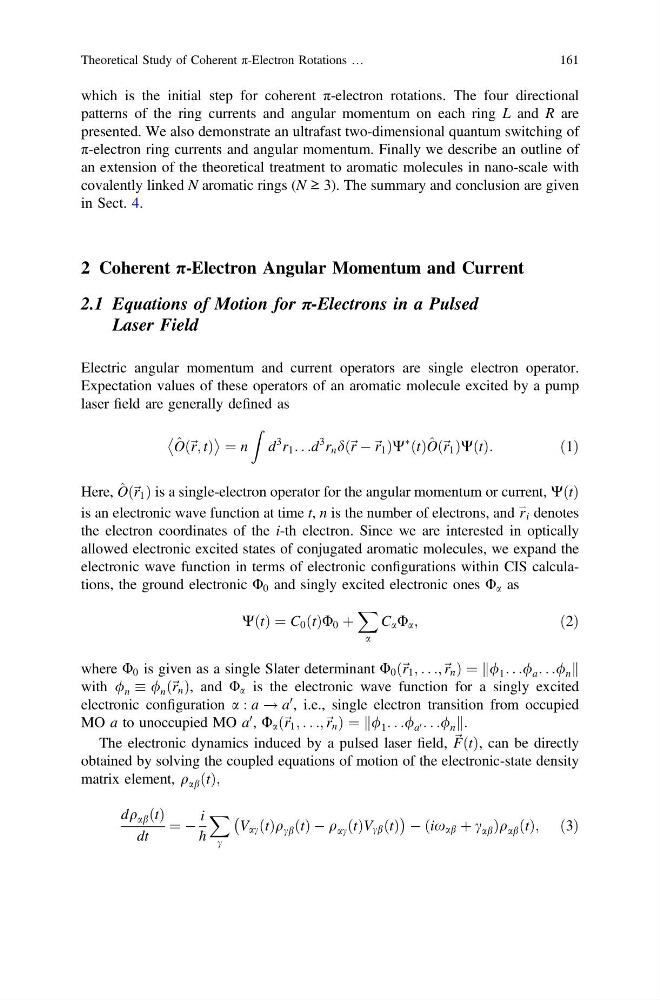
Electric angular momentum and current operators are single electron operator.
Expectation values of these operators of an aromatic molecule excited by a pump
laser field are generally defined as
^
Oð~ r; tÞ
¼ n
Z
d
3 r 1 . . .d
3 r n d ~ r À~ r 1
ð
ÞW
Ã
ðtÞ ^
Oð~ r 1 ÞWðtÞ:
ð1Þ
Here, ^
Oð~ r 1 Þ is a single-electron operator for the angular momentum or current, WðtÞ
is an electronic wave function at time t, n is the number of electrons, and r
*
i denotes
the electron coordinates of the i-th electron. Since we are interested in optically
allowed electronic excited states of conjugated aromatic molecules, we expand the
electronic wave function in terms of electronic configurations within CIS calculations, the ground electronic U 0 and singly excited electronic ones U a as
WðtÞ ¼ C 0 ðtÞU 0 þ
X
a
C a U a ;
ð2Þ
where U 0 is given as a single Slater determinant U 0 ð~ r 1 ; . . .;~ r n Þ ¼ / 1 . . ./ a . . ./ n
k
k
with / n / n ð~ r n Þ, and U a is the electronic wave function for a singly excited
electronic configuration a : a ! a
0 , i.e., single electron transition from occupied
MO a to unoccupied MO a
0 , U a ð~ r 1 ; . . .;~ r n Þ ¼ / 1 . . ./ a 0 . . ./ n
k
k :
The electronic dynamics induced by a pulsed laser field, ~ FðtÞ, can be directly
obtained by solving the coupled equations of motion of the electronic-state density
matrix element, q ab ðtÞ;
dq ab ðtÞ
dt
¼ À
i
h
X
c
V ac ðtÞq cb ðtÞ À q ac ðtÞV cb ðtÞ
À
Á À ðix ab þ c ab Þq ab ðtÞ; ð3Þ
Theoretical Study of Coherent π-Electron Rotations …
161
patterns of the ring currents and angular momentum on each ring L and R are
presented. We also demonstrate an ultrafast two-dimensional quantum switching of
π-electron ring currents and angular momentum. Finally we describe an outline of
an extension of the theoretical treatment to aromatic molecules in nano-scale with
covalently linked N aromatic rings (N ≥ 3). The summary and conclusion are given
in Sect. 4.
2 Coherent π-Electron Angular Momentum and Current
2.1 Equations of Motion for π-Electrons in a Pulsed
Laser Field
Electric angular momentum and current operators are single electron operator.
Expectation values of these operators of an aromatic molecule excited by a pump
laser field are generally defined as
^
Oð~ r; tÞ
¼ n
Z
d
3 r 1 . . .d
3 r n d ~ r À~ r 1
ð
ÞW
Ã
ðtÞ ^
Oð~ r 1 ÞWðtÞ:
ð1Þ
Here, ^
Oð~ r 1 Þ is a single-electron operator for the angular momentum or current, WðtÞ
is an electronic wave function at time t, n is the number of electrons, and r
*
i denotes
the electron coordinates of the i-th electron. Since we are interested in optically
allowed electronic excited states of conjugated aromatic molecules, we expand the
electronic wave function in terms of electronic configurations within CIS calculations, the ground electronic U 0 and singly excited electronic ones U a as
WðtÞ ¼ C 0 ðtÞU 0 þ
X
a
C a U a ;
ð2Þ
where U 0 is given as a single Slater determinant U 0 ð~ r 1 ; . . .;~ r n Þ ¼ / 1 . . ./ a . . ./ n
k
k
with / n / n ð~ r n Þ, and U a is the electronic wave function for a singly excited
electronic configuration a : a ! a
0 , i.e., single electron transition from occupied
MO a to unoccupied MO a
0 , U a ð~ r 1 ; . . .;~ r n Þ ¼ / 1 . . ./ a 0 . . ./ n
k
k :
The electronic dynamics induced by a pulsed laser field, ~ FðtÞ, can be directly
obtained by solving the coupled equations of motion of the electronic-state density
matrix element, q ab ðtÞ;
dq ab ðtÞ
dt
¼ À
i
h
X
c
V ac ðtÞq cb ðtÞ À q ac ðtÞV cb ðtÞ
À
Á À ðix ab þ c ab Þq ab ðtÞ; ð3Þ
Theoretical Study of Coherent π-Electron Rotations …
161