

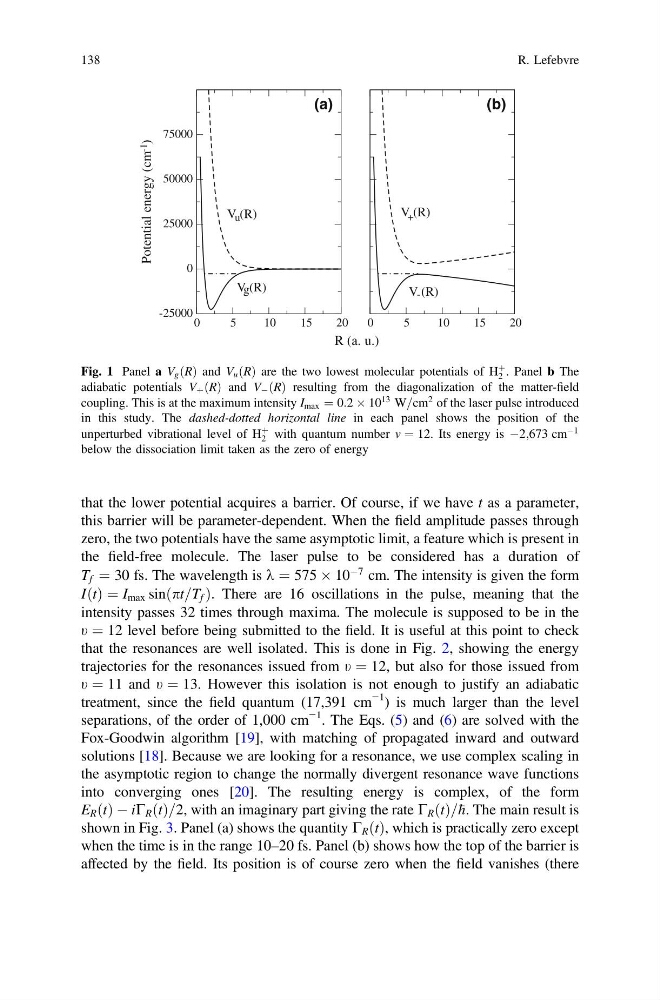
that the lower potential acquires a barrier. Of course, if we have t as a parameter,
this barrier will be parameter-dependent. When the field amplitude passes through
zero, the two potentials have the same asymptotic limit, a feature which is present in
the field-free molecule. The laser pulse to be considered has a duration of
T f ¼ 30 fs. The wavelength is k ¼ 575 Â 10
À7 cm. The intensity is given the form
IðtÞ ¼ I max sinðpt=T f Þ. There are 16 oscillations in the pulse, meaning that the
intensity passes 32 times through maxima. The molecule is supposed to be in the
t ¼ 12 level before being submitted to the field. It is useful at this point to check
that the resonances are well isolated. This is done in Fig. 2, showing the energy
trajectories for the resonances issued from t ¼ 12, but also for those issued from
t ¼ 11 and t ¼ 13. However this isolation is not enough to justify an adiabatic
treatment, since the field quantum (17,391 cm
−1 ) is much larger than the level
separations, of the order of 1,000 cm
−1 . The Eqs. (5) and (6) are solved with the
Fox-Goodwin algorithm [19], with matching of propagated inward and outward
solutions [18]. Because we are looking for a resonance, we use complex scaling in
the asymptotic region to change the normally divergent resonance wave functions
into converging ones [20]. The resulting energy is complex, of the form
E R ðtÞ À iC R ðtÞ=2, with an imaginary part giving the rate C R ðtÞ= h. The main result is
shown in Fig. 3. Panel (a) shows the quantity C R ðtÞ, which is practically zero except
when the time is in the range 10–20 fs. Panel (b) shows how the top of the barrier is
affected by the field. Its position is of course zero when the field vanishes (there
0
5
10
15
20
-25000
0
25000
50000
75000
0
5
10
15
20
(a)
(b)
R (a. u.)
Potential energy (cm )
-1
g
V (R)
V (R)
V (R)
V (R)
u
-
+
Fig. 1 Panel a V g ðRÞ and V u ðRÞ are the two lowest molecular potentials of H
þ
2 . Panel b The
adiabatic potentials V þ ðRÞ and V À ðRÞ resulting from the diagonalization of the matter-field
coupling. This is at the maximum intensity I max ¼ 0:2 Â 10
13 W=cm
2 of the laser pulse introduced
in this study. The dashed-dotted horizontal line in each panel shows the position of the
unperturbed vibrational level of H
þ
2 with quantum number v ¼ 12. Its energy is À2;673 cm
À1
below the dissociation limit taken as the zero of energy
138
R. Lefebvre
this barrier will be parameter-dependent. When the field amplitude passes through
zero, the two potentials have the same asymptotic limit, a feature which is present in
the field-free molecule. The laser pulse to be considered has a duration of
T f ¼ 30 fs. The wavelength is k ¼ 575 Â 10
À7 cm. The intensity is given the form
IðtÞ ¼ I max sinðpt=T f Þ. There are 16 oscillations in the pulse, meaning that the
intensity passes 32 times through maxima. The molecule is supposed to be in the
t ¼ 12 level before being submitted to the field. It is useful at this point to check
that the resonances are well isolated. This is done in Fig. 2, showing the energy
trajectories for the resonances issued from t ¼ 12, but also for those issued from
t ¼ 11 and t ¼ 13. However this isolation is not enough to justify an adiabatic
treatment, since the field quantum (17,391 cm
−1 ) is much larger than the level
separations, of the order of 1,000 cm
−1 . The Eqs. (5) and (6) are solved with the
Fox-Goodwin algorithm [19], with matching of propagated inward and outward
solutions [18]. Because we are looking for a resonance, we use complex scaling in
the asymptotic region to change the normally divergent resonance wave functions
into converging ones [20]. The resulting energy is complex, of the form
E R ðtÞ À iC R ðtÞ=2, with an imaginary part giving the rate C R ðtÞ= h. The main result is
shown in Fig. 3. Panel (a) shows the quantity C R ðtÞ, which is practically zero except
when the time is in the range 10–20 fs. Panel (b) shows how the top of the barrier is
affected by the field. Its position is of course zero when the field vanishes (there
0
5
10
15
20
-25000
0
25000
50000
75000
0
5
10
15
20
(a)
(b)
R (a. u.)
Potential energy (cm )
-1
g
V (R)
V (R)
V (R)
V (R)
u
-
+
Fig. 1 Panel a V g ðRÞ and V u ðRÞ are the two lowest molecular potentials of H
þ
2 . Panel b The
adiabatic potentials V þ ðRÞ and V À ðRÞ resulting from the diagonalization of the matter-field
coupling. This is at the maximum intensity I max ¼ 0:2 Â 10
13 W=cm
2 of the laser pulse introduced
in this study. The dashed-dotted horizontal line in each panel shows the position of the
unperturbed vibrational level of H
þ
2 with quantum number v ¼ 12. Its energy is À2;673 cm
À1
below the dissociation limit taken as the zero of energy
138
R. Lefebvre