

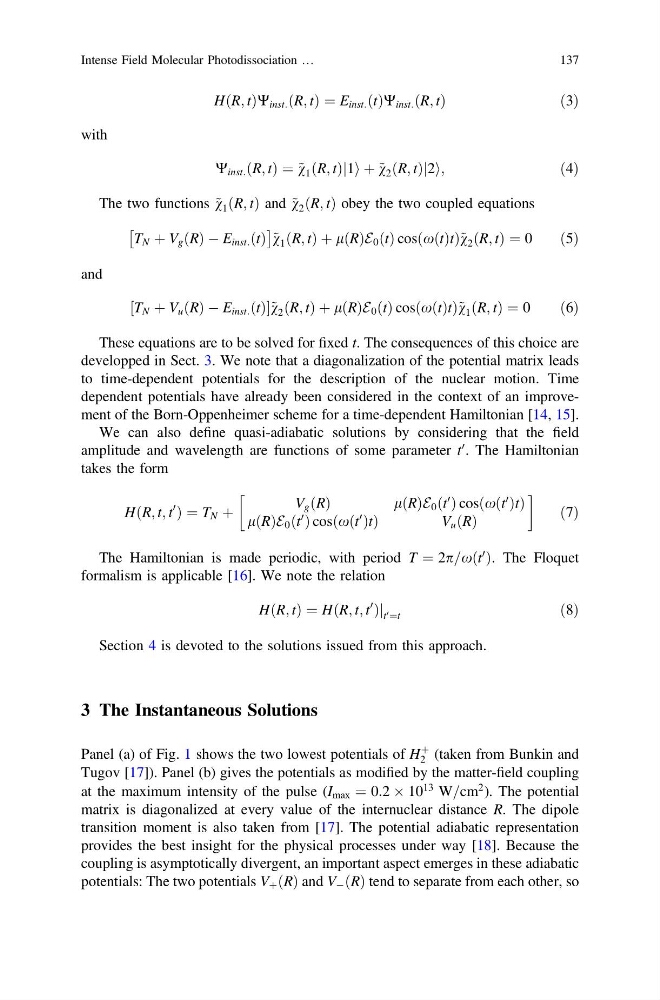
HðR; tÞW inst: ðR; tÞ ¼ E inst: ðtÞW inst: ðR; tÞ
ð 3Þ
with
W inst: ðR; tÞ ¼ ~ v 1 ðR; tÞj1i þ ~ v 2 ðR; tÞj2i;
ð4Þ
The two functions ~ v 1 ðR; tÞ and ~ v 2 ðR; tÞ obey the two coupled equations
T N þ V g ðRÞ À E inst: ðtÞ
Â
Ã
~ v 1 ðR; tÞ þ lðRÞE 0 ðtÞ cosðxðtÞtÞ~ v 2 ðR; tÞ ¼ 0
ð5Þ
and
T N þ V u ðRÞ À E inst: ðtÞ
½
~ v 2 ðR; tÞ þ lðRÞE 0 ðtÞ cosðxðtÞtÞ~ v 1 ðR; tÞ ¼ 0
ð6Þ
These equations are to be solved for fixed t. The consequences of this choice are
developped in Sect. 3. We note that a diagonalization of the potential matrix leads
to time-dependent potentials for the description of the nuclear motion. Time
dependent potentials have already been considered in the context of an improvement of the Born-Oppenheimer scheme for a time-dependent Hamiltonian [14, 15].
We can also define quasi-adiabatic solutions by considering that the field
amplitude and wavelength are functions of some parameter t
0 . The Hamiltonian
takes the form
HðR; t; t
0
Þ ¼ T N þ
V g ðRÞ
lðRÞE 0 ðt
0
Þ cosðxðt
0
ÞtÞ
lðRÞE 0 ðt
0
Þ cosðxðt
0
ÞtÞ
V u ðRÞ
!
ð7Þ
The Hamiltonian is made periodic, with period T ¼ 2p=xðt
0
Þ. The Floquet
formalism is applicable [16]. We note the relation
HðR; tÞ ¼ HðR; t; t
0
Þj t 0 ¼t
ð8Þ
Section 4 is devoted to the solutions issued from this approach.
3 The Instantaneous Solutions
Panel (a) of Fig. 1 shows the two lowest potentials of H
þ
2 (taken from Bunkin and
Tugov [17]). Panel (b) gives the potentials as modified by the matter-field coupling
at the maximum intensity of the pulse (I max ¼ 0:2 Â 10
13 W=cm
2 ). The potential
matrix is diagonalized at every value of the internuclear distance R. The dipole
transition moment is also taken from [17]. The potential adiabatic representation
provides the best insight for the physical processes under way [18]. Because the
coupling is asymptotically divergent, an important aspect emerges in these adiabatic
potentials: The two potentials V þ ðRÞ and V À ðRÞ tend to separate from each other, so
Intense Field Molecular Photodissociation …
137
ð 3Þ
with
W inst: ðR; tÞ ¼ ~ v 1 ðR; tÞj1i þ ~ v 2 ðR; tÞj2i;
ð4Þ
The two functions ~ v 1 ðR; tÞ and ~ v 2 ðR; tÞ obey the two coupled equations
T N þ V g ðRÞ À E inst: ðtÞ
Â
Ã
~ v 1 ðR; tÞ þ lðRÞE 0 ðtÞ cosðxðtÞtÞ~ v 2 ðR; tÞ ¼ 0
ð5Þ
and
T N þ V u ðRÞ À E inst: ðtÞ
½
~ v 2 ðR; tÞ þ lðRÞE 0 ðtÞ cosðxðtÞtÞ~ v 1 ðR; tÞ ¼ 0
ð6Þ
These equations are to be solved for fixed t. The consequences of this choice are
developped in Sect. 3. We note that a diagonalization of the potential matrix leads
to time-dependent potentials for the description of the nuclear motion. Time
dependent potentials have already been considered in the context of an improvement of the Born-Oppenheimer scheme for a time-dependent Hamiltonian [14, 15].
We can also define quasi-adiabatic solutions by considering that the field
amplitude and wavelength are functions of some parameter t
0 . The Hamiltonian
takes the form
HðR; t; t
0
Þ ¼ T N þ
V g ðRÞ
lðRÞE 0 ðt
0
Þ cosðxðt
0
ÞtÞ
lðRÞE 0 ðt
0
Þ cosðxðt
0
ÞtÞ
V u ðRÞ
!
ð7Þ
The Hamiltonian is made periodic, with period T ¼ 2p=xðt
0
Þ. The Floquet
formalism is applicable [16]. We note the relation
HðR; tÞ ¼ HðR; t; t
0
Þj t 0 ¼t
ð8Þ
Section 4 is devoted to the solutions issued from this approach.
3 The Instantaneous Solutions
Panel (a) of Fig. 1 shows the two lowest potentials of H
þ
2 (taken from Bunkin and
Tugov [17]). Panel (b) gives the potentials as modified by the matter-field coupling
at the maximum intensity of the pulse (I max ¼ 0:2 Â 10
13 W=cm
2 ). The potential
matrix is diagonalized at every value of the internuclear distance R. The dipole
transition moment is also taken from [17]. The potential adiabatic representation
provides the best insight for the physical processes under way [18]. Because the
coupling is asymptotically divergent, an important aspect emerges in these adiabatic
potentials: The two potentials V þ ðRÞ and V À ðRÞ tend to separate from each other, so
Intense Field Molecular Photodissociation …
137