

approach (see for instance [7–9]). We will show that this method is not in conformity
with the standard adiabatic procedure. Adiabatic transport has also been recently
discussed for the case of two neighbouring resonances which may coalesce at a
so-called exceptional point in parameter space [8, 10–13]. We consider here only the
case of an isolated resonance. The paper is organized as follows: Sect. 2 gives the
elements of the description of a diatomic molecule exposed to a pulsed electromagnetic field. We then consider two options which are possible steps toward an
adiabatic description of the dynamics. In Sect. 3 we follow the traditional adiabatic
treatment based on the instantaneous solutions of the wave equation. In Sect. 4 we
review a route leading to more acceptable results. In Sect. 5 a wave packet
description, with a step by step solution of the time-dependent Schrödinger equation,
confirms the results of Sect. 4. The system H
þ
2 is considered in the applications.
2 The Time-Dependent Wave-Equation
We consider a one-dimensional model molecule involving only two electronic
states j1i and j2i. Potential energies V 1 ðRÞ and V 2 ðRÞ are associated to these two
states, R being the interatomic distance. V 1 ðRÞ accommodates a series of bound
vibrational states while V 2 ðRÞ is a repulsive potential. This is the situation met in the
H
þ
2 species, where V 1 ðRÞ is in fact V g ðRÞ, the potential of the state described by a
1r g orbital, and V 2 ðRÞ the potential V u ðRÞ of the state described by a 1r u orbital. If
the rotational period of the molecule is shorter than the laser pulse duration, R is
enough to account for the nuclear motion. This is the case for H
þ
2 where the
rotational period can estimated to be about 7 ps while we will be considering pulses
of duration 30 fs. The wave function of the system is expanded on these two states
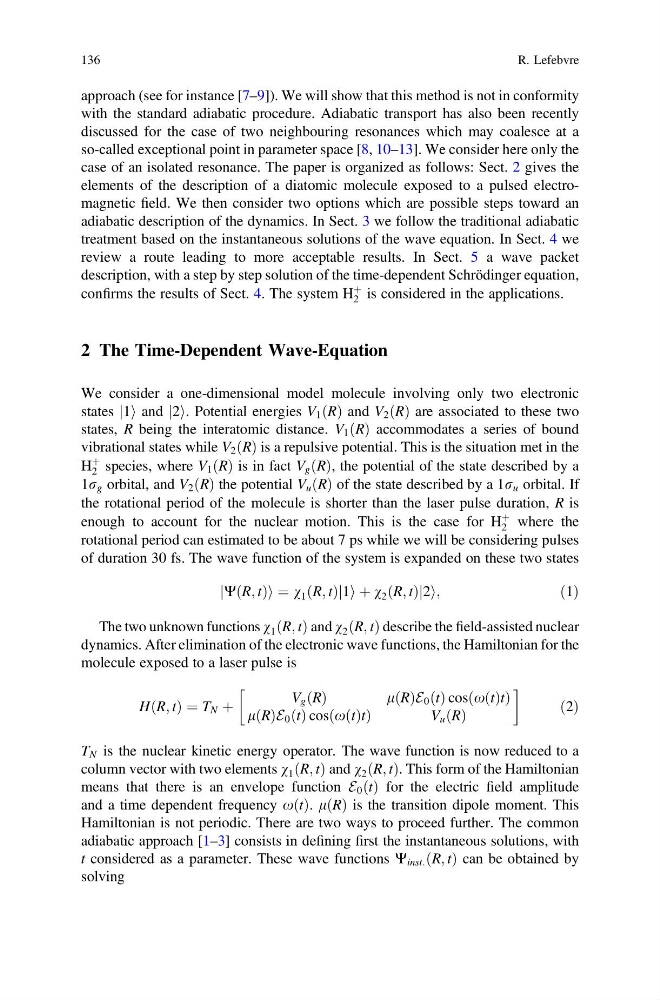
jWðR; tÞi ¼ v 1 ðR; tÞj1i þ v 2 ðR; tÞj2i;
ð1Þ
The two unknown functions v 1 ðR; tÞ and v 2 ðR; tÞ describe the field-assisted nuclear
dynamics. After elimination of the electronic wave functions, the Hamiltonian for the
molecule exposed to a laser pulse is
HðR; tÞ ¼ T N þ
V g ðRÞ
lðRÞE 0 ðtÞ cosðxðtÞtÞ
lðRÞE 0 ðtÞ cosðxðtÞtÞ
V u ðRÞ
!
ð2Þ
T N is the nuclear kinetic energy operator. The wave function is now reduced to a
column vector with two elements v 1 ðR; tÞ and v 2 ðR; tÞ. This form of the Hamiltonian
means that there is an envelope function E 0 ðtÞ for the electric field amplitude
and a time dependent frequency xðtÞ. lðRÞ is the transition dipole moment. This
Hamiltonian is not periodic. There are two ways to proceed further. The common
adiabatic approach [1–3] consists in defining first the instantaneous solutions, with
t considered as a parameter. These wave functions W inst: ðR; tÞ can be obtained by
solving
136
R. Lefebvre
with the standard adiabatic procedure. Adiabatic transport has also been recently
discussed for the case of two neighbouring resonances which may coalesce at a
so-called exceptional point in parameter space [8, 10–13]. We consider here only the
case of an isolated resonance. The paper is organized as follows: Sect. 2 gives the
elements of the description of a diatomic molecule exposed to a pulsed electromagnetic field. We then consider two options which are possible steps toward an
adiabatic description of the dynamics. In Sect. 3 we follow the traditional adiabatic
treatment based on the instantaneous solutions of the wave equation. In Sect. 4 we
review a route leading to more acceptable results. In Sect. 5 a wave packet
description, with a step by step solution of the time-dependent Schrödinger equation,
confirms the results of Sect. 4. The system H
þ
2 is considered in the applications.
2 The Time-Dependent Wave-Equation
We consider a one-dimensional model molecule involving only two electronic
states j1i and j2i. Potential energies V 1 ðRÞ and V 2 ðRÞ are associated to these two
states, R being the interatomic distance. V 1 ðRÞ accommodates a series of bound
vibrational states while V 2 ðRÞ is a repulsive potential. This is the situation met in the
H
þ
2 species, where V 1 ðRÞ is in fact V g ðRÞ, the potential of the state described by a
1r g orbital, and V 2 ðRÞ the potential V u ðRÞ of the state described by a 1r u orbital. If
the rotational period of the molecule is shorter than the laser pulse duration, R is
enough to account for the nuclear motion. This is the case for H
þ
2 where the
rotational period can estimated to be about 7 ps while we will be considering pulses
of duration 30 fs. The wave function of the system is expanded on these two states
jWðR; tÞi ¼ v 1 ðR; tÞj1i þ v 2 ðR; tÞj2i;
ð1Þ
The two unknown functions v 1 ðR; tÞ and v 2 ðR; tÞ describe the field-assisted nuclear
dynamics. After elimination of the electronic wave functions, the Hamiltonian for the
molecule exposed to a laser pulse is
HðR; tÞ ¼ T N þ
V g ðRÞ
lðRÞE 0 ðtÞ cosðxðtÞtÞ
lðRÞE 0 ðtÞ cosðxðtÞtÞ
V u ðRÞ
!
ð2Þ
T N is the nuclear kinetic energy operator. The wave function is now reduced to a
column vector with two elements v 1 ðR; tÞ and v 2 ðR; tÞ. This form of the Hamiltonian
means that there is an envelope function E 0 ðtÞ for the electric field amplitude
and a time dependent frequency xðtÞ. lðRÞ is the transition dipole moment. This
Hamiltonian is not periodic. There are two ways to proceed further. The common
adiabatic approach [1–3] consists in defining first the instantaneous solutions, with
t considered as a parameter. These wave functions W inst: ðR; tÞ can be obtained by
solving
136
R. Lefebvre