

is in fact no barrier in this case). Also shown is the position of the energy of the
field-free level (E 12 ¼ À2;673 cm
À1 ). There is a strong correlation between the
range of time when the barrier top is equal or below this energy and the appearance
of a rate. Of course in this range it is still possible for the field to vanish. This
explains the vanishing rates between two peaks in panel (a). The fact that the barrier
has to be lowered by the field for the molecule to find its way toward dissociation is
reminiscent of that described under the name of DDQ (Dynamic Dissociation
Quenching) in [21], but with a major difference, since the field in this case in the
infrared range. This is in fact the reason why the instantaneous solutions make
sense in the DDQ case, whereas, as we will see in the next section, another
approach, although not in conformity with the traditional adiabatic method, is to be
preferred. A comparison to be made further down with the quasi-adiabatic approach
and the wave-packet method will show how poor the instantaneous procedure is to
evaluate the dissociation rate.
4 The Quasi-Adiabatic Solutions
According to the Floquet theorem the solutions of the wave equation with the
Hamiltonian of Eq. (7) can be given the form [16]
-4000 -3500 -3000 -2500 -2000 -1500 -1000
-400
-300
-200
-100
0
v = 11
v = 12
v = 13
Im (E) (cm )
-1
Re (E) (cm )
-1
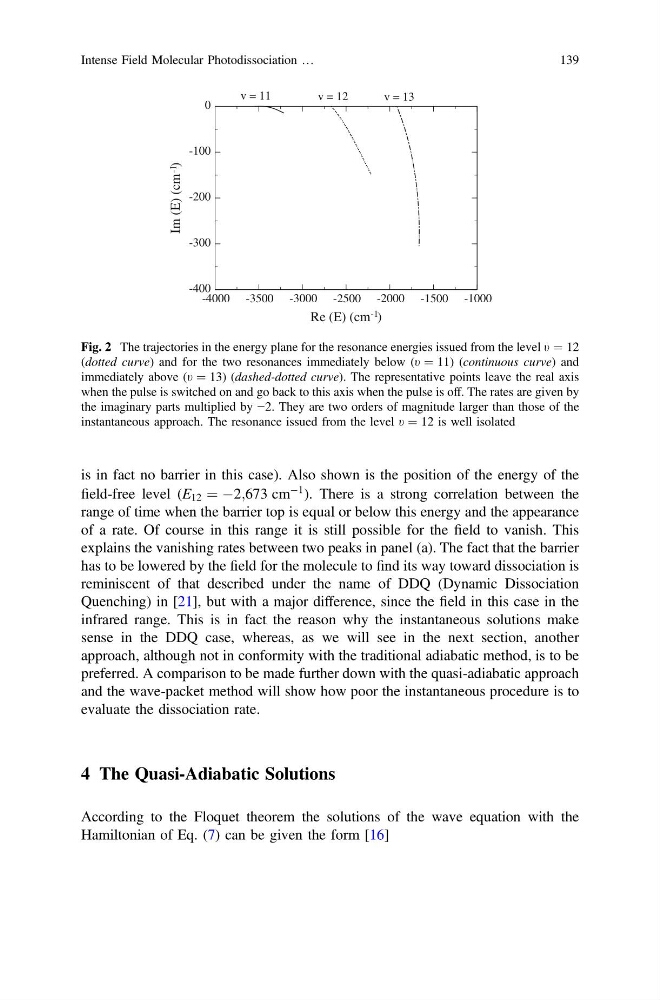
Fig. 2 The trajectories in the energy plane for the resonance energies issued from the level t ¼ 12
(dotted curve) and for the two resonances immediately below (t ¼ 11) (continuous curve) and
immediately above (t ¼ 13) (dashed-dotted curve). The representative points leave the real axis
when the pulse is switched on and go back to this axis when the pulse is off. The rates are given by
the imaginary parts multiplied by −2. They are two orders of magnitude larger than those of the
instantaneous approach. The resonance issued from the level t ¼ 12 is well isolated
Intense Field Molecular Photodissociation …
139
field-free level (E 12 ¼ À2;673 cm
À1 ). There is a strong correlation between the
range of time when the barrier top is equal or below this energy and the appearance
of a rate. Of course in this range it is still possible for the field to vanish. This
explains the vanishing rates between two peaks in panel (a). The fact that the barrier
has to be lowered by the field for the molecule to find its way toward dissociation is
reminiscent of that described under the name of DDQ (Dynamic Dissociation
Quenching) in [21], but with a major difference, since the field in this case in the
infrared range. This is in fact the reason why the instantaneous solutions make
sense in the DDQ case, whereas, as we will see in the next section, another
approach, although not in conformity with the traditional adiabatic method, is to be
preferred. A comparison to be made further down with the quasi-adiabatic approach
and the wave-packet method will show how poor the instantaneous procedure is to
evaluate the dissociation rate.
4 The Quasi-Adiabatic Solutions
According to the Floquet theorem the solutions of the wave equation with the
Hamiltonian of Eq. (7) can be given the form [16]
-4000 -3500 -3000 -2500 -2000 -1500 -1000
-400
-300
-200
-100
0
v = 11
v = 12
v = 13
Im (E) (cm )
-1
Re (E) (cm )
-1
Fig. 2 The trajectories in the energy plane for the resonance energies issued from the level t ¼ 12
(dotted curve) and for the two resonances immediately below (t ¼ 11) (continuous curve) and
immediately above (t ¼ 13) (dashed-dotted curve). The representative points leave the real axis
when the pulse is switched on and go back to this axis when the pulse is off. The rates are given by
the imaginary parts multiplied by −2. They are two orders of magnitude larger than those of the
instantaneous approach. The resonance issued from the level t ¼ 12 is well isolated
Intense Field Molecular Photodissociation …
139