

Hydrogen Bonding (H-Bond) analysis. To obtain a more atomic-level picture
of the hydrogen bonds identified in the previous section from the RDF analysis and
to identify additional relevant hydrogen bonds involving the anandamide substrate
we decided to perform a full-hydrogen bonding analysis.
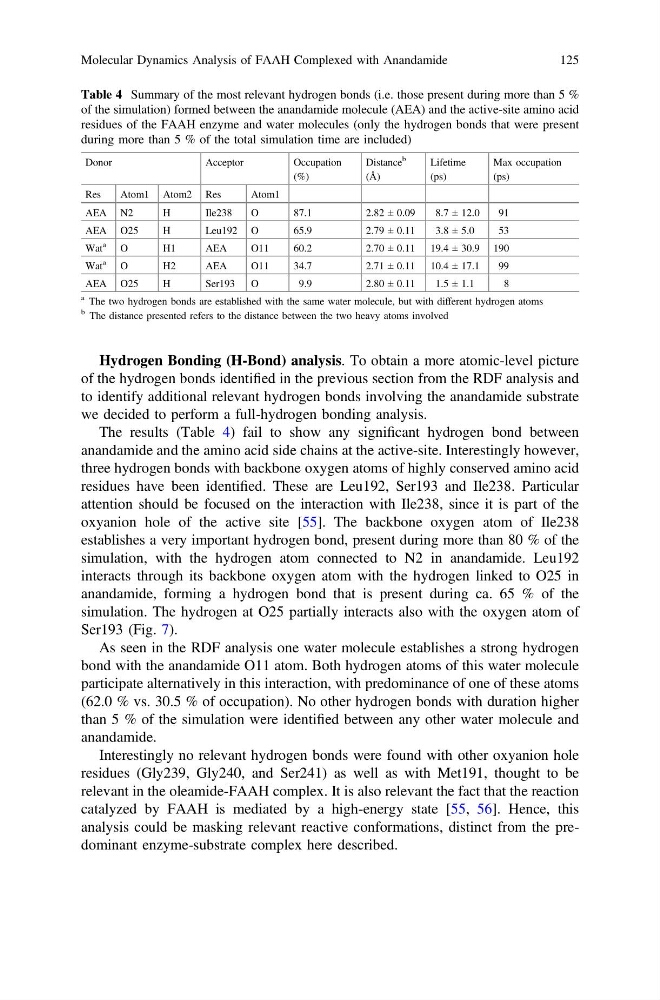
The results (Table 4) fail to show any significant hydrogen bond between
anandamide and the amino acid side chains at the active-site. Interestingly however,
three hydrogen bonds with backbone oxygen atoms of highly conserved amino acid
residues have been identified. These are Leu192, Ser193 and Ile238. Particular
attention should be focused on the interaction with Ile238, since it is part of the
oxyanion hole of the active site [55]. The backbone oxygen atom of Ile238
establishes a very important hydrogen bond, present during more than 80 % of the
simulation, with the hydrogen atom connected to N2 in anandamide. Leu192
interacts through its backbone oxygen atom with the hydrogen linked to O25 in
anandamide, forming a hydrogen bond that is present during ca. 65 % of the
simulation. The hydrogen at O25 partially interacts also with the oxygen atom of
Ser193 (Fig. 7).
As seen in the RDF analysis one water molecule establishes a strong hydrogen
bond with the anandamide O11 atom. Both hydrogen atoms of this water molecule
participate alternatively in this interaction, with predominance of one of these atoms
(62.0 % vs. 30.5 % of occupation). No other hydrogen bonds with duration higher
than 5 % of the simulation were identified between any other water molecule and
anandamide.
Interestingly no relevant hydrogen bonds were found with other oxyanion hole
residues (Gly239, Gly240, and Ser241) as well as with Met191, thought to be
relevant in the oleamide-FAAH complex. It is also relevant the fact that the reaction
catalyzed by FAAH is mediated by a high-energy state [55, 56]. Hence, this
analysis could be masking relevant reactive conformations, distinct from the predominant enzyme-substrate complex here described.
Table 4 Summary of the most relevant hydrogen bonds (i.e. those present during more than 5 %
of the simulation) formed between the anandamide molecule (AEA) and the active-site amino acid
residues of the FAAH enzyme and water molecules (only the hydrogen bonds that were present
during more than 5 % of the total simulation time are included)
Donor
Acceptor
Occupation
(%)
Distance
b
(Å)
Lifetime
(ps)
Max occupation
(ps)
Res
Atom1 Atom2 Res
Atom1
AEA N2
H
Ile238
O
87.1
2.82 ± 0.09
8.7 ± 12.0
91
AEA O25
H
Leu192 O
65.9
2.79 ± 0.11
3.8 ± 5.0
53
Wat
a
O
H1
AEA
O11
60.2
2.70 ± 0.11 19.4 ± 30.9 190
Wat
a
O
H2
AEA
O11
34.7
2.71 ± 0.11 10.4 ± 17.1
99
AEA O25
H
Ser193
O
9.9
2.80 ± 0.11
1.5 ± 1.1
8
a The two hydrogen bonds are established with the same water molecule, but with different hydrogen atoms
b The distance presented refers to the distance between the two heavy atoms involved
Molecular Dynamics Analysis of FAAH Complexed with Anandamide
125
of the hydrogen bonds identified in the previous section from the RDF analysis and
to identify additional relevant hydrogen bonds involving the anandamide substrate
we decided to perform a full-hydrogen bonding analysis.
The results (Table 4) fail to show any significant hydrogen bond between
anandamide and the amino acid side chains at the active-site. Interestingly however,
three hydrogen bonds with backbone oxygen atoms of highly conserved amino acid
residues have been identified. These are Leu192, Ser193 and Ile238. Particular
attention should be focused on the interaction with Ile238, since it is part of the
oxyanion hole of the active site [55]. The backbone oxygen atom of Ile238
establishes a very important hydrogen bond, present during more than 80 % of the
simulation, with the hydrogen atom connected to N2 in anandamide. Leu192
interacts through its backbone oxygen atom with the hydrogen linked to O25 in
anandamide, forming a hydrogen bond that is present during ca. 65 % of the
simulation. The hydrogen at O25 partially interacts also with the oxygen atom of
Ser193 (Fig. 7).
As seen in the RDF analysis one water molecule establishes a strong hydrogen
bond with the anandamide O11 atom. Both hydrogen atoms of this water molecule
participate alternatively in this interaction, with predominance of one of these atoms
(62.0 % vs. 30.5 % of occupation). No other hydrogen bonds with duration higher
than 5 % of the simulation were identified between any other water molecule and
anandamide.
Interestingly no relevant hydrogen bonds were found with other oxyanion hole
residues (Gly239, Gly240, and Ser241) as well as with Met191, thought to be
relevant in the oleamide-FAAH complex. It is also relevant the fact that the reaction
catalyzed by FAAH is mediated by a high-energy state [55, 56]. Hence, this
analysis could be masking relevant reactive conformations, distinct from the predominant enzyme-substrate complex here described.
Table 4 Summary of the most relevant hydrogen bonds (i.e. those present during more than 5 %
of the simulation) formed between the anandamide molecule (AEA) and the active-site amino acid
residues of the FAAH enzyme and water molecules (only the hydrogen bonds that were present
during more than 5 % of the total simulation time are included)
Donor
Acceptor
Occupation
(%)
Distance
b
(Å)
Lifetime
(ps)
Max occupation
(ps)
Res
Atom1 Atom2 Res
Atom1
AEA N2
H
Ile238
O
87.1
2.82 ± 0.09
8.7 ± 12.0
91
AEA O25
H
Leu192 O
65.9
2.79 ± 0.11
3.8 ± 5.0
53
Wat
a
O
H1
AEA
O11
60.2
2.70 ± 0.11 19.4 ± 30.9 190
Wat
a
O
H2
AEA
O11
34.7
2.71 ± 0.11 10.4 ± 17.1
99
AEA O25
H
Ser193
O
9.9
2.80 ± 0.11
1.5 ± 1.1
8
a The two hydrogen bonds are established with the same water molecule, but with different hydrogen atoms
b The distance presented refers to the distance between the two heavy atoms involved
Molecular Dynamics Analysis of FAAH Complexed with Anandamide
125