

The HOMO-LUMO energy gaps (Table 7) are in line with the known huge
difference between HF and DFT estimations, with the DFT estimations being the
less reliable [27]. Studies on a high number of other molecules of the same class
(acylphloroglucinols, [28]) have highlighted that, although the DFT values for the
energy gap are not realistic, the trends that can be identified on the basis of those
values are realistic. For the results in vacuo, the trends are similar in the HF and
DFT results. The HOMO-LUMO gap does not vary considerably for different
conformers, and it has slightly higher values for the conformers containing the
H23⋯O41 IHB.
Figure 6 shows representative shapes of the HOMO and LUMO frontier orbitals.
The shapes are largely similar in the HF and DFT results. For the conformers of
types 1, 3, 5, 6, 9 and 11, the HOMO is mostly located on the A ring, whereas it
extends also to the xanthone moiety for conformers containing the H23⋯O41 IHB.
The LUMO is located on the xanthone moiety for all the conformers.
3.2 Results in Solution
Since calculations in solution were performed only at the DFT/B3LYP/6-31+G(d,p)
level, the comparison of relevant quantities in different media is based only on the
DFT/B3LYP/6-31+G(d,p) results.
0
1
2
3
4
5
6
7
8
50 100 150 200 250 300 350 400 450 500 550
Relative energy (kcal/mol)
Torsion angle
0
1
2
3
4
5
6
0
100
200
300
400
Relative energy (kcal/mol)
Torsion angle
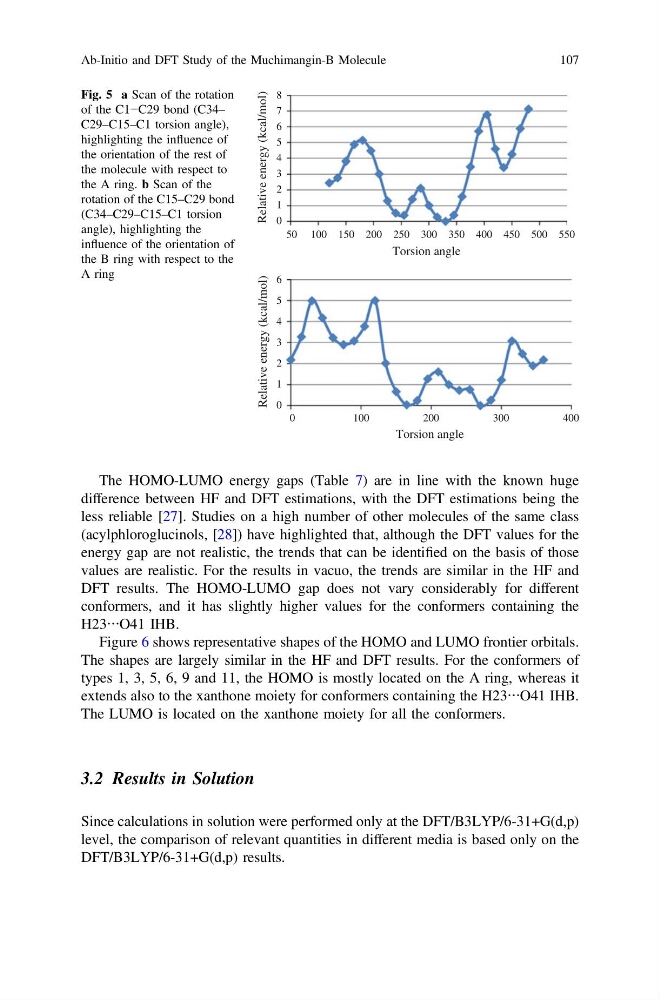
Fig. 5 a Scan of the rotation
of the C1−C29 bond (C34–
C29–C15–C1 torsion angle),
highlighting the influence of
the orientation of the rest of
the molecule with respect to
the A ring. b Scan of the
rotation of the C15–C29 bond
(C34–C29–C15–C1 torsion
angle), highlighting the
influence of the orientation of
the B ring with respect to the
A ring
Ab-Initio and DFT Study of the Muchimangin-B Molecule
107
difference between HF and DFT estimations, with the DFT estimations being the
less reliable [27]. Studies on a high number of other molecules of the same class
(acylphloroglucinols, [28]) have highlighted that, although the DFT values for the
energy gap are not realistic, the trends that can be identified on the basis of those
values are realistic. For the results in vacuo, the trends are similar in the HF and
DFT results. The HOMO-LUMO gap does not vary considerably for different
conformers, and it has slightly higher values for the conformers containing the
H23⋯O41 IHB.
Figure 6 shows representative shapes of the HOMO and LUMO frontier orbitals.
The shapes are largely similar in the HF and DFT results. For the conformers of
types 1, 3, 5, 6, 9 and 11, the HOMO is mostly located on the A ring, whereas it
extends also to the xanthone moiety for conformers containing the H23⋯O41 IHB.
The LUMO is located on the xanthone moiety for all the conformers.
3.2 Results in Solution
Since calculations in solution were performed only at the DFT/B3LYP/6-31+G(d,p)
level, the comparison of relevant quantities in different media is based only on the
DFT/B3LYP/6-31+G(d,p) results.
0
1
2
3
4
5
6
7
8
50 100 150 200 250 300 350 400 450 500 550
Relative energy (kcal/mol)
Torsion angle
0
1
2
3
4
5
6
0
100
200
300
400
Relative energy (kcal/mol)
Torsion angle
Fig. 5 a Scan of the rotation
of the C1−C29 bond (C34–
C29–C15–C1 torsion angle),
highlighting the influence of
the orientation of the rest of
the molecule with respect to
the A ring. b Scan of the
rotation of the C15–C29 bond
(C34–C29–C15–C1 torsion
angle), highlighting the
influence of the orientation of
the B ring with respect to the
A ring
Ab-Initio and DFT Study of the Muchimangin-B Molecule
107