

The results in solution show trends consistent with many other observations in
solution, above all for molecules containing OH groups. For conformers with the
most stable IHB pattern (1-type conformers), the energy in solution does not
decrease significantly and may increase. This is likely related to the mainly
hydrophobic character of the IHB regions and to the greater stability of this IHB
pattern. For the other conformers, the relative energy decreases as the solvent
polarity increases. The decrease is sharper—above all in water solution—for conformers having an OH not engaged in an IHB (3, 7, 9), as this OH is available to
form intermolecular H-bonds with the water molecules. Although PCM does not
explicitly take into account directional solute-solvent interactions such as H-bonds,
its results are often attuned to the expected stronger solute-solvent interactions
when H-bonds are possible [8]. The relative energies in water suggest that even
conformers such as 2-a, 2-b or 3-a may be somewhat responsible for the molecule’s
biological activity (although these conformers would be excluded on the sole basis
of the results in vacuo).
Table 8 reports the solvent effect (free energy of solvation, ΔG solv ) and its
electrostatic component (G el ) for the three solvents considered. The ΔG solv values
would suggest greater solubility in water than in the other two solvents. The
magnitude of ΔG solv in water increases for higher energy conformers, in correspondence with weaker IHB patterns or the absence of one IHB in the conformer
(both these factors facilitate stronger solute-water interactions, with consequent
greater stabilising effect by the solvent).
The dipole moment (Table 6) increases slightly as the solvent polarity increases.
1-b
HOMO
1-b
LUMO
2-a
HOMO
2-a
LUMO
DFT/B3LYP/6-31+G(d,p) results
1-b
HOMO
1-b
LUMO
2-a
HOMO
2-a
LUMO
HF/6-31G(d,p) results
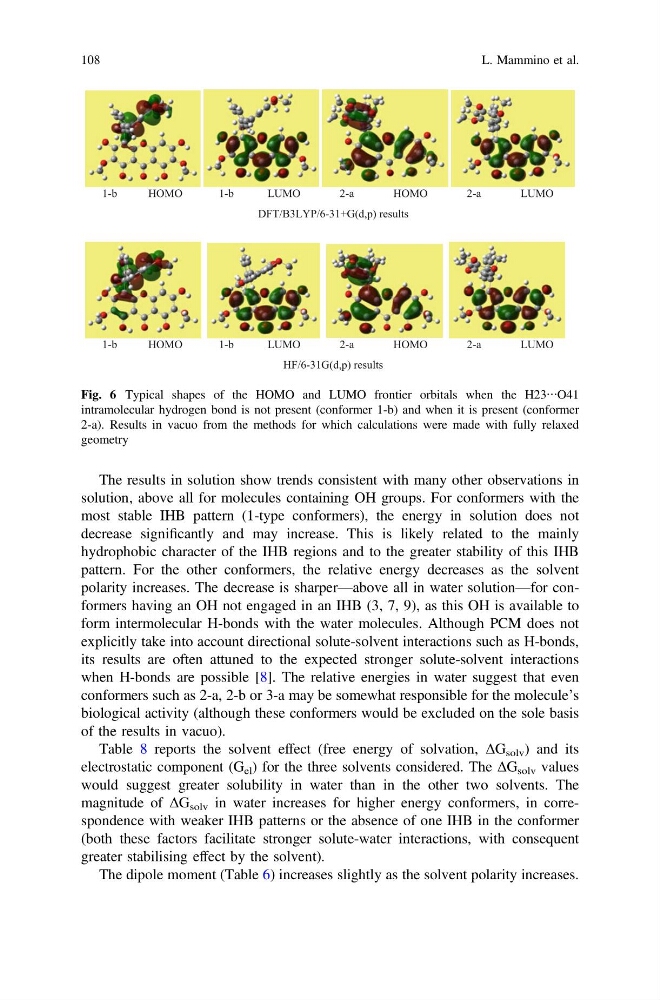
Fig. 6 Typical shapes of the HOMO and LUMO frontier orbitals when the H23⋯O41
intramolecular hydrogen bond is not present (conformer 1-b) and when it is present (conformer
2-a). Results in vacuo from the methods for which calculations were made with fully relaxed
geometry
108
L. Mammino et al.
solution, above all for molecules containing OH groups. For conformers with the
most stable IHB pattern (1-type conformers), the energy in solution does not
decrease significantly and may increase. This is likely related to the mainly
hydrophobic character of the IHB regions and to the greater stability of this IHB
pattern. For the other conformers, the relative energy decreases as the solvent
polarity increases. The decrease is sharper—above all in water solution—for conformers having an OH not engaged in an IHB (3, 7, 9), as this OH is available to
form intermolecular H-bonds with the water molecules. Although PCM does not
explicitly take into account directional solute-solvent interactions such as H-bonds,
its results are often attuned to the expected stronger solute-solvent interactions
when H-bonds are possible [8]. The relative energies in water suggest that even
conformers such as 2-a, 2-b or 3-a may be somewhat responsible for the molecule’s
biological activity (although these conformers would be excluded on the sole basis
of the results in vacuo).
Table 8 reports the solvent effect (free energy of solvation, ΔG solv ) and its
electrostatic component (G el ) for the three solvents considered. The ΔG solv values
would suggest greater solubility in water than in the other two solvents. The
magnitude of ΔG solv in water increases for higher energy conformers, in correspondence with weaker IHB patterns or the absence of one IHB in the conformer
(both these factors facilitate stronger solute-water interactions, with consequent
greater stabilising effect by the solvent).
The dipole moment (Table 6) increases slightly as the solvent polarity increases.
1-b
HOMO
1-b
LUMO
2-a
HOMO
2-a
LUMO
DFT/B3LYP/6-31+G(d,p) results
1-b
HOMO
1-b
LUMO
2-a
HOMO
2-a
LUMO
HF/6-31G(d,p) results
Fig. 6 Typical shapes of the HOMO and LUMO frontier orbitals when the H23⋯O41
intramolecular hydrogen bond is not present (conformer 1-b) and when it is present (conformer
2-a). Results in vacuo from the methods for which calculations were made with fully relaxed
geometry
108
L. Mammino et al.