

is considerably smaller than that caused by H23⋯O41. An analysis of Tables 2, 3
and 4 highlights similar trends for the other IHBs involving ether O atoms.
Estimating the energy of IHBs is not easy. In principle, the removal of the IHB
by 180° rotation of the donor OH should enable an estimation by comparison of the
conformers with and without the IHB. In practice, if the molecule is flexible, the
IHB removal may cause substantial geometry changes, so that the two conformers
do not differ only by the presence or absence of the IHB. When the donor and the
acceptor are attached to an aromatic ring, the geometry of the molecule does not
change significantly, but the ensuing O↔O repulsion contributes remarkably to the
energy increase on IHB removal. In the case of the MUCH-B molecule, the situation is further complicated by the fact that, in most cases, the rotation of a donor
OH removes one IHB but brings the formation of another. The only IHB that is
removed without bringing about the formation of another is H28⋯O21. Comparison of relevant pairs of conformers (1-a and 3-a, 1-b and 3-b, 1-c and 3-c, 4 and 7,
6-a and 9-a, 6-c and 9-c) yields 4.83–4.99/HF, 5.65–5.89/MP, 5.56–5.97/DF+. The
comparison of 6-b and 9-b yields 5.73/HF, 6.37/MP and 6.19/DF+.
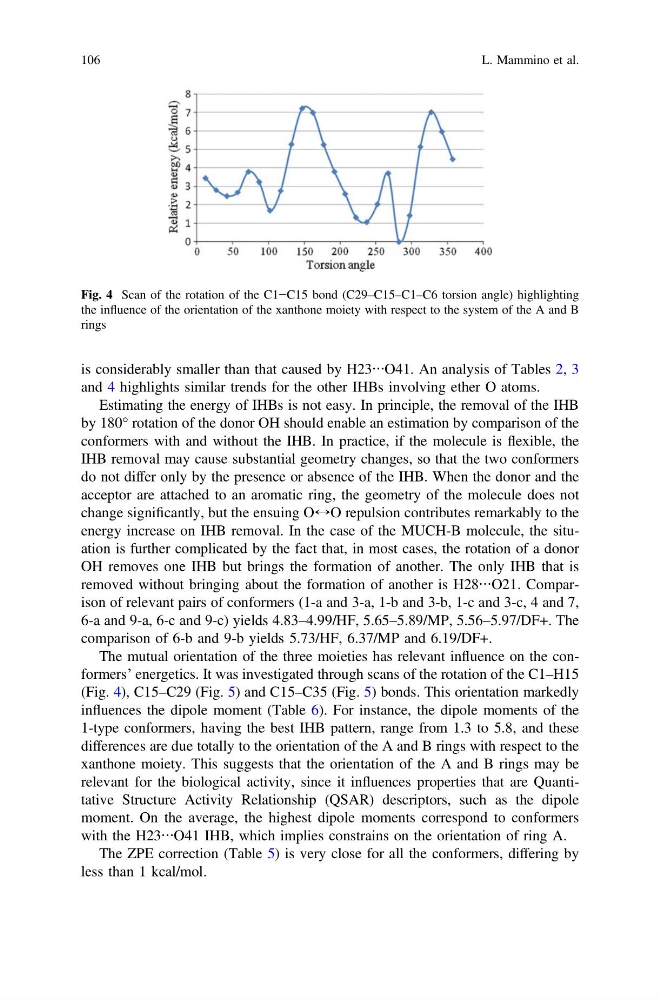
The mutual orientation of the three moieties has relevant influence on the conformers’ energetics. It was investigated through scans of the rotation of the C1–H15
(Fig. 4), C15–C29 (Fig. 5) and C15–C35 (Fig. 5) bonds. This orientation markedly
influences the dipole moment (Table 6). For instance, the dipole moments of the
1-type conformers, having the best IHB pattern, range from 1.3 to 5.8, and these
differences are due totally to the orientation of the A and B rings with respect to the
xanthone moiety. This suggests that the orientation of the A and B rings may be
relevant for the biological activity, since it influences properties that are Quantitative Structure Activity Relationship (QSAR) descriptors, such as the dipole
moment. On the average, the highest dipole moments correspond to conformers
with the H23⋯O41 IHB, which implies constrains on the orientation of ring A.
The ZPE correction (Table 5) is very close for all the conformers, differing by
less than 1 kcal/mol.
Fig. 4 Scan of the rotation of the C1−C15 bond (C29–C15–C1–C6 torsion angle) highlighting
the influence of the orientation of the xanthone moiety with respect to the system of the A and B
rings
106
L. Mammino et al.
and 4 highlights similar trends for the other IHBs involving ether O atoms.
Estimating the energy of IHBs is not easy. In principle, the removal of the IHB
by 180° rotation of the donor OH should enable an estimation by comparison of the
conformers with and without the IHB. In practice, if the molecule is flexible, the
IHB removal may cause substantial geometry changes, so that the two conformers
do not differ only by the presence or absence of the IHB. When the donor and the
acceptor are attached to an aromatic ring, the geometry of the molecule does not
change significantly, but the ensuing O↔O repulsion contributes remarkably to the
energy increase on IHB removal. In the case of the MUCH-B molecule, the situation is further complicated by the fact that, in most cases, the rotation of a donor
OH removes one IHB but brings the formation of another. The only IHB that is
removed without bringing about the formation of another is H28⋯O21. Comparison of relevant pairs of conformers (1-a and 3-a, 1-b and 3-b, 1-c and 3-c, 4 and 7,
6-a and 9-a, 6-c and 9-c) yields 4.83–4.99/HF, 5.65–5.89/MP, 5.56–5.97/DF+. The
comparison of 6-b and 9-b yields 5.73/HF, 6.37/MP and 6.19/DF+.
The mutual orientation of the three moieties has relevant influence on the conformers’ energetics. It was investigated through scans of the rotation of the C1–H15
(Fig. 4), C15–C29 (Fig. 5) and C15–C35 (Fig. 5) bonds. This orientation markedly
influences the dipole moment (Table 6). For instance, the dipole moments of the
1-type conformers, having the best IHB pattern, range from 1.3 to 5.8, and these
differences are due totally to the orientation of the A and B rings with respect to the
xanthone moiety. This suggests that the orientation of the A and B rings may be
relevant for the biological activity, since it influences properties that are Quantitative Structure Activity Relationship (QSAR) descriptors, such as the dipole
moment. On the average, the highest dipole moments correspond to conformers
with the H23⋯O41 IHB, which implies constrains on the orientation of ring A.
The ZPE correction (Table 5) is very close for all the conformers, differing by
less than 1 kcal/mol.
Fig. 4 Scan of the rotation of the C1−C15 bond (C29–C15–C1–C6 torsion angle) highlighting
the influence of the orientation of the xanthone moiety with respect to the system of the A and B
rings
106
L. Mammino et al.