

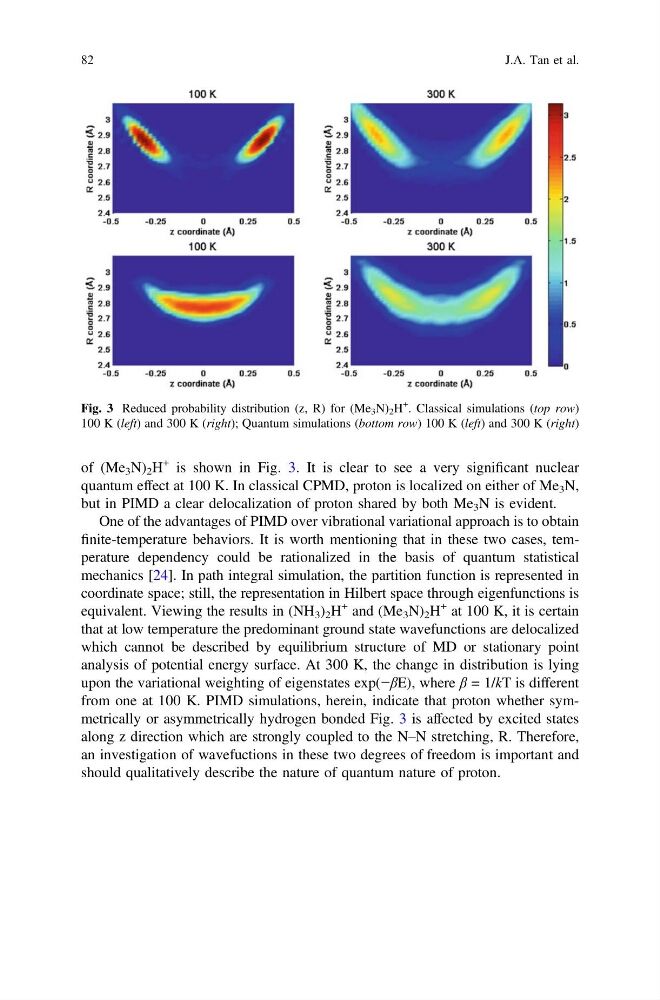
of (Me 3 N) 2 H
+ is shown in Fig. 3. It is clear to see a very significant nuclear
quantum effect at 100 K. In classical CPMD, proton is localized on either of Me 3 N,
but in PIMD a clear delocalization of proton shared by both Me 3 N is evident.
One of the advantages of PIMD over vibrational variational approach is to obtain
finite-temperature behaviors. It is worth mentioning that in these two cases, temperature dependency could be rationalized in the basis of quantum statistical
mechanics [24]. In path integral simulation, the partition function is represented in
coordinate space; still, the representation in Hilbert space through eigenfunctions is
equivalent. Viewing the results in (NH 3 ) 2 H
+ and (Me 3 N) 2 H
+ at 100 K, it is certain
that at low temperature the predominant ground state wavefunctions are delocalized
which cannot be described by equilibrium structure of MD or stationary point
analysis of potential energy surface. At 300 K, the change in distribution is lying
upon the variational weighting of eigenstates exp(−βE), where β = 1/kT is different
from one at 100 K. PIMD simulations, herein, indicate that proton whether symmetrically or asymmetrically hydrogen bonded Fig. 3 is affected by excited states
along z direction which are strongly coupled to the N–N stretching, R. Therefore,
an investigation of wavefuctions in these two degrees of freedom is important and
should qualitatively describe the nature of quantum nature of proton.
Fig. 3 Reduced probability distribution (z, R) for (Me 3 N) 2 H
+ . Classical simulations (top row)
100 K (left) and 300 K (right); Quantum simulations (bottom row) 100 K (left) and 300 K (right)
82
J.A. Tan et al.
+ is shown in Fig. 3. It is clear to see a very significant nuclear
quantum effect at 100 K. In classical CPMD, proton is localized on either of Me 3 N,
but in PIMD a clear delocalization of proton shared by both Me 3 N is evident.
One of the advantages of PIMD over vibrational variational approach is to obtain
finite-temperature behaviors. It is worth mentioning that in these two cases, temperature dependency could be rationalized in the basis of quantum statistical
mechanics [24]. In path integral simulation, the partition function is represented in
coordinate space; still, the representation in Hilbert space through eigenfunctions is
equivalent. Viewing the results in (NH 3 ) 2 H
+ and (Me 3 N) 2 H
+ at 100 K, it is certain
that at low temperature the predominant ground state wavefunctions are delocalized
which cannot be described by equilibrium structure of MD or stationary point
analysis of potential energy surface. At 300 K, the change in distribution is lying
upon the variational weighting of eigenstates exp(−βE), where β = 1/kT is different
from one at 100 K. PIMD simulations, herein, indicate that proton whether symmetrically or asymmetrically hydrogen bonded Fig. 3 is affected by excited states
along z direction which are strongly coupled to the N–N stretching, R. Therefore,
an investigation of wavefuctions in these two degrees of freedom is important and
should qualitatively describe the nature of quantum nature of proton.
Fig. 3 Reduced probability distribution (z, R) for (Me 3 N) 2 H
+ . Classical simulations (top row)
100 K (left) and 300 K (right); Quantum simulations (bottom row) 100 K (left) and 300 K (right)
82
J.A. Tan et al.