

2.3 Vibrational Hamiltonian at Reduced Dimensions
To account for the quantum effect of the nuclei and to compute spectra, one of the
most powerful approaches is to construct a vibrational Hamiltonian and solve the
corresponding Schrödinger equation. However, a full dimensional treatment is not
feasible for the systems we are interested in. In this work, we use a simple finite
difference method to treat the relevant degrees of freedom. The one-dimensional
vibrational Schrödinger equation is written as
^
HW ¼ À
h
2
2l z
d
2
W
dz 2
þ ^
U z
ð ÞW ¼ EW
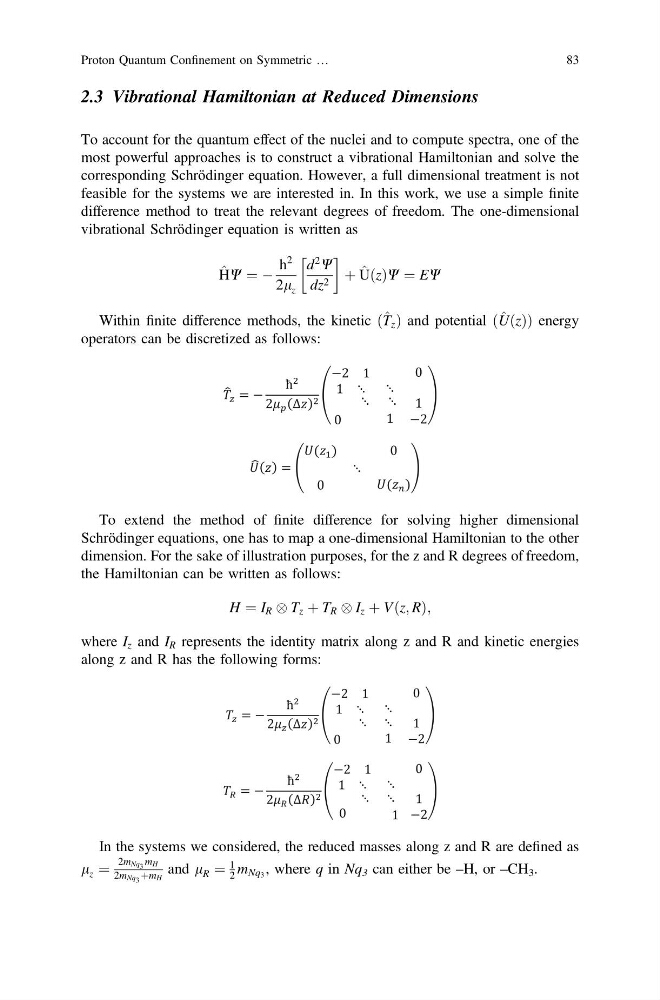
Within finite difference methods, the kinetic ð ^
T z Þ and potential ð ^
UðzÞÞ energy
operators can be discretized as follows:
To extend the method of finite difference for solving higher dimensional
Schrödinger equations, one has to map a one-dimensional Hamiltonian to the other
dimension. For the sake of illustration purposes, for the z and R degrees of freedom,
the Hamiltonian can be written as follows:
H ¼ I R T z þ T R I z þ Vðz; RÞ;
where I z and I R represents the identity matrix along z and R and kinetic energies
along z and R has the following forms:
In the systems we considered, the reduced masses along z and R are defined as
l z ¼
2m Nq 3 m H
2m Nq 3 þm H
and l R ¼
1
2 m Nq 3 , where q in Nq 3 can either be –H, or –CH 3 .
Proton Quantum Confinement on Symmetric …
83
To account for the quantum effect of the nuclei and to compute spectra, one of the
most powerful approaches is to construct a vibrational Hamiltonian and solve the
corresponding Schrödinger equation. However, a full dimensional treatment is not
feasible for the systems we are interested in. In this work, we use a simple finite
difference method to treat the relevant degrees of freedom. The one-dimensional
vibrational Schrödinger equation is written as
^
HW ¼ À
h
2
2l z
d
2
W
dz 2
þ ^
U z
ð ÞW ¼ EW
Within finite difference methods, the kinetic ð ^
T z Þ and potential ð ^
UðzÞÞ energy
operators can be discretized as follows:
To extend the method of finite difference for solving higher dimensional
Schrödinger equations, one has to map a one-dimensional Hamiltonian to the other
dimension. For the sake of illustration purposes, for the z and R degrees of freedom,
the Hamiltonian can be written as follows:
H ¼ I R T z þ T R I z þ Vðz; RÞ;
where I z and I R represents the identity matrix along z and R and kinetic energies
along z and R has the following forms:
In the systems we considered, the reduced masses along z and R are defined as
l z ¼
2m Nq 3 m H
2m Nq 3 þm H
and l R ¼
1
2 m Nq 3 , where q in Nq 3 can either be –H, or –CH 3 .
Proton Quantum Confinement on Symmetric …
83