

2.2 Ab Initio Path Integral Molecular Dynamics (PIMD)
The full dimensional treatment of nuclear degrees of freedom using PIMD could be
achieved via an efficient Car-Parrinello PIMD algorithm [22]. Owing to the inefficiency of plane-wave pseudopotential (PWP) method for exact exchange calculation,
electronic ground energy in current work is carried out on the fly using Becke-LeeYang-Parr (BLYP) exchange-correlation functional and Martins-Trouiller (MT)
normconserving pseudopotentials. Effectiveness of this standard method has been
well documented [23]. In our PIMD calculations, the number of Trotter slices
(P) was set to 32 or 16 in order to obtain sufficient convergence at temperatures 100
and 300 K. In addition, classical CPMD (that is P = 1) calculations were also
performed in the same protocol for comparisons. Statistical properties are collected
from six independent trajectories starting from uncorrelated structures.
In the case of protonated ammonia dimer (NH 3 ) 2 H
+
, classical CPMD simulations
show significant coupling between z and R and giving rise to the necessity of study
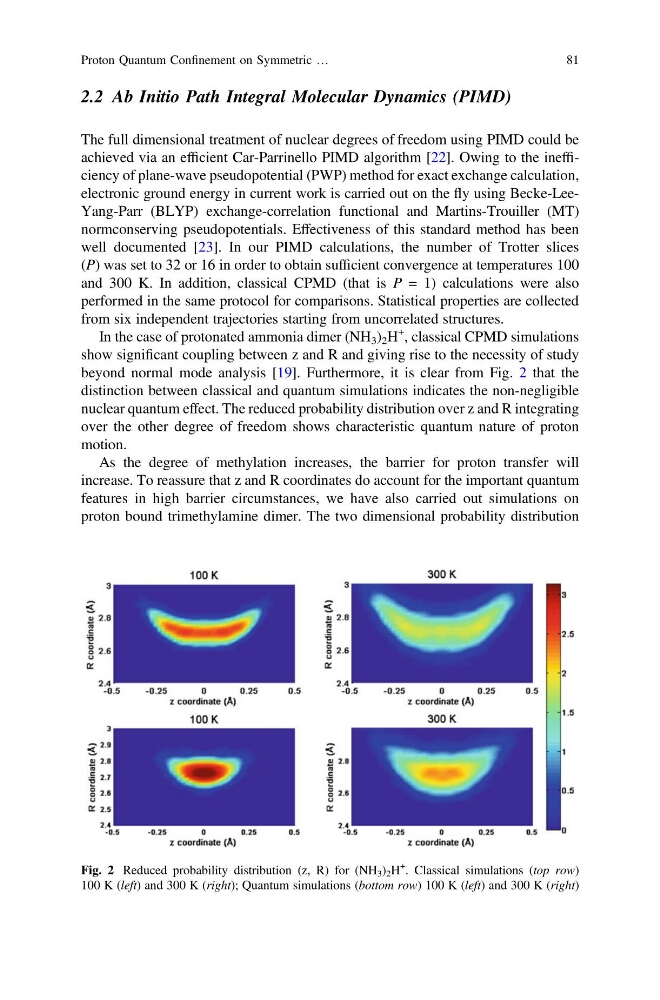
beyond normal mode analysis [19]. Furthermore, it is clear from Fig. 2 that the
distinction between classical and quantum simulations indicates the non-negligible
nuclear quantum effect. The reduced probability distribution over z and R integrating
over the other degree of freedom shows characteristic quantum nature of proton
motion.
As the degree of methylation increases, the barrier for proton transfer will
increase. To reassure that z and R coordinates do account for the important quantum
features in high barrier circumstances, we have also carried out simulations on
proton bound trimethylamine dimer. The two dimensional probability distribution
Fig. 2 Reduced probability distribution (z, R) for (NH 3 ) 2 H
+ . Classical simulations (top row)
100 K (left) and 300 K (right); Quantum simulations (bottom row) 100 K (left) and 300 K (right)
Proton Quantum Confinement on Symmetric …
81
The full dimensional treatment of nuclear degrees of freedom using PIMD could be
achieved via an efficient Car-Parrinello PIMD algorithm [22]. Owing to the inefficiency of plane-wave pseudopotential (PWP) method for exact exchange calculation,
electronic ground energy in current work is carried out on the fly using Becke-LeeYang-Parr (BLYP) exchange-correlation functional and Martins-Trouiller (MT)
normconserving pseudopotentials. Effectiveness of this standard method has been
well documented [23]. In our PIMD calculations, the number of Trotter slices
(P) was set to 32 or 16 in order to obtain sufficient convergence at temperatures 100
and 300 K. In addition, classical CPMD (that is P = 1) calculations were also
performed in the same protocol for comparisons. Statistical properties are collected
from six independent trajectories starting from uncorrelated structures.
In the case of protonated ammonia dimer (NH 3 ) 2 H
+
, classical CPMD simulations
show significant coupling between z and R and giving rise to the necessity of study
beyond normal mode analysis [19]. Furthermore, it is clear from Fig. 2 that the
distinction between classical and quantum simulations indicates the non-negligible
nuclear quantum effect. The reduced probability distribution over z and R integrating
over the other degree of freedom shows characteristic quantum nature of proton
motion.
As the degree of methylation increases, the barrier for proton transfer will
increase. To reassure that z and R coordinates do account for the important quantum
features in high barrier circumstances, we have also carried out simulations on
proton bound trimethylamine dimer. The two dimensional probability distribution
Fig. 2 Reduced probability distribution (z, R) for (NH 3 ) 2 H
+ . Classical simulations (top row)
100 K (left) and 300 K (right); Quantum simulations (bottom row) 100 K (left) and 300 K (right)
Proton Quantum Confinement on Symmetric …
81