

2.1 Density Functional Methods
All static ab initio calculations (geometry optimizations, transition state locations
and potential energy surface (PES) scan) were done using Gaussian 09 [21] under
B3LYP level of theory with 6-311+G(d,p) taken as the basis set. The definition of
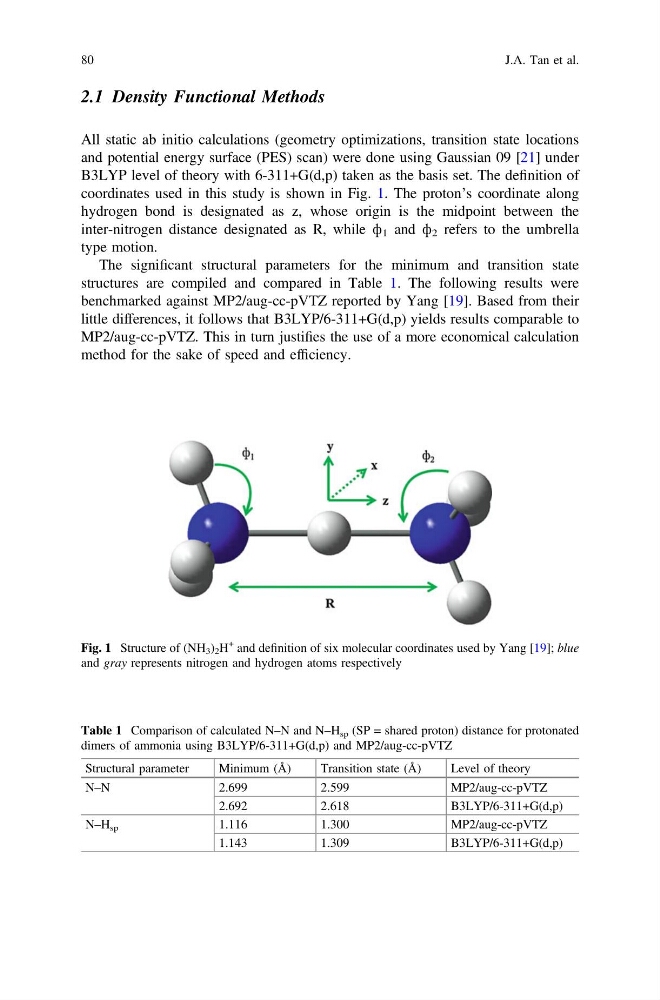
coordinates used in this study is shown in Fig. 1. The proton’s coordinate along
hydrogen bond is designated as z, whose origin is the midpoint between the
inter-nitrogen distance designated as R, while ф 1 and ф 2 refers to the umbrella
type motion.
The significant structural parameters for the minimum and transition state
structures are compiled and compared in Table 1. The following results were
benchmarked against MP2/aug-cc-pVTZ reported by Yang [19]. Based from their
little differences, it follows that B3LYP/6-311+G(d,p) yields results comparable to
MP2/aug-cc-pVTZ. This in turn justifies the use of a more economical calculation
method for the sake of speed and efficiency.
Fig. 1 Structure of (NH 3 ) 2 H
+ and definition of six molecular coordinates used by Yang [19]; blue
and gray represents nitrogen and hydrogen atoms respectively
Table 1 Comparison of calculated N–N and N–H sp (SP = shared proton) distance for protonated
dimers of ammonia using B3LYP/6-311+G(d,p) and MP2/aug-cc-pVTZ
Structural parameter
Minimum (Å)
Transition state (Å)
Level of theory
N–N
2.699
2.599
MP2/aug-cc-pVTZ
2.692
2.618
B3LYP/6-311+G(d,p)
N–H sp
1.116
1.300
MP2/aug-cc-pVTZ
1.143
1.309
B3LYP/6-311+G(d,p)
80
J.A. Tan et al.
All static ab initio calculations (geometry optimizations, transition state locations
and potential energy surface (PES) scan) were done using Gaussian 09 [21] under
B3LYP level of theory with 6-311+G(d,p) taken as the basis set. The definition of
coordinates used in this study is shown in Fig. 1. The proton’s coordinate along
hydrogen bond is designated as z, whose origin is the midpoint between the
inter-nitrogen distance designated as R, while ф 1 and ф 2 refers to the umbrella
type motion.
The significant structural parameters for the minimum and transition state
structures are compiled and compared in Table 1. The following results were
benchmarked against MP2/aug-cc-pVTZ reported by Yang [19]. Based from their
little differences, it follows that B3LYP/6-311+G(d,p) yields results comparable to
MP2/aug-cc-pVTZ. This in turn justifies the use of a more economical calculation
method for the sake of speed and efficiency.
Fig. 1 Structure of (NH 3 ) 2 H
+ and definition of six molecular coordinates used by Yang [19]; blue
and gray represents nitrogen and hydrogen atoms respectively
Table 1 Comparison of calculated N–N and N–H sp (SP = shared proton) distance for protonated
dimers of ammonia using B3LYP/6-311+G(d,p) and MP2/aug-cc-pVTZ
Structural parameter
Minimum (Å)
Transition state (Å)
Level of theory
N–N
2.699
2.599
MP2/aug-cc-pVTZ
2.692
2.618
B3LYP/6-311+G(d,p)
N–H sp
1.116
1.300
MP2/aug-cc-pVTZ
1.143
1.309
B3LYP/6-311+G(d,p)
80
J.A. Tan et al.