

often generate sand waves which tend to migrate in the
ebb direction, but they may also be modified by flood
currents.
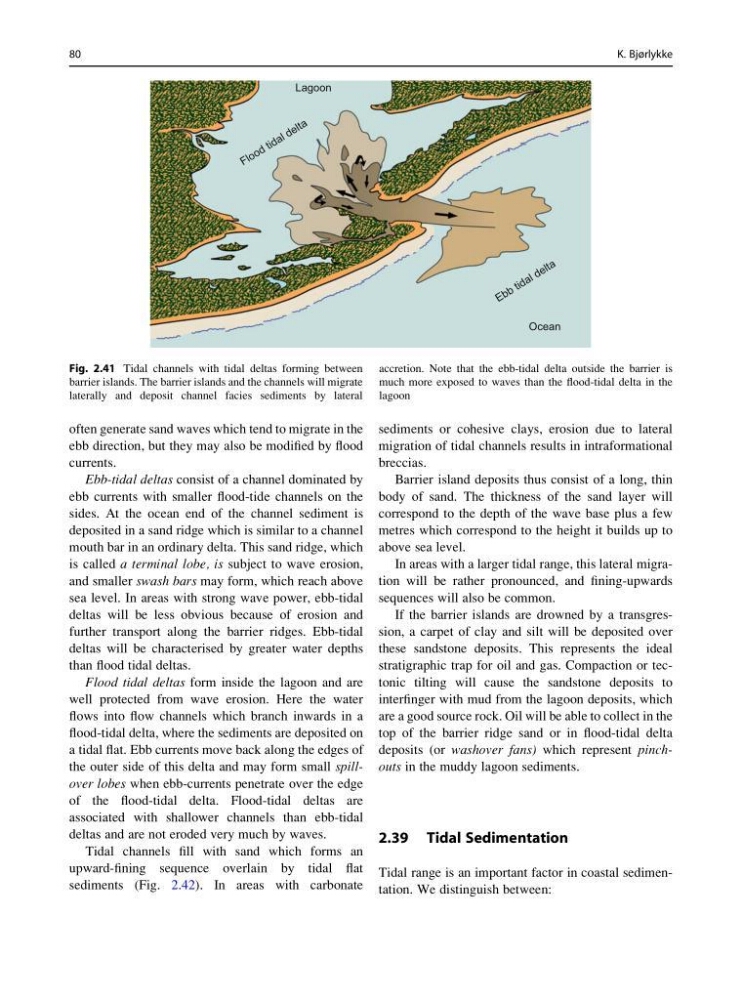
Ebb-tidal deltas consist of a channel dominated by
ebb currents with smaller flood-tide channels on the
sides. At the ocean end of the channel sediment is
deposited in a sand ridge which is similar to a channel
mouth bar in an ordinary delta. This sand ridge, which
is called a terminal lobe, is subject to wave erosion,
and smaller swash bars may form, which reach above
sea level. In areas with strong wave power, ebb-tidal
deltas will be less obvious because of erosion and
further transport along the barrier ridges. Ebb-tidal
deltas will be characterised by greater water depths
than flood tidal deltas.
Flood tidal deltas form inside the lagoon and are
well protected from wave erosion. Here the water
flows into flow channels which branch inwards in a
flood-tidal delta, where the sediments are deposited on
a tidal flat. Ebb currents move back along the edges of
the outer side of this delta and may form small spillover lobes when ebb-currents penetrate over the edge
of the flood-tidal delta. Flood-tidal deltas are
associated with shallower channels than ebb-tidal
deltas and are not eroded very much by waves.
Tidal channels fill with sand which forms an
upward-fining sequence overlain by tidal flat
sediments (Fig. 2.42). In areas with carbonate
sediments or cohesive clays, erosion due to lateral
migration of tidal channels results in intraformational
breccias.
Barrier island deposits thus consist of a long, thin
body of sand. The thickness of the sand layer will
correspond to the depth of the wave base plus a few
metres which correspond to the height it builds up to
above sea level.
In areas with a larger tidal range, this lateral migration will be rather pronounced, and fining-upwards
sequences will also be common.
If the barrier islands are drowned by a transgression, a carpet of clay and silt will be deposited over
these sandstone deposits. This represents the ideal
stratigraphic trap for oil and gas. Compaction or tectonic tilting will cause the sandstone deposits to
interfinger with mud from the lagoon deposits, which
are a good source rock. Oil will be able to collect in the
top of the barrier ridge sand or in flood-tidal delta
deposits (or washover fans) which represent pinchouts in the muddy lagoon sediments.
2.39 Tidal Sedimentation
Tidal range is an important factor in coastal sedimentation. We distinguish between:
F lo o d t id a l d e lt a
Lagoon
E b b t id a l d e lt a
Ocean
Fig. 2.41 Tidal channels with tidal deltas forming between
barrier islands. The barrier islands and the channels will migrate
laterally and deposit channel facies sediments by lateral
accretion. Note that the ebb-tidal delta outside the barrier is
much more exposed to waves than the flood-tidal delta in the
lagoon
80
K. Bjørlykke
ebb direction, but they may also be modified by flood
currents.
Ebb-tidal deltas consist of a channel dominated by
ebb currents with smaller flood-tide channels on the
sides. At the ocean end of the channel sediment is
deposited in a sand ridge which is similar to a channel
mouth bar in an ordinary delta. This sand ridge, which
is called a terminal lobe, is subject to wave erosion,
and smaller swash bars may form, which reach above
sea level. In areas with strong wave power, ebb-tidal
deltas will be less obvious because of erosion and
further transport along the barrier ridges. Ebb-tidal
deltas will be characterised by greater water depths
than flood tidal deltas.
Flood tidal deltas form inside the lagoon and are
well protected from wave erosion. Here the water
flows into flow channels which branch inwards in a
flood-tidal delta, where the sediments are deposited on
a tidal flat. Ebb currents move back along the edges of
the outer side of this delta and may form small spillover lobes when ebb-currents penetrate over the edge
of the flood-tidal delta. Flood-tidal deltas are
associated with shallower channels than ebb-tidal
deltas and are not eroded very much by waves.
Tidal channels fill with sand which forms an
upward-fining sequence overlain by tidal flat
sediments (Fig. 2.42). In areas with carbonate
sediments or cohesive clays, erosion due to lateral
migration of tidal channels results in intraformational
breccias.
Barrier island deposits thus consist of a long, thin
body of sand. The thickness of the sand layer will
correspond to the depth of the wave base plus a few
metres which correspond to the height it builds up to
above sea level.
In areas with a larger tidal range, this lateral migration will be rather pronounced, and fining-upwards
sequences will also be common.
If the barrier islands are drowned by a transgression, a carpet of clay and silt will be deposited over
these sandstone deposits. This represents the ideal
stratigraphic trap for oil and gas. Compaction or tectonic tilting will cause the sandstone deposits to
interfinger with mud from the lagoon deposits, which
are a good source rock. Oil will be able to collect in the
top of the barrier ridge sand or in flood-tidal delta
deposits (or washover fans) which represent pinchouts in the muddy lagoon sediments.
2.39 Tidal Sedimentation
Tidal range is an important factor in coastal sedimentation. We distinguish between:
F lo o d t id a l d e lt a
Lagoon
E b b t id a l d e lt a
Ocean
Fig. 2.41 Tidal channels with tidal deltas forming between
barrier islands. The barrier islands and the channels will migrate
laterally and deposit channel facies sediments by lateral
accretion. Note that the ebb-tidal delta outside the barrier is
much more exposed to waves than the flood-tidal delta in the
lagoon
80
K. Bjørlykke