

be transported across the lagoon, and must be added
along the length of the islands parallel to the coast
(strike-feeding from deltas or eroding coastlines).
During storms or hurricanes the sea level may rise
due to wind stress, and waves may break over and
through the barrier island. An erosion channel is then
formed through the island, and a washover fan delta
develops at the rear, out into the lagoon. A delta of this
type can form in a matter of hours during a hurricane.
Barrier islands may extend for tens of kilometres, but
they will not form a continuous belt along the coast.
Water has to circulate between the lagoons and the
ocean through gaps between barrier islands. The gaps
are called tidal inlets, and the distance between them
will be a function of the tidal range. Both seaward and
landward of the inlets small sandy deltas may develop
in response to ebb and flood currents respectively
(Fig. 2.41). Flow at ebb tide will normally be stronger
than that at flood tide. This is due to the profile of the
lagoons. At high water in the lagoon the volume of
water which must flow out to compensate for a specific
lowering of sea level is greater than the volume needed
to raise the water level in the lagoon correspondingly
at low tide when the area of the lagoon is smaller. The
tidal inlets are therefore capable of transporting more
sediment out during the ebb, and structures indicating
this flow direction may predominate (Fig. 2.41). Inlets
are characterised by an erosional base, and lateral
migration of inlets produces a characteristic finingupwards sequence. The strong currents in tidal inlets
1
2
Legend
Lagoon
3
4
5
5
4
3
2
1
6
6
7
7
S tr a ti g ra p h ic
u n it s
Relative sea-level rise
Ocean
Sea level
Transgression
7 - Nearshore marine
6 - Barrier
Holocene
5 - Back-barrier marsh
4 - Sublagoonal barrier
3 - Lagoon
2 - Fringing marsh
1 - Pre-holocene
Lagoon
5
1
1
2
3
4
6
4
3
2
Ocean
Sea level
Relative
sea-level
Change
Stratigraphic
units
5
6
Holocene
Legend
1 - Weathered,
2 - Laminated very fine
3 - Bored and bedded shoreface
4 - Nearshore marine, interbedded sands
barrier, very fine sands and silt
and silt-clay with shells
5 - Lagoonal, mixed sands and silt-clay
6 - Pre-holocene
Estimated time lines
barrier sands
laminated,
fine to very
fine barrier
sands
Estimated time lines
Regression
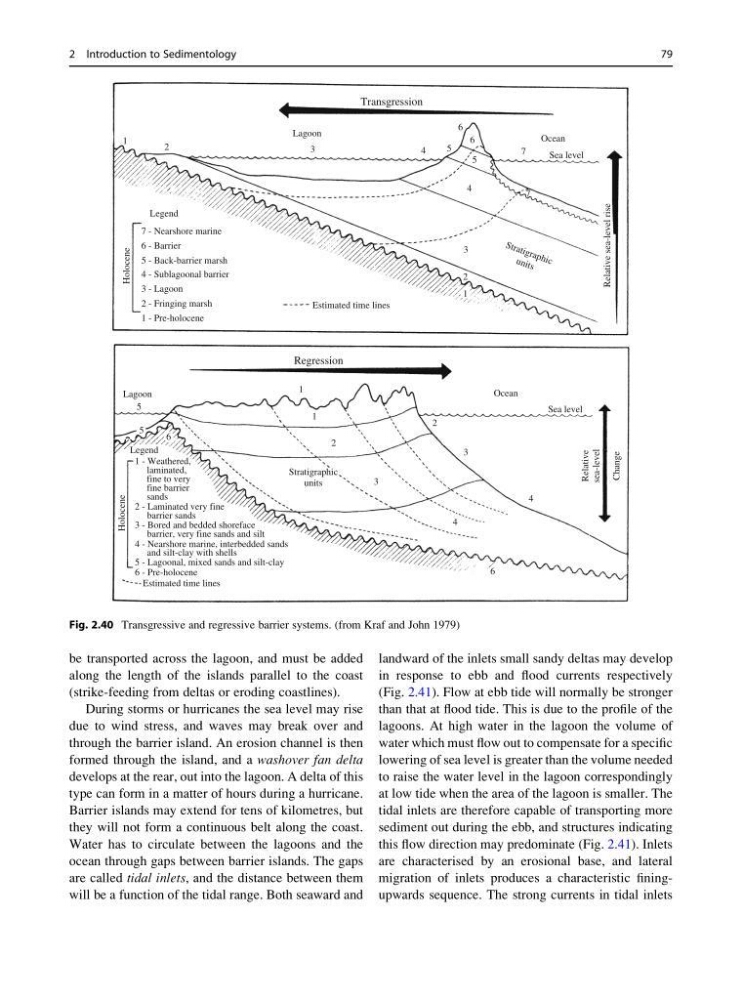
Fig. 2.40 Transgressive and regressive barrier systems. (from Kraf and John 1979)
2 Introduction to Sedimentology
79
along the length of the islands parallel to the coast
(strike-feeding from deltas or eroding coastlines).
During storms or hurricanes the sea level may rise
due to wind stress, and waves may break over and
through the barrier island. An erosion channel is then
formed through the island, and a washover fan delta
develops at the rear, out into the lagoon. A delta of this
type can form in a matter of hours during a hurricane.
Barrier islands may extend for tens of kilometres, but
they will not form a continuous belt along the coast.
Water has to circulate between the lagoons and the
ocean through gaps between barrier islands. The gaps
are called tidal inlets, and the distance between them
will be a function of the tidal range. Both seaward and
landward of the inlets small sandy deltas may develop
in response to ebb and flood currents respectively
(Fig. 2.41). Flow at ebb tide will normally be stronger
than that at flood tide. This is due to the profile of the
lagoons. At high water in the lagoon the volume of
water which must flow out to compensate for a specific
lowering of sea level is greater than the volume needed
to raise the water level in the lagoon correspondingly
at low tide when the area of the lagoon is smaller. The
tidal inlets are therefore capable of transporting more
sediment out during the ebb, and structures indicating
this flow direction may predominate (Fig. 2.41). Inlets
are characterised by an erosional base, and lateral
migration of inlets produces a characteristic finingupwards sequence. The strong currents in tidal inlets
1
2
Legend
Lagoon
3
4
5
5
4
3
2
1
6
6
7
7
S tr a ti g ra p h ic
u n it s
Relative sea-level rise
Ocean
Sea level
Transgression
7 - Nearshore marine
6 - Barrier
Holocene
5 - Back-barrier marsh
4 - Sublagoonal barrier
3 - Lagoon
2 - Fringing marsh
1 - Pre-holocene
Lagoon
5
1
1
2
3
4
6
4
3
2
Ocean
Sea level
Relative
sea-level
Change
Stratigraphic
units
5
6
Holocene
Legend
1 - Weathered,
2 - Laminated very fine
3 - Bored and bedded shoreface
4 - Nearshore marine, interbedded sands
barrier, very fine sands and silt
and silt-clay with shells
5 - Lagoonal, mixed sands and silt-clay
6 - Pre-holocene
Estimated time lines
barrier sands
laminated,
fine to very
fine barrier
sands
Estimated time lines
Regression
Fig. 2.40 Transgressive and regressive barrier systems. (from Kraf and John 1979)
2 Introduction to Sedimentology
79