

2.29 Delta Sedimentation
Large deltas require drainage areas with sufficient
precipitation to produce high runoff. They are formed
along passive plate margins where extensive drainage
systems can unite into large rivers. The greater part of
the drainage from North and South America and
Africa flows into the Atlantic Ocean. Only minor
rivers enter the Pacific Ocean from the American
continent, and relatively little of the drainage from
Africa enters the Indian Ocean. The major rivers follow old drainage systems, the main features of which
have existed since the Mesozoic, and which often
seem to have been governed by Mesozoic rifting
along the Atlantic continental margin.
As mentioned in connection with fluvial
sediments, the erosion area will determine the composition and grain size of the sediments which are
transported by rivers and deposited on the delta. The
Mississippi, for example, drains extensive tracts of
Palaeozoic and younger sediments which contain a
large percentage of shale, and the river therefore
transports a high percentage of clay and silt in suspension. Areas of metamorphic and acid eruptive
rocks will give sandier sediments because of their
quartz and feldspar contents. Deltas prograde outwards into a sedimentary basin and form a surface
called a delta top (delta plain) near the lake or ocean
level. The waves break against the delta front,
beyond which is the delta slope.
The formation of a delta can be depicted as a battle
between the fluvial development of the delta and its
erosion by marine forces. We therefore distinguish
first between river-dominated deltas, which prograde
far out into the basin and consist largely of fluvial
sediments, and deltas which are eroded more rapidly
by marine forces (tide and waves) and consist largely
of marine sediments (Fig. 2.31).
River-dominated deltas are often referred to as
constructive deltas, since they tend to prograde more
rapidly into the basin without much marine reworking.
Tide- and wave-dominated deltas are often called
destructive deltas.
We may therefore distinguish between three main
types of deltas: (1) river-dominated, (2) tidedominated and (3) wave-dominated. Most deltas fall
somewhere between these three extremes. The
Mississippi, however, comes near the river-dominated
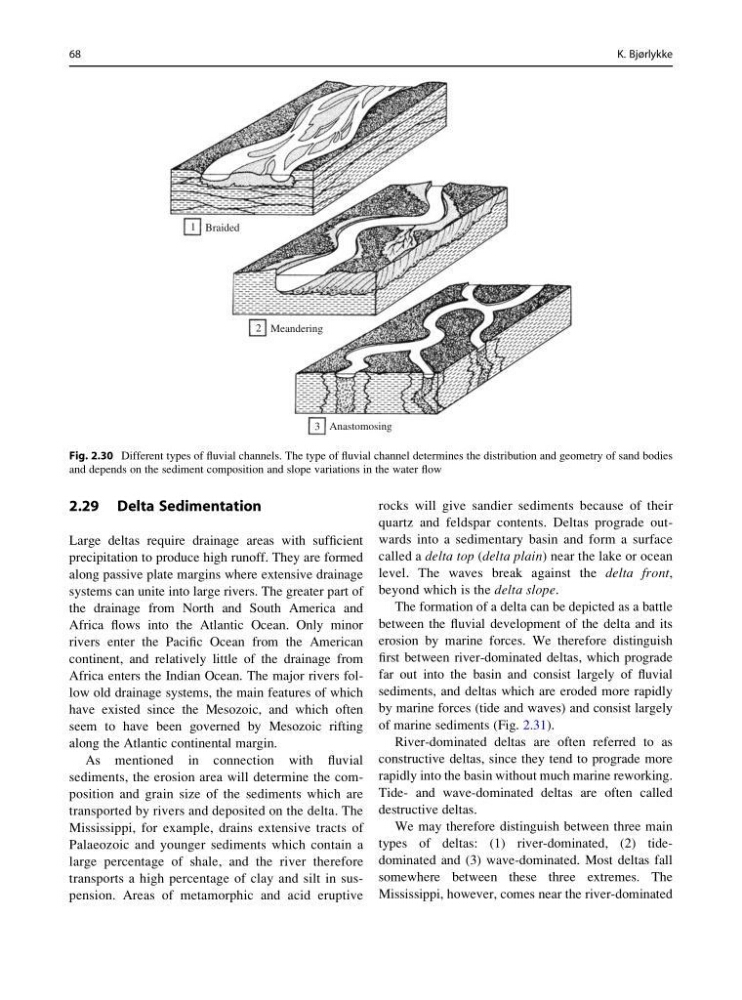
Braided
1
2
3
Meandering
Anastomosing
Fig. 2.30 Different types of fluvial channels. The type of fluvial channel determines the distribution and geometry of sand bodies
and depends on the sediment composition and slope variations in the water flow
68
K. Bjørlykke
Large deltas require drainage areas with sufficient
precipitation to produce high runoff. They are formed
along passive plate margins where extensive drainage
systems can unite into large rivers. The greater part of
the drainage from North and South America and
Africa flows into the Atlantic Ocean. Only minor
rivers enter the Pacific Ocean from the American
continent, and relatively little of the drainage from
Africa enters the Indian Ocean. The major rivers follow old drainage systems, the main features of which
have existed since the Mesozoic, and which often
seem to have been governed by Mesozoic rifting
along the Atlantic continental margin.
As mentioned in connection with fluvial
sediments, the erosion area will determine the composition and grain size of the sediments which are
transported by rivers and deposited on the delta. The
Mississippi, for example, drains extensive tracts of
Palaeozoic and younger sediments which contain a
large percentage of shale, and the river therefore
transports a high percentage of clay and silt in suspension. Areas of metamorphic and acid eruptive
rocks will give sandier sediments because of their
quartz and feldspar contents. Deltas prograde outwards into a sedimentary basin and form a surface
called a delta top (delta plain) near the lake or ocean
level. The waves break against the delta front,
beyond which is the delta slope.
The formation of a delta can be depicted as a battle
between the fluvial development of the delta and its
erosion by marine forces. We therefore distinguish
first between river-dominated deltas, which prograde
far out into the basin and consist largely of fluvial
sediments, and deltas which are eroded more rapidly
by marine forces (tide and waves) and consist largely
of marine sediments (Fig. 2.31).
River-dominated deltas are often referred to as
constructive deltas, since they tend to prograde more
rapidly into the basin without much marine reworking.
Tide- and wave-dominated deltas are often called
destructive deltas.
We may therefore distinguish between three main
types of deltas: (1) river-dominated, (2) tidedominated and (3) wave-dominated. Most deltas fall
somewhere between these three extremes. The
Mississippi, however, comes near the river-dominated
Braided
1
2
3
Meandering
Anastomosing
Fig. 2.30 Different types of fluvial channels. The type of fluvial channel determines the distribution and geometry of sand bodies
and depends on the sediment composition and slope variations in the water flow
68
K. Bjørlykke