

end in a marine environment because the sediments
are fine-grained and rather cohesive. The delta front is
also protected from big ocean waves by a shallow
shelf.
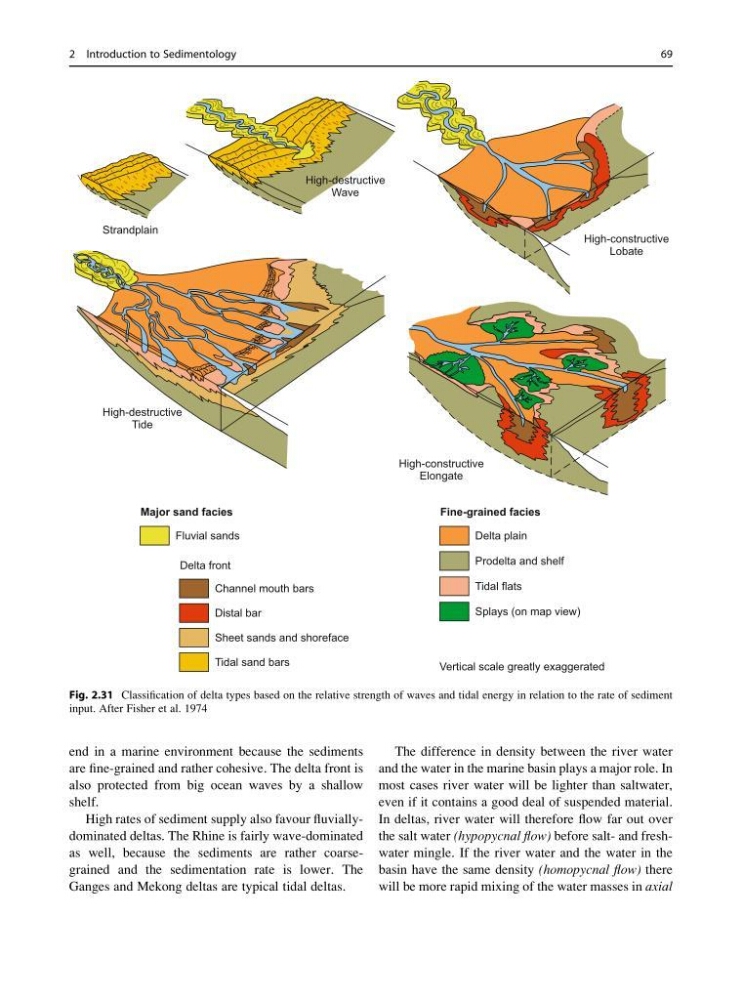
High rates of sediment supply also favour fluviallydominated deltas. The Rhine is fairly wave-dominated
as well, because the sediments are rather coarsegrained and the sedimentation rate is lower. The
Ganges and Mekong deltas are typical tidal deltas.
The difference in density between the river water
and the water in the marine basin plays a major role. In
most cases river water will be lighter than saltwater,
even if it contains a good deal of suspended material.
In deltas, river water will therefore flow far out over
the salt water (hypopycnal flow) before salt- and freshwater mingle. If the river water and the water in the
basin have the same density (homopycnal flow) there
will be more rapid mixing of the water masses in axial
Strandplain
High-destructive
Wave
High-constructive
Lobate
High-destructive
Tide
High-constructive
Elongate
Major sand facies
Fine-grained facies
Fluvial sands
Channel mouth bars
Distal bar
Sheet sands and shoreface
Tidal sand bars
Delta plain
Prodelta and shelf
Tidal flats
Splays (on map view)
Delta front
Vertical scale greatly exaggerated
Fig. 2.31 Classification of delta types based on the relative strength of waves and tidal energy in relation to the rate of sediment
input. After Fisher et al. 1974
2 Introduction to Sedimentology
69
are fine-grained and rather cohesive. The delta front is
also protected from big ocean waves by a shallow
shelf.
High rates of sediment supply also favour fluviallydominated deltas. The Rhine is fairly wave-dominated
as well, because the sediments are rather coarsegrained and the sedimentation rate is lower. The
Ganges and Mekong deltas are typical tidal deltas.
The difference in density between the river water
and the water in the marine basin plays a major role. In
most cases river water will be lighter than saltwater,
even if it contains a good deal of suspended material.
In deltas, river water will therefore flow far out over
the salt water (hypopycnal flow) before salt- and freshwater mingle. If the river water and the water in the
basin have the same density (homopycnal flow) there
will be more rapid mixing of the water masses in axial
Strandplain
High-destructive
Wave
High-constructive
Lobate
High-destructive
Tide
High-constructive
Elongate
Major sand facies
Fine-grained facies
Fluvial sands
Channel mouth bars
Distal bar
Sheet sands and shoreface
Tidal sand bars
Delta plain
Prodelta and shelf
Tidal flats
Splays (on map view)
Delta front
Vertical scale greatly exaggerated
Fig. 2.31 Classification of delta types based on the relative strength of waves and tidal energy in relation to the rate of sediment
input. After Fisher et al. 1974
2 Introduction to Sedimentology
69