

and of transport capacity outwards across the fan.
With fluvial transport, the velocity v and thereby transport capacity is both a function of the slope and the
depth (hydraulic radius) of the channels (see Chezy
equation, p. 42).
The velocity is therefore much higher during
flooding.
2.24.1 The Water Budget
A part of the total rainfall will sink into the ground and
supply the groundwater. Another part will evaporate
on the surface or flow on the surface into rivers
(Fig. 2.26). In hot, desert areas where the air is very
dry, evaporation may correspond to 2–3,000 mm/year,
i.e. more than the normal amount of precipitation in
most places. Plants also contribute to water loss
through transpiration, and in areas with vegetation,
evaporation and transpiration may reach up to
2,000 mm/ year. Without vegetation we find a significant amount of evaporation only when there is free
water or damp ground right up to the surface. Even if
the water table is shallow (less than 1 m), there is little
direct evaporation, but some water will be drawn up by
capillary forces and evaporate.
Plants are important in connection with evaporation
of groundwater as tree roots may penetrate more than
10 m below the surface. Trees can be a major drain on
groundwater reserves because they use water which
could otherwise have seeped into wells, rivers or lakes.
Dense forests may use water corresponding to
200–500 mm of precipitation. In areas with limited
water reserves it may consequently be necessary to
limit vegetation, particularly of varieties of trees and
bushes with a relatively high transpiration rate and no
useful function. However, vegetation is important for
stabilising the topsoil and thereby preventing erosion.
Much of the water evporated from vegetation may
return as rain locally. Vegetation may also have an
effect on the albedo, i.e. the amount of sunlight which
is reflected from the Earth’s surface, and this in turn
may affect the climate.
Runoff is the fraction of precipitation which reaches
the rivers. The percentage of precipitation which filters
down to and recharges the groundwater is of particular
Subsidence
Playa
lake
Alluvial
plain
Apex
Basement
block
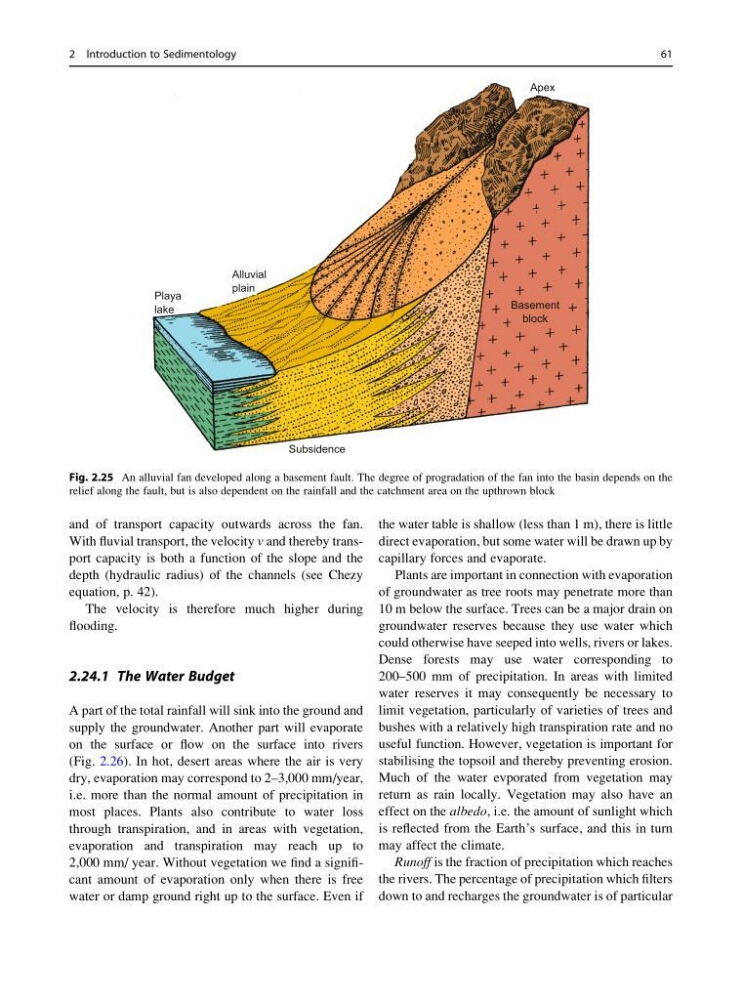
Fig. 2.25 An alluvial fan developed along a basement fault. The degree of progradation of the fan into the basin depends on the
relief along the fault, but is also dependent on the rainfall and the catchment area on the upthrown block
2 Introduction to Sedimentology
61
With fluvial transport, the velocity v and thereby transport capacity is both a function of the slope and the
depth (hydraulic radius) of the channels (see Chezy
equation, p. 42).
The velocity is therefore much higher during
flooding.
2.24.1 The Water Budget
A part of the total rainfall will sink into the ground and
supply the groundwater. Another part will evaporate
on the surface or flow on the surface into rivers
(Fig. 2.26). In hot, desert areas where the air is very
dry, evaporation may correspond to 2–3,000 mm/year,
i.e. more than the normal amount of precipitation in
most places. Plants also contribute to water loss
through transpiration, and in areas with vegetation,
evaporation and transpiration may reach up to
2,000 mm/ year. Without vegetation we find a significant amount of evaporation only when there is free
water or damp ground right up to the surface. Even if
the water table is shallow (less than 1 m), there is little
direct evaporation, but some water will be drawn up by
capillary forces and evaporate.
Plants are important in connection with evaporation
of groundwater as tree roots may penetrate more than
10 m below the surface. Trees can be a major drain on
groundwater reserves because they use water which
could otherwise have seeped into wells, rivers or lakes.
Dense forests may use water corresponding to
200–500 mm of precipitation. In areas with limited
water reserves it may consequently be necessary to
limit vegetation, particularly of varieties of trees and
bushes with a relatively high transpiration rate and no
useful function. However, vegetation is important for
stabilising the topsoil and thereby preventing erosion.
Much of the water evporated from vegetation may
return as rain locally. Vegetation may also have an
effect on the albedo, i.e. the amount of sunlight which
is reflected from the Earth’s surface, and this in turn
may affect the climate.
Runoff is the fraction of precipitation which reaches
the rivers. The percentage of precipitation which filters
down to and recharges the groundwater is of particular
Subsidence
Playa
lake
Alluvial
plain
Apex
Basement
block
Fig. 2.25 An alluvial fan developed along a basement fault. The degree of progradation of the fan into the basin depends on the
relief along the fault, but is also dependent on the rainfall and the catchment area on the upthrown block
2 Introduction to Sedimentology
61