

faults which keep uplifting the erosion area in relation
to the area of deposition. This tectonic subsidence of
the alluvial fans is a necessary condition for their
being preserved in the geological series. Alluvial fan
deposits in older rocks may therefore supply important
information about tectonic movements during deposition. Alluvial fans which have formed in areas with a
high relief but little tectonic activity, will merely represent a stage in the transport of the sediments. For
example, in glaciated areas we may find alluvial fans
on slopes steepened by glacial erosion. They will be
eroded again if they are not rapidly covered by a
transgression.
Erosion on the uplifted block will form V-shaped
valleys (or canyons), and these will drain into the
valley. The apex of the alluvial fan is usually near
the main fault plane and sediment transport from
here will tend to follow the steepest slope downwards
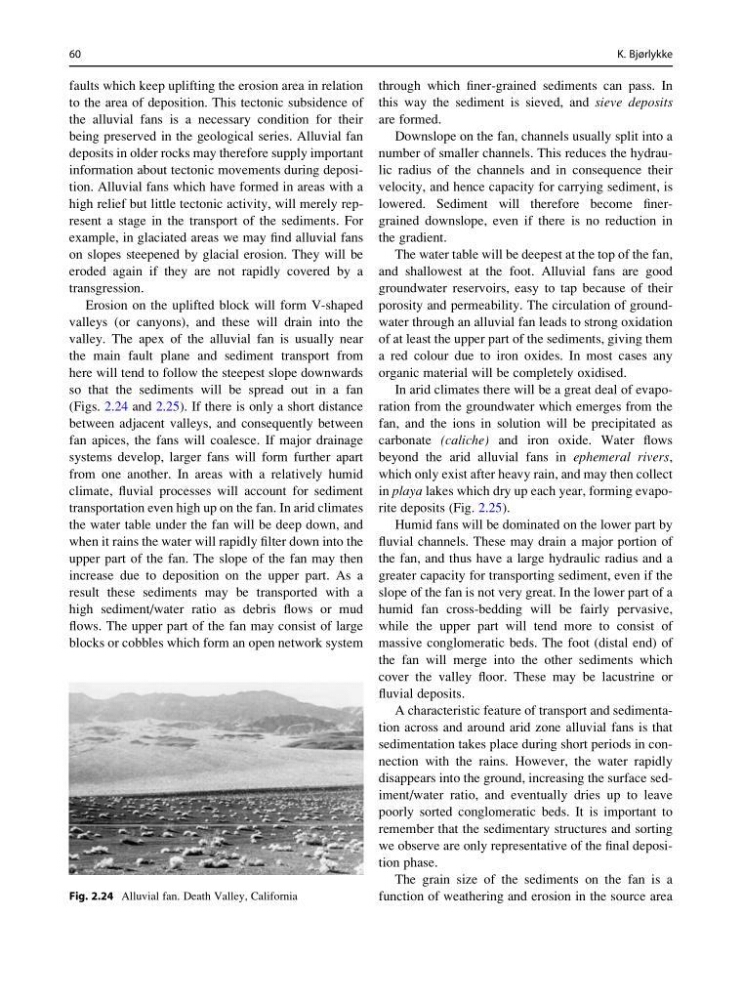
so that the sediments will be spread out in a fan
(Figs. 2.24 and 2.25). If there is only a short distance
between adjacent valleys, and consequently between
fan apices, the fans will coalesce. If major drainage
systems develop, larger fans will form further apart
from one another. In areas with a relatively humid
climate, fluvial processes will account for sediment
transportation even high up on the fan. In arid climates
the water table under the fan will be deep down, and
when it rains the water will rapidly filter down into the
upper part of the fan. The slope of the fan may then
increase due to deposition on the upper part. As a
result these sediments may be transported with a
high sediment/water ratio as debris flows or mud
flows. The upper part of the fan may consist of large
blocks or cobbles which form an open network system
through which finer-grained sediments can pass. In
this way the sediment is sieved, and sieve deposits
are formed.
Downslope on the fan, channels usually split into a
number of smaller channels. This reduces the hydraulic radius of the channels and in consequence their
velocity, and hence capacity for carrying sediment, is
lowered. Sediment will therefore become finergrained downslope, even if there is no reduction in
the gradient.
The water table will be deepest at the top of the fan,
and shallowest at the foot. Alluvial fans are good
groundwater reservoirs, easy to tap because of their
porosity and permeability. The circulation of groundwater through an alluvial fan leads to strong oxidation
of at least the upper part of the sediments, giving them
a red colour due to iron oxides. In most cases any
organic material will be completely oxidised.
In arid climates there will be a great deal of evaporation from the groundwater which emerges from the
fan, and the ions in solution will be precipitated as
carbonate (caliche) and iron oxide. Water flows
beyond the arid alluvial fans in ephemeral rivers,
which only exist after heavy rain, and may then collect
in playa lakes which dry up each year, forming evaporite deposits (Fig. 2.25).
Humid fans will be dominated on the lower part by
fluvial channels. These may drain a major portion of
the fan, and thus have a large hydraulic radius and a
greater capacity for transporting sediment, even if the
slope of the fan is not very great. In the lower part of a
humid fan cross-bedding will be fairly pervasive,
while the upper part will tend more to consist of
massive conglomeratic beds. The foot (distal end) of
the fan will merge into the other sediments which
cover the valley floor. These may be lacustrine or
fluvial deposits.
A characteristic feature of transport and sedimentation across and around arid zone alluvial fans is that
sedimentation takes place during short periods in connection with the rains. However, the water rapidly
disappears into the ground, increasing the surface sediment/water ratio, and eventually dries up to leave
poorly sorted conglomeratic beds. It is important to
remember that the sedimentary structures and sorting
we observe are only representative of the final deposition phase.
The grain size of the sediments on the fan is a
function of weathering and erosion in the source area
Fig. 2.24 Alluvial fan. Death Valley, California
60
K. Bjørlykke
to the area of deposition. This tectonic subsidence of
the alluvial fans is a necessary condition for their
being preserved in the geological series. Alluvial fan
deposits in older rocks may therefore supply important
information about tectonic movements during deposition. Alluvial fans which have formed in areas with a
high relief but little tectonic activity, will merely represent a stage in the transport of the sediments. For
example, in glaciated areas we may find alluvial fans
on slopes steepened by glacial erosion. They will be
eroded again if they are not rapidly covered by a
transgression.
Erosion on the uplifted block will form V-shaped
valleys (or canyons), and these will drain into the
valley. The apex of the alluvial fan is usually near
the main fault plane and sediment transport from
here will tend to follow the steepest slope downwards
so that the sediments will be spread out in a fan
(Figs. 2.24 and 2.25). If there is only a short distance
between adjacent valleys, and consequently between
fan apices, the fans will coalesce. If major drainage
systems develop, larger fans will form further apart
from one another. In areas with a relatively humid
climate, fluvial processes will account for sediment
transportation even high up on the fan. In arid climates
the water table under the fan will be deep down, and
when it rains the water will rapidly filter down into the
upper part of the fan. The slope of the fan may then
increase due to deposition on the upper part. As a
result these sediments may be transported with a
high sediment/water ratio as debris flows or mud
flows. The upper part of the fan may consist of large
blocks or cobbles which form an open network system
through which finer-grained sediments can pass. In
this way the sediment is sieved, and sieve deposits
are formed.
Downslope on the fan, channels usually split into a
number of smaller channels. This reduces the hydraulic radius of the channels and in consequence their
velocity, and hence capacity for carrying sediment, is
lowered. Sediment will therefore become finergrained downslope, even if there is no reduction in
the gradient.
The water table will be deepest at the top of the fan,
and shallowest at the foot. Alluvial fans are good
groundwater reservoirs, easy to tap because of their
porosity and permeability. The circulation of groundwater through an alluvial fan leads to strong oxidation
of at least the upper part of the sediments, giving them
a red colour due to iron oxides. In most cases any
organic material will be completely oxidised.
In arid climates there will be a great deal of evaporation from the groundwater which emerges from the
fan, and the ions in solution will be precipitated as
carbonate (caliche) and iron oxide. Water flows
beyond the arid alluvial fans in ephemeral rivers,
which only exist after heavy rain, and may then collect
in playa lakes which dry up each year, forming evaporite deposits (Fig. 2.25).
Humid fans will be dominated on the lower part by
fluvial channels. These may drain a major portion of
the fan, and thus have a large hydraulic radius and a
greater capacity for transporting sediment, even if the
slope of the fan is not very great. In the lower part of a
humid fan cross-bedding will be fairly pervasive,
while the upper part will tend more to consist of
massive conglomeratic beds. The foot (distal end) of
the fan will merge into the other sediments which
cover the valley floor. These may be lacustrine or
fluvial deposits.
A characteristic feature of transport and sedimentation across and around arid zone alluvial fans is that
sedimentation takes place during short periods in connection with the rains. However, the water rapidly
disappears into the ground, increasing the surface sediment/water ratio, and eventually dries up to leave
poorly sorted conglomeratic beds. It is important to
remember that the sedimentary structures and sorting
we observe are only representative of the final deposition phase.
The grain size of the sediments on the fan is a
function of weathering and erosion in the source area
Fig. 2.24 Alluvial fan. Death Valley, California
60
K. Bjørlykke