

have acted in the environment in which the rock was
deposited. The sedimentary structures we observe tell
us something of the hydrodynamic conditions during
deposition. Organic structures and fossil content help
us reconstruct the ecological conditions at the time of
deposition in the basin. Evidence of chemical processes such as weathering, diagenesis and precipitation of authigenic minerals also supply important
information about the depositional environment, as
well as its early post-depositional history. Figure
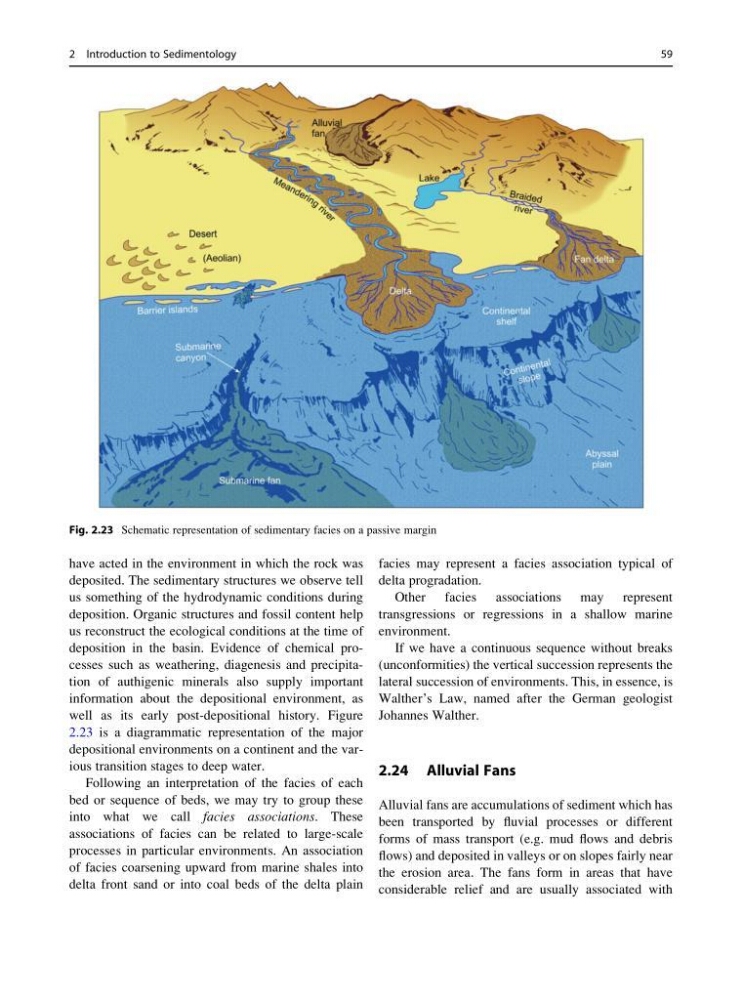
2.23 is a diagrammatic representation of the major
depositional environments on a continent and the various transition stages to deep water.
Following an interpretation of the facies of each
bed or sequence of beds, we may try to group these
into what we call facies associations. These
associations of facies can be related to large-scale
processes in particular environments. An association
of facies coarsening upward from marine shales into
delta front sand or into coal beds of the delta plain
facies may represent a facies association typical of
delta progradation.
Other facies associations may represent
transgressions or regressions in a shallow marine
environment.
If we have a continuous sequence without breaks
(unconformities) the vertical succession represents the
lateral succession of environments. This, in essence, is
Walther’s Law, named after the German geologist
Johannes Walther.
2.24 Alluvial Fans
Alluvial fans are accumulations of sediment which has
been transported by fluvial processes or different
forms of mass transport (e.g. mud flows and debris
flows) and deposited in valleys or on slopes fairly near
the erosion area. The fans form in areas that have
considerable relief and are usually associated with
Fig. 2.23 Schematic representation of sedimentary facies on a passive margin
2 Introduction to Sedimentology
59
deposited. The sedimentary structures we observe tell
us something of the hydrodynamic conditions during
deposition. Organic structures and fossil content help
us reconstruct the ecological conditions at the time of
deposition in the basin. Evidence of chemical processes such as weathering, diagenesis and precipitation of authigenic minerals also supply important
information about the depositional environment, as
well as its early post-depositional history. Figure
2.23 is a diagrammatic representation of the major
depositional environments on a continent and the various transition stages to deep water.
Following an interpretation of the facies of each
bed or sequence of beds, we may try to group these
into what we call facies associations. These
associations of facies can be related to large-scale
processes in particular environments. An association
of facies coarsening upward from marine shales into
delta front sand or into coal beds of the delta plain
facies may represent a facies association typical of
delta progradation.
Other facies associations may represent
transgressions or regressions in a shallow marine
environment.
If we have a continuous sequence without breaks
(unconformities) the vertical succession represents the
lateral succession of environments. This, in essence, is
Walther’s Law, named after the German geologist
Johannes Walther.
2.24 Alluvial Fans
Alluvial fans are accumulations of sediment which has
been transported by fluvial processes or different
forms of mass transport (e.g. mud flows and debris
flows) and deposited in valleys or on slopes fairly near
the erosion area. The fans form in areas that have
considerable relief and are usually associated with
Fig. 2.23 Schematic representation of sedimentary facies on a passive margin
2 Introduction to Sedimentology
59