

importance. Rivers also have groundwater added to
them if their surface is below the water table. If their
surface is above the water table they will lose water. In
consequence, rivers cannot be considered in isolation
from groundwater reserves.
Infiltration of surface water into the ground
depends on the permeability of the soil cover and on
the vegetation. Clayey sediments allow far slower
infiltration of surface water than sand or gravel.
Where there are soil types with swelling clay (smectite
group), which are very common in desert areas, the
first rains will cause these minerals to swell, further
reducing their permeability. Consequently, infiltration
is reduced, and the runoff which creates floods
increases. If the earth is dry above groundwater
level, water has to overcome the capillary forces
which act against water percolating down through
dry, fine-grained sediments. We may find a layer
with air in the pores between the groundwater table
and the water filtering down from above (trapped air).
Alluvial fans are porous and have a relatively good
potential as water reservoirs, and we often find springs
at the foot of fans. In dry areas the depth to the water
table can be most simply charted through seismic
recordings.
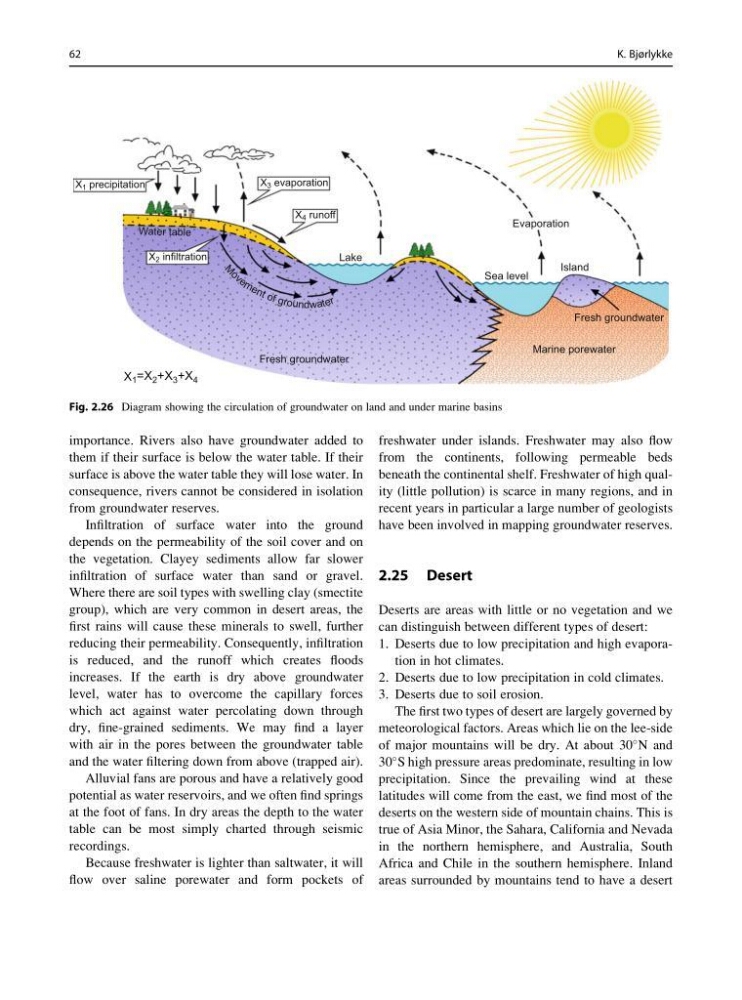
Because freshwater is lighter than saltwater, it will
flow over saline porewater and form pockets of
freshwater under islands. Freshwater may also flow
from the continents, following permeable beds
beneath the continental shelf. Freshwater of high quality (little pollution) is scarce in many regions, and in
recent years in particular a large number of geologists
have been involved in mapping groundwater reserves.
2.25 Desert
Deserts are areas with little or no vegetation and we
can distinguish between different types of desert:
1. Deserts due to low precipitation and high evaporation in hot climates.
2. Deserts due to low precipitation in cold climates.
3. Deserts due to soil erosion.
The first two types of desert are largely governed by
meteorological factors. Areas which lie on the lee-side
of major mountains will be dry. At about 30
N and
30
S high pressure areas predominate, resulting in low
precipitation. Since the prevailing wind at these
latitudes will come from the east, we find most of the
deserts on the western side of mountain chains. This is
true of Asia Minor, the Sahara, California and Nevada
in the northern hemisphere, and Australia, South
Africa and Chile in the southern hemisphere. Inland
areas surrounded by mountains tend to have a desert
Water table
Fresh groundwater
M
o v e m e n t o f g
r
ro
e
u
t
n a
dw
X evaporation
3
X runoff
4
X infiltration
2
X precipitation
1
Lake
Sea level
Island
Evaporation
Fresh groundwater
Marine porewater
=X +X +X
X 1 2 3 4
Fig. 2.26 Diagram showing the circulation of groundwater on land and under marine basins
62
K. Bjørlykke
them if their surface is below the water table. If their
surface is above the water table they will lose water. In
consequence, rivers cannot be considered in isolation
from groundwater reserves.
Infiltration of surface water into the ground
depends on the permeability of the soil cover and on
the vegetation. Clayey sediments allow far slower
infiltration of surface water than sand or gravel.
Where there are soil types with swelling clay (smectite
group), which are very common in desert areas, the
first rains will cause these minerals to swell, further
reducing their permeability. Consequently, infiltration
is reduced, and the runoff which creates floods
increases. If the earth is dry above groundwater
level, water has to overcome the capillary forces
which act against water percolating down through
dry, fine-grained sediments. We may find a layer
with air in the pores between the groundwater table
and the water filtering down from above (trapped air).
Alluvial fans are porous and have a relatively good
potential as water reservoirs, and we often find springs
at the foot of fans. In dry areas the depth to the water
table can be most simply charted through seismic
recordings.
Because freshwater is lighter than saltwater, it will
flow over saline porewater and form pockets of
freshwater under islands. Freshwater may also flow
from the continents, following permeable beds
beneath the continental shelf. Freshwater of high quality (little pollution) is scarce in many regions, and in
recent years in particular a large number of geologists
have been involved in mapping groundwater reserves.
2.25 Desert
Deserts are areas with little or no vegetation and we
can distinguish between different types of desert:
1. Deserts due to low precipitation and high evaporation in hot climates.
2. Deserts due to low precipitation in cold climates.
3. Deserts due to soil erosion.
The first two types of desert are largely governed by
meteorological factors. Areas which lie on the lee-side
of major mountains will be dry. At about 30
N and
30
S high pressure areas predominate, resulting in low
precipitation. Since the prevailing wind at these
latitudes will come from the east, we find most of the
deserts on the western side of mountain chains. This is
true of Asia Minor, the Sahara, California and Nevada
in the northern hemisphere, and Australia, South
Africa and Chile in the southern hemisphere. Inland
areas surrounded by mountains tend to have a desert
Water table
Fresh groundwater
M
o v e m e n t o f g
r
ro
e
u
t
n a
dw
X evaporation
3
X runoff
4
X infiltration
2
X precipitation
1
Lake
Sea level
Island
Evaporation
Fresh groundwater
Marine porewater
=X +X +X
X 1 2 3 4
Fig. 2.26 Diagram showing the circulation of groundwater on land and under marine basins
62
K. Bjørlykke