

Sea and Barents Sea. In all areas fourth generation
exploration has resulted in new successful play types
that clearly demonstrate that the maturity of the shelf
was fiction due to lack of exploration drilling.
Examples of new discoveries are the Alvheim, Edvard
Grieg, Ivar Aasen, Johan Sverdrup, Johan Castberg,
Wisting and Gohta fields and discoveries.
Prior to the Alvheim oil field discovery in 2003 the
prospects were assumed to be gas tie-in satellites to the
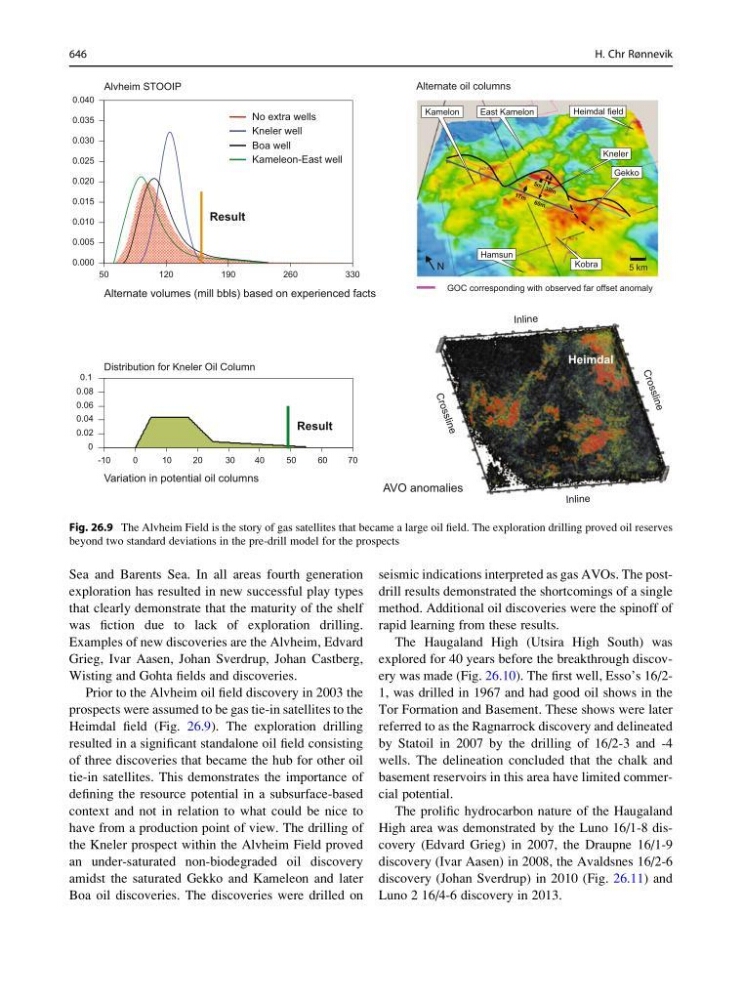
Heimdal field (Fig. 26.9). The exploration drilling
resulted in a significant standalone oil field consisting
of three discoveries that became the hub for other oil
tie-in satellites. This demonstrates the importance of
defining the resource potential in a subsurface-based
context and not in relation to what could be nice to
have from a production point of view. The drilling of
the Kneler prospect within the Alvheim Field proved
an under-saturated non-biodegraded oil discovery
amidst the saturated Gekko and Kameleon and later
Boa oil discoveries. The discoveries were drilled on
seismic indications interpreted as gas AVOs. The postdrill results demonstrated the shortcomings of a single
method. Additional oil discoveries were the spinoff of
rapid learning from these results.
The Haugaland High (Utsira High South) was
explored for 40 years before the breakthrough discovery was made (Fig. 26.10). The first well, Esso’s 16/21, was drilled in 1967 and had good oil shows in the
Tor Formation and Basement. These shows were later
referred to as the Ragnarrock discovery and delineated
by Statoil in 2007 by the drilling of 16/2-3 and -4
wells. The delineation concluded that the chalk and
basement reservoirs in this area have limited commercial potential.
The prolific hydrocarbon nature of the Haugaland
High area was demonstrated by the Luno 16/1-8 discovery (Edvard Grieg) in 2007, the Draupne 16/1-9
discovery (Ivar Aasen) in 2008, the Avaldsnes 16/2-6
discovery (Johan Sverdrup) in 2010 (Fig. 26.11) and
Luno 2 16/4-6 discovery in 2013.
0.000
50
-10
0
10
20
30
40
50
60
70
120
190
260
330
Distribution for Kneler Oil Column
0
0.02
0.04
0.06
0.1
0.08
Alvheim STOOIP
Inline
C ro s s li n e
C ro s s li n e
Inline
0.005
0.010
0.015
0.020
0.025
0.030
0.035
0.040
No extra wells
Kneler well
Boa well
Kameleon-East well
Boa
5 km
17 m
5m
60 m
30 m
Result
Result
Alternate volumes (mill bbls) based on experienced facts
Variation in potential oil columns
AVO anomalies
Alternate oil columns
GOC corresponding with observed far offset anomaly
Heimdal
N
Heimdal field
Kamelon
East Kamelon
Hamsun
Gekko
Kobra
Kneler
Fig. 26.9 The Alvheim Field is the story of gas satellites that became a large oil field. The exploration drilling proved oil reserves
beyond two standard deviations in the pre-drill model for the prospects
646
H. Chr Rønnevik