

negotiations for each new licence in order to secure the
necessary funding of seismic and drilling activities
considered necessary from a national point of view.
A mixture of established and new plays where selected
in the various allocations rounds. This early period
included the Statfjord allocation, and the third, fourth,
fifth, sixth, seventh and eighth concession rounds. The
fourth and subsequent rounds were designed after the
Jurassic had been established as the third major play
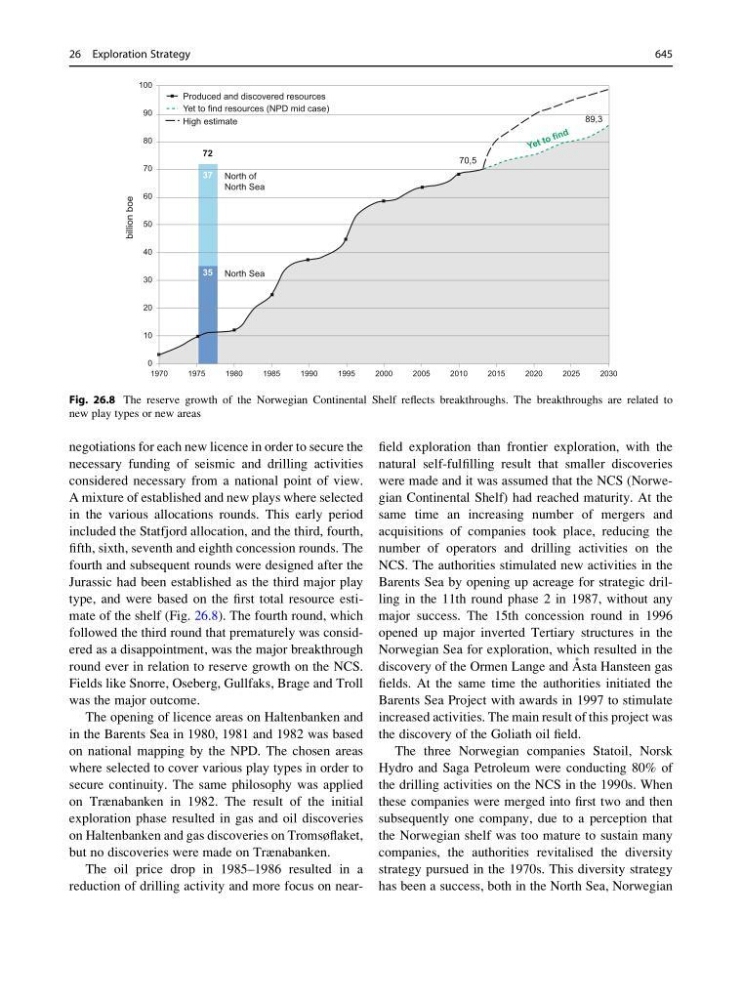
type, and were based on the first total resource estimate of the shelf (Fig. 26.8). The fourth round, which
followed the third round that prematurely was considered as a disappointment, was the major breakthrough
round ever in relation to reserve growth on the NCS.
Fields like Snorre, Oseberg, Gullfaks, Brage and Troll
was the major outcome.
The opening of licence areas on Haltenbanken and
in the Barents Sea in 1980, 1981 and 1982 was based
on national mapping by the NPD. The chosen areas
where selected to cover various play types in order to
secure continuity. The same philosophy was applied
on Trænabanken in 1982. The result of the initial
exploration phase resulted in gas and oil discoveries
on Haltenbanken and gas discoveries on Tromsøflaket,
but no discoveries were made on Trænabanken.
The oil price drop in 1985–1986 resulted in a
reduction of drilling activity and more focus on nearfield exploration than frontier exploration, with the
natural self-fulfilling result that smaller discoveries
were made and it was assumed that the NCS (Norwegian Continental Shelf) had reached maturity. At the
same time an increasing number of mergers and
acquisitions of companies took place, reducing the
number of operators and drilling activities on the
NCS. The authorities stimulated new activities in the
Barents Sea by opening up acreage for strategic drilling in the 11th round phase 2 in 1987, without any
major success. The 15th concession round in 1996
opened up major inverted Tertiary structures in the
Norwegian Sea for exploration, which resulted in the
discovery of the Ormen Lange and A ˚ sta Hansteen gas
fields. At the same time the authorities initiated the
Barents Sea Project with awards in 1997 to stimulate
increased activities. The main result of this project was
the discovery of the Goliath oil field.
The three Norwegian companies Statoil, Norsk
Hydro and Saga Petroleum were conducting 80% of
the drilling activities on the NCS in the 1990s. When
these companies were merged into first two and then
subsequently one company, due to a perception that
the Norwegian shelf was too mature to sustain many
companies, the authorities revitalised the diversity
strategy pursued in the 1970s. This diversity strategy
has been a success, both in the North Sea, Norwegian
billion boe
1970
Produced and discovered resources
Yet to find resources (NPD mid case)
High estimate
100
90
80
70
60
50
40
30
20
10
0
1975
35
37
72
1980
1985
1990
1995
2000
2005
2010
2015
2020
2025
2030
North of
North Sea
North Sea
70,5
89,3
Y e t to fi n d
Fig. 26.8 The reserve growth of the Norwegian Continental Shelf reflects breakthroughs. The breakthroughs are related to
new play types or new areas
26 Exploration Strategy
645