

speed of the team depends on the quality of the
relations between humans.
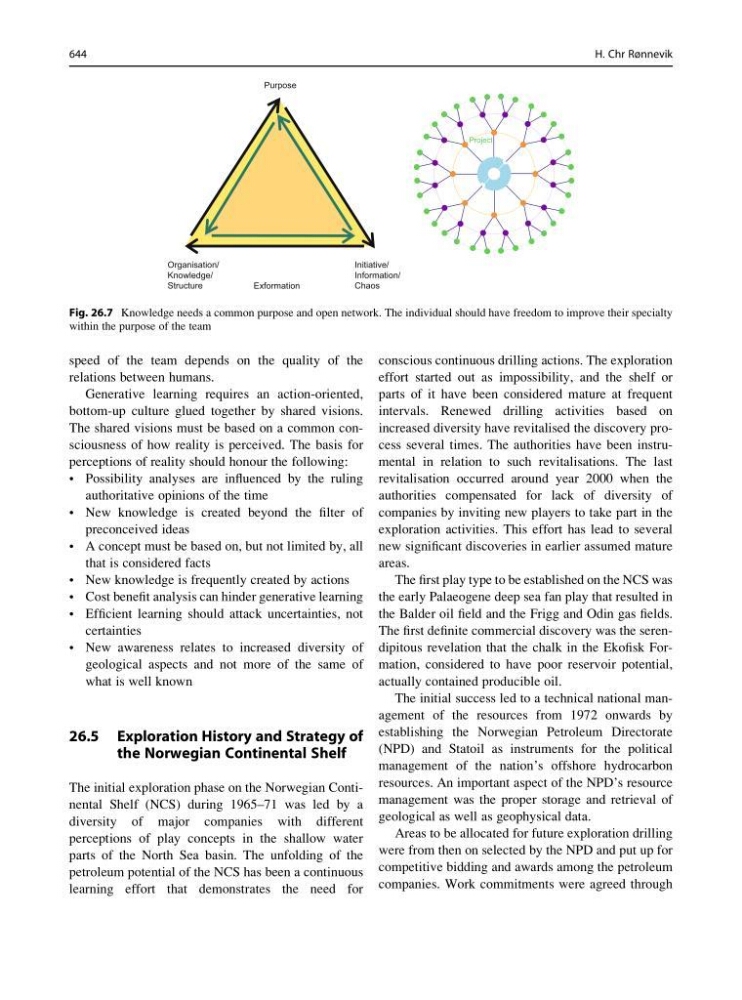
Generative learning requires an action-oriented,
bottom-up culture glued together by shared visions.
The shared visions must be based on a common consciousness of how reality is perceived. The basis for
perceptions of reality should honour the following:
• Possibility analyses are influenced by the ruling
authoritative opinions of the time
• New knowledge is created beyond the filter of
preconceived ideas
• A concept must be based on, but not limited by, all
that is considered facts
• New knowledge is frequently created by actions
• Cost benefit analysis can hinder generative learning
• Efficient learning should attack uncertainties, not
certainties
• New awareness relates to increased diversity of
geological aspects and not more of the same of
what is well known
26.5 Exploration History and Strategy of
the Norwegian Continental Shelf
The initial exploration phase on the Norwegian Continental Shelf (NCS) during 1965–71 was led by a
diversity of major companies with different
perceptions of play concepts in the shallow water
parts of the North Sea basin. The unfolding of the
petroleum potential of the NCS has been a continuous
learning effort that demonstrates the need for
conscious continuous drilling actions. The exploration
effort started out as impossibility, and the shelf or
parts of it have been considered mature at frequent
intervals. Renewed drilling activities based on
increased diversity have revitalised the discovery process several times. The authorities have been instrumental in relation to such revitalisations. The last
revitalisation occurred around year 2000 when the
authorities compensated for lack of diversity of
companies by inviting new players to take part in the
exploration activities. This effort has lead to several
new significant discoveries in earlier assumed mature
areas.
The first play type to be established on the NCS was
the early Palaeogene deep sea fan play that resulted in
the Balder oil field and the Frigg and Odin gas fields.
The first definite commercial discovery was the serendipitous revelation that the chalk in the Ekofisk Formation, considered to have poor reservoir potential,
actually contained producible oil.
The initial success led to a technical national management of the resources from 1972 onwards by
establishing the Norwegian Petroleum Directorate
(NPD) and Statoil as instruments for the political
management of the nation’s offshore hydrocarbon
resources. An important aspect of the NPD’s resource
management was the proper storage and retrieval of
geological as well as geophysical data.
Areas to be allocated for future exploration drilling
were from then on selected by the NPD and put up for
competitive bidding and awards among the petroleum
companies. Work commitments were agreed through
Purpose
Project
Exformation
Organisation/
Knowledge/
Structure
Initiative/
Information/
Chaos
Fig. 26.7 Knowledge needs a common purpose and open network. The individual should have freedom to improve their specialty
within the purpose of the team
644
H. Chr Rønnevik