

The Edvard Grieg and Johan Sverdrup discoveries
on the Haugaland High contain under-saturated nonbiodegraded oil originating from the same Draupne
formation source rocks. These discoveries flank the
saturated biodegraded Ragnarrock discovery at the
crest of the high.
The pre-drill possibilities for oil in the Johan
Sverdrup discovery were considered remote by most
companies, but the possibility of an oil-filled reservoir
was backed up with seismic indications of
hydrocarbons venting vertically into the overlying
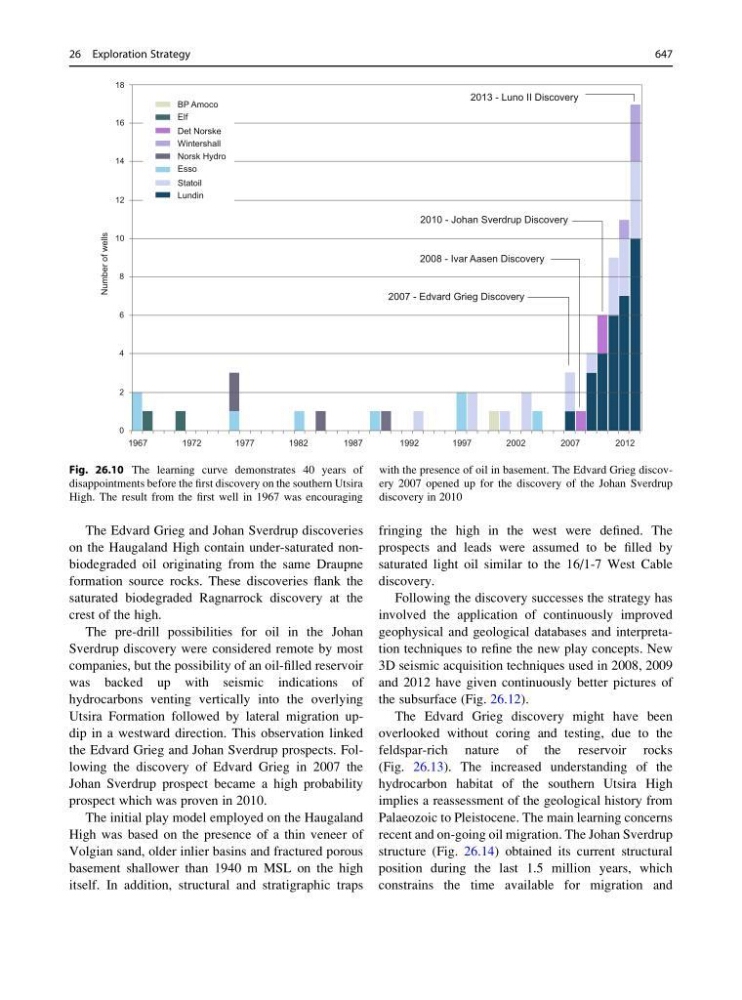
Utsira Formation followed by lateral migration updip in a westward direction. This observation linked
the Edvard Grieg and Johan Sverdrup prospects. Following the discovery of Edvard Grieg in 2007 the
Johan Sverdrup prospect became a high probability
prospect which was proven in 2010.
The initial play model employed on the Haugaland
High was based on the presence of a thin veneer of
Volgian sand, older inlier basins and fractured porous
basement shallower than 1940 m MSL on the high
itself. In addition, structural and stratigraphic traps
fringing the high in the west were defined. The
prospects and leads were assumed to be filled by
saturated light oil similar to the 16/1-7 West Cable
discovery.
Following the discovery successes the strategy has
involved the application of continuously improved
geophysical and geological databases and interpretation techniques to refine the new play concepts. New
3D seismic acquisition techniques used in 2008, 2009
and 2012 have given continuously better pictures of
the subsurface (Fig. 26.12).
The Edvard Grieg discovery might have been
overlooked without coring and testing, due to the
feldspar-rich nature of the reservoir rocks
(Fig. 26.13). The increased understanding of the
hydrocarbon habitat of the southern Utsira High
implies a reassessment of the geological history from
Palaeozoic to Pleistocene. The main learning concerns
recent and on-going oil migration. The Johan Sverdrup
structure (Fig. 26.14) obtained its current structural
position during the last 1.5 million years, which
constrains the time available for migration and
16
18
2013 - Luno II Discovery
2010 - Johan Sverdrup Discovery
2008 - Ivar Aasen Discovery
2007 - Edvard Grieg Discovery
Number of wells
14
12
10
1967
1972
1977
1982
1987
1992
1997
2002
2007
2012
8
6
4
2
0
BP Amoco
Elf
Det Norske
Wintershall
Norsk Hydro
Esso
Statoil
Lundin
Fig. 26.10 The learning curve demonstrates 40 years of
disappointments before the first discovery on the southern Utsira
High. The result from the first well in 1967 was encouraging
with the presence of oil in basement. The Edvard Grieg discovery 2007 opened up for the discovery of the Johan Sverdrup
discovery in 2010
26 Exploration Strategy
647