

Denmark). The Sorgenfrei-Tornquist Zone strikes in a
NW-SE direction from the western Skagerrak across
northern Jutland and the Kattegat into Scania
(Fig. 25.2). If the effects of post-Permian structuring
along the Sorgenfrei-Tornquist Zone are restored, late
Palaeozoic rift structures similar to those seen in the
Oslo Rift are observed. The major NW-SE trending
faults are associated with dextral strike-slip
movements during Late Carboniferous-Early Permian
times.
25.2.2 Stratigraphy/Evolution
A stratigraphic summary for the North Sea is given in
Fig. 25.4.
25.2.2.1 Devonian
The Caledonian Orogeny led to uplift and formation of
a major mountain chain along western Scandinavia
and Scotland, East Greenland and a southern branch
into Poland. Thick red continental sediments, which in
Britain are known as Old Red Sandstone, were deposited in Devonian time in response to the extensional
collapse of the Caledonides. On the Norwegian mainland we have Devonian basins in western Norway
(Hornelen, Ha ˚steinen, Kvamshesten, Solund) which
are filled with thick conglomeratic sediments. There
are also Devonian deposits further north, for example
on the island of Smøla. The Devonian sandstones of
western Norway are metamorphosed and can not be
reservoir rocks, but they are somewhat more porous in
southern England.
E. Shetland
Basin
Viking
Graben
Horda
Platform
Øygarden
Fault Zone
Tampen
Spur
Magnus
Basin
0
5
10
15
0
50
100
150
200
250 km
NW
SE
s twt
Neogene
Palaeogene
Upper Cretaceous
Lower Cretaceous
Jurassic
Triassic-Upper
Palaeozoic
0
10
20
30
40
Magnus
Basin
E. Shetland
Basin
Tampen
Spur
Horda
Platform
Øygarden
Fault Zone
Viking
Graben
km
NW
SE
0
km
50
1
1
Crystalline basement
High velocity lower crustal body
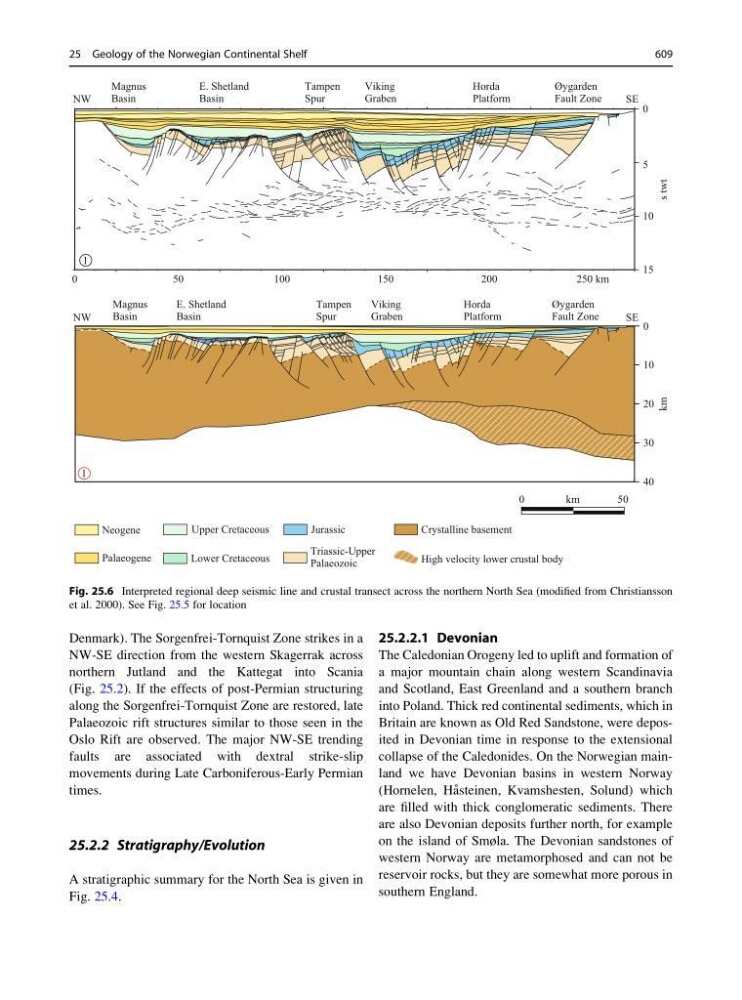
Fig. 25.6 Interpreted regional deep seismic line and crustal transect across the northern North Sea (modified from Christiansson
et al. 2000). See Fig. 25.5 for location
25 Geology of the Norwegian Continental Shelf
609
NW-SE direction from the western Skagerrak across
northern Jutland and the Kattegat into Scania
(Fig. 25.2). If the effects of post-Permian structuring
along the Sorgenfrei-Tornquist Zone are restored, late
Palaeozoic rift structures similar to those seen in the
Oslo Rift are observed. The major NW-SE trending
faults are associated with dextral strike-slip
movements during Late Carboniferous-Early Permian
times.
25.2.2 Stratigraphy/Evolution
A stratigraphic summary for the North Sea is given in
Fig. 25.4.
25.2.2.1 Devonian
The Caledonian Orogeny led to uplift and formation of
a major mountain chain along western Scandinavia
and Scotland, East Greenland and a southern branch
into Poland. Thick red continental sediments, which in
Britain are known as Old Red Sandstone, were deposited in Devonian time in response to the extensional
collapse of the Caledonides. On the Norwegian mainland we have Devonian basins in western Norway
(Hornelen, Ha ˚steinen, Kvamshesten, Solund) which
are filled with thick conglomeratic sediments. There
are also Devonian deposits further north, for example
on the island of Smøla. The Devonian sandstones of
western Norway are metamorphosed and can not be
reservoir rocks, but they are somewhat more porous in
southern England.
E. Shetland
Basin
Viking
Graben
Horda
Platform
Øygarden
Fault Zone
Tampen
Spur
Magnus
Basin
0
5
10
15
0
50
100
150
200
250 km
NW
SE
s twt
Neogene
Palaeogene
Upper Cretaceous
Lower Cretaceous
Jurassic
Triassic-Upper
Palaeozoic
0
10
20
30
40
Magnus
Basin
E. Shetland
Basin
Tampen
Spur
Horda
Platform
Øygarden
Fault Zone
Viking
Graben
km
NW
SE
0
km
50
1
1
Crystalline basement
High velocity lower crustal body
Fig. 25.6 Interpreted regional deep seismic line and crustal transect across the northern North Sea (modified from Christiansson
et al. 2000). See Fig. 25.5 for location
25 Geology of the Norwegian Continental Shelf
609