

many salt structures but has not been affected by
significant rifting (Figs. 25.8 and 25.9).
The geometric shape of the sedimentary basin is
influenced by the structure in the underlying rocks
(basement) and by the thickness of the continental
crust. Most of the North Sea is underlain by a
Caledonian basement. Long-lived zones of weakness
inherited from the Caledonian Orogeny played a role
in the later evolution of the North Sea basin. The
southeastern North Sea and Skagerrak are underlain
by a Precambrian basement covered by a Lower
Palaeozoic sedimentary succession. In the south the
North Sea basin is bounded by the Hercynian
(Variscan) mountain range which runs E-W through
Germany, northern France and southwest England.
The contraction occurred during the CarbonifererousPermian. Uplift in this area resulted in vast amounts of
sediment being deposited in the area to the north and
this initiated the formation of the North Sea basin.
The offshore part of the Oslo Rift in the Skagerrak
is characterised by NE-SW striking half-grabens
(Fig. 25.9). Cross-sections across the Skagerrak show
tilted half-grabens filled with down-faulted Upper
Carboniferous-Lower Permian and Lower Palaeozoic
strata that are unconformably overlain by Triassic
sedimentary rocks. Although a thick succession of
Lower Palaeozoic strata has been preserved in the
Skagerrak Graben, a substantial part of this pre-rift
unit has been eroded in the central part of the rift.
From strata preserved in the onshore Oslo Graben we
know that the Lower Palaeozoic succession consists
mainly of Cambrian-Ordovician and Silurian platform
series and Upper Silurian-lowermost Devonian clastic
sedimentary rocks, with the latter being deposited in
the Caledonian foreland basin. In the western part of
the Skagerrak, the late Palaeozoic structures of the
Oslo Rift link up with the Sorgenfrei-Tornquist Zone
(also termed the Fennoscandian Border Zone in
OG
SkG
HP
VG
ESP
NDB
S T Z
CG
Late Cretaceous -
Palaeocene
Late Jurassic -
Early Cretaceous
Late Palaeozoic
60
58
56
54
–5
0
5
10
2
1
3
4
5
6
SB
SH
UH
ÅG
WG
HG
FB
T S
ESB
SG
M
g B M
rB
MNSH
RFH
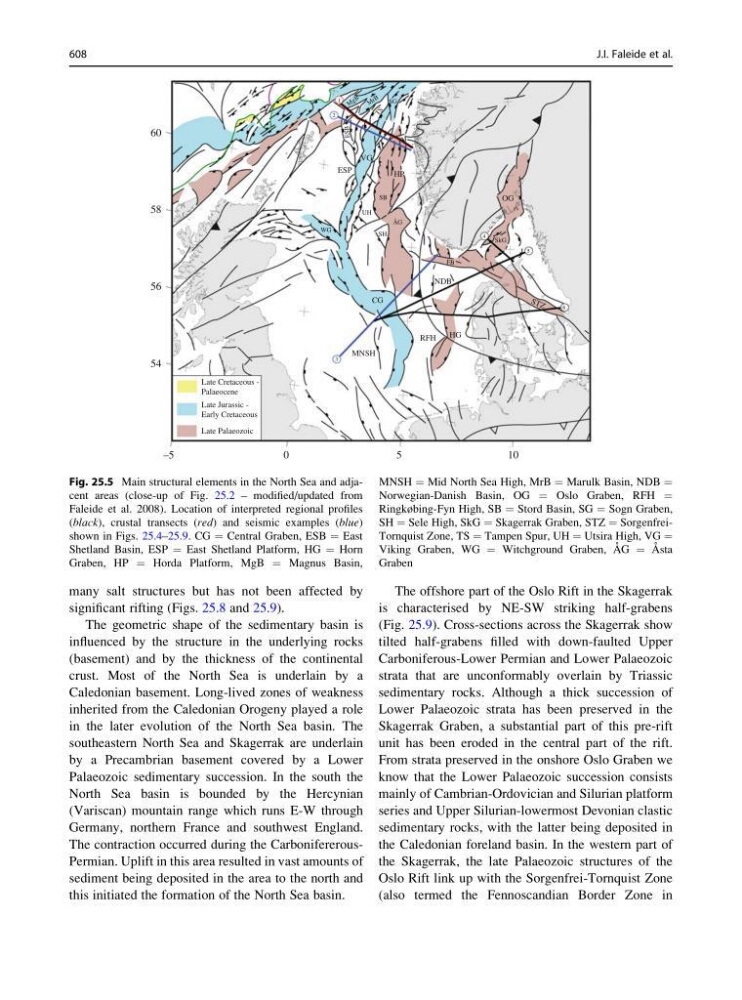
Fig. 25.5 Main structural elements in the North Sea and adjacent areas (close-up of Fig. 25.2 – modified/updated from
Faleide et al. 2008). Location of interpreted regional profiles
(black), crustal transects (red) and seismic examples (blue)
shown in Figs. 25.4–25.9. CG ¼ Central Graben, ESB ¼ East
Shetland Basin, ESP ¼ East Shetland Platform, HG ¼ Horn
Graben, HP ¼ Horda Platform, MgB ¼ Magnus Basin,
MNSH ¼ Mid North Sea High, MrB ¼ Marulk Basin, NDB ¼
Norwegian-Danish Basin, OG ¼ Oslo Graben, RFH ¼
Ringkøbing-Fyn High, SB ¼ Stord Basin, SG ¼ Sogn Graben,
SH ¼ Sele High, SkG ¼ Skagerrak Graben, STZ ¼ SorgenfreiTornquist Zone, TS ¼ Tampen Spur, UH ¼ Utsira High, VG ¼
Viking Graben, WG ¼ Witchground Graben, A ˚ G ¼ A ˚ sta
Graben
608
J.I. Faleide et al.
significant rifting (Figs. 25.8 and 25.9).
The geometric shape of the sedimentary basin is
influenced by the structure in the underlying rocks
(basement) and by the thickness of the continental
crust. Most of the North Sea is underlain by a
Caledonian basement. Long-lived zones of weakness
inherited from the Caledonian Orogeny played a role
in the later evolution of the North Sea basin. The
southeastern North Sea and Skagerrak are underlain
by a Precambrian basement covered by a Lower
Palaeozoic sedimentary succession. In the south the
North Sea basin is bounded by the Hercynian
(Variscan) mountain range which runs E-W through
Germany, northern France and southwest England.
The contraction occurred during the CarbonifererousPermian. Uplift in this area resulted in vast amounts of
sediment being deposited in the area to the north and
this initiated the formation of the North Sea basin.
The offshore part of the Oslo Rift in the Skagerrak
is characterised by NE-SW striking half-grabens
(Fig. 25.9). Cross-sections across the Skagerrak show
tilted half-grabens filled with down-faulted Upper
Carboniferous-Lower Permian and Lower Palaeozoic
strata that are unconformably overlain by Triassic
sedimentary rocks. Although a thick succession of
Lower Palaeozoic strata has been preserved in the
Skagerrak Graben, a substantial part of this pre-rift
unit has been eroded in the central part of the rift.
From strata preserved in the onshore Oslo Graben we
know that the Lower Palaeozoic succession consists
mainly of Cambrian-Ordovician and Silurian platform
series and Upper Silurian-lowermost Devonian clastic
sedimentary rocks, with the latter being deposited in
the Caledonian foreland basin. In the western part of
the Skagerrak, the late Palaeozoic structures of the
Oslo Rift link up with the Sorgenfrei-Tornquist Zone
(also termed the Fennoscandian Border Zone in
OG
SkG
HP
VG
ESP
NDB
S T Z
CG
Late Cretaceous -
Palaeocene
Late Jurassic -
Early Cretaceous
Late Palaeozoic
60
58
56
54
–5
0
5
10
2
1
3
4
5
6
SB
SH
UH
ÅG
WG
HG
FB
T S
ESB
SG
M
g B M
rB
MNSH
RFH
Fig. 25.5 Main structural elements in the North Sea and adjacent areas (close-up of Fig. 25.2 – modified/updated from
Faleide et al. 2008). Location of interpreted regional profiles
(black), crustal transects (red) and seismic examples (blue)
shown in Figs. 25.4–25.9. CG ¼ Central Graben, ESB ¼ East
Shetland Basin, ESP ¼ East Shetland Platform, HG ¼ Horn
Graben, HP ¼ Horda Platform, MgB ¼ Magnus Basin,
MNSH ¼ Mid North Sea High, MrB ¼ Marulk Basin, NDB ¼
Norwegian-Danish Basin, OG ¼ Oslo Graben, RFH ¼
Ringkøbing-Fyn High, SB ¼ Stord Basin, SG ¼ Sogn Graben,
SH ¼ Sele High, SkG ¼ Skagerrak Graben, STZ ¼ SorgenfreiTornquist Zone, TS ¼ Tampen Spur, UH ¼ Utsira High, VG ¼
Viking Graben, WG ¼ Witchground Graben, A ˚ G ¼ A ˚ sta
Graben
608
J.I. Faleide et al.