

subsidence and sediment loading in the Cretaceous.
However, the Viking Graben and its margins are
underlain by an older major rift basin of assumed
Permian-Early Triassic age. The axis of this rift system is thought to lie beneath the present Horda Platform. It is bounded by the East Shetland Platform in
the west and the Øygarden Fault Zone in the east.
Structures within this area are characterised by large
rotated fault blocks with sedimentary basins in asymmetric half-grabens associated with lithospheric
extension and crustal thinning (Fig. 25.6). The area
was presumably also strongly affected by postorogenic (post-Caledonian) extension in Middle to
Late Devonian times.
The Norwegian Central North Sea Province
encompasses the northwestern part of the Central Graben (Figs. 25.5, 25.8 and 25.9), which is mainly a
Jurassic-Cretaceous structure, and its northeastern
margin. The strata of the Central Graben area were
affected by halokinesis already in the Triassic, and
major structuring accordingly occurred already in
pre-Jurassic times. However, salt movements have
locally continued into the Tertiary. Jurassic rifting
and generation of large, rotated fault blocks resulted
in extreme erosion in places. The complex structural
pattern established during this stage was further complicated by Cretaceous inversion. The NorwegianDanish Basin, east of the Central Graben, also contains
Mandal
Tau
Sandnes
Bryne
Sleipner
Hugin
Brae
Burton
Cook
Drake
Heather
Draupne
Brent
S ta tf jo rd
F o ld v ik -
cr ee
k
Kap
Stewart
N ei ll K li n te r
Hekkingen
Janusfjellet
Nordmela eq?
Tubåen
Botneheia
Ula
V ar d e -
k lø ft
Helvetiafjellet
Kviting
Klip pfisk
Nordmela
?
?
?
?
?
?
?
?
?
Maast
Camp
Sant
Coni
Tur
Cen
Alb
Apt
Barr
Haut
Valang
Ryaz
Volg
Kimm
Oxf
Call
Bath
Bajoc
Aalen
Toarc
Plienc
Sinem
Hett
Rhæt
Nor
Carn
Ladin
Anis
Scyth
Tatar
Kazan
Kung
Artin
Sakm
Assel
Gzel
Kasim
Moscov
Bash
Serpuk
Vise
Tour
L
M
U
L
U
L
M
U
L
M
L
Quat
Tertiary
Cretaceous
Jurassic
Triassic
Permian
Carboniferous
Din Nam
Steph
WF
Southern
North Sea
NorwegianDanish Basin
Southern
Viking Graben
Tampen
Spur
Trøndelag
Platform
Halten
Terrace
Vøring
Basin
East
Greenland
Tromsø
Basin
Svalbard
Nordkapp B.,
Bjarmeland P.
SE Barents
Basin
Utsira high
Rogn
Spekk
Melke
Garn
Ile
Tofte
Tilje
Åre
Hekkingen
Stø
Stø
?
?
?
?
?
?
?
?
?
?
Condensed
sequence
Condensed
sequence
?
?
?
Neogene
Palaeogene
U
U
Palaeo
Eoc
Oligo
Mio
Plio
Pleist
Continental clastics, unspecified
Continental clastics, mainly sands
Continental clastics, mainly shales and silts
Halite
Marginal evaporite deposits, sabkha
Coastal-, delta- and flood plain deposits
Marginal marine and shallow marine deposits, mainly sands
Shallow marine deposits, mainly shales
Deeper marine deposits, mainly shales
Shallow marine carbonates
Volcanic deposits
Carbonaceous shales
Clastic mixing in carbonates,
sands in shales
Spiculite
Coal
Coarse clastics
Source rocks
Chalk Group
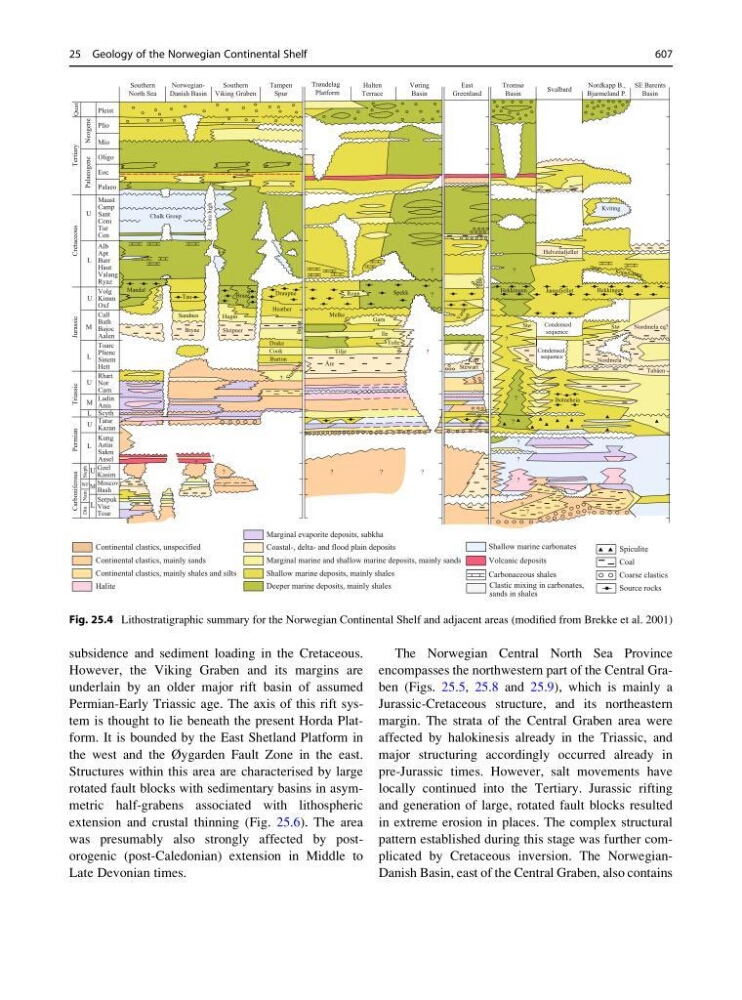
Fig. 25.4 Lithostratigraphic summary for the Norwegian Continental Shelf and adjacent areas (modified from Brekke et al. 2001)
25 Geology of the Norwegian Continental Shelf
607
However, the Viking Graben and its margins are
underlain by an older major rift basin of assumed
Permian-Early Triassic age. The axis of this rift system is thought to lie beneath the present Horda Platform. It is bounded by the East Shetland Platform in
the west and the Øygarden Fault Zone in the east.
Structures within this area are characterised by large
rotated fault blocks with sedimentary basins in asymmetric half-grabens associated with lithospheric
extension and crustal thinning (Fig. 25.6). The area
was presumably also strongly affected by postorogenic (post-Caledonian) extension in Middle to
Late Devonian times.
The Norwegian Central North Sea Province
encompasses the northwestern part of the Central Graben (Figs. 25.5, 25.8 and 25.9), which is mainly a
Jurassic-Cretaceous structure, and its northeastern
margin. The strata of the Central Graben area were
affected by halokinesis already in the Triassic, and
major structuring accordingly occurred already in
pre-Jurassic times. However, salt movements have
locally continued into the Tertiary. Jurassic rifting
and generation of large, rotated fault blocks resulted
in extreme erosion in places. The complex structural
pattern established during this stage was further complicated by Cretaceous inversion. The NorwegianDanish Basin, east of the Central Graben, also contains
Mandal
Tau
Sandnes
Bryne
Sleipner
Hugin
Brae
Burton
Cook
Drake
Heather
Draupne
Brent
S ta tf jo rd
F o ld v ik -
cr ee
k
Kap
Stewart
N ei ll K li n te r
Hekkingen
Janusfjellet
Nordmela eq?
Tubåen
Botneheia
Ula
V ar d e -
k lø ft
Helvetiafjellet
Kviting
Klip pfisk
Nordmela
?
?
?
?
?
?
?
?
?
Maast
Camp
Sant
Coni
Tur
Cen
Alb
Apt
Barr
Haut
Valang
Ryaz
Volg
Kimm
Oxf
Call
Bath
Bajoc
Aalen
Toarc
Plienc
Sinem
Hett
Rhæt
Nor
Carn
Ladin
Anis
Scyth
Tatar
Kazan
Kung
Artin
Sakm
Assel
Gzel
Kasim
Moscov
Bash
Serpuk
Vise
Tour
L
M
U
L
U
L
M
U
L
M
L
Quat
Tertiary
Cretaceous
Jurassic
Triassic
Permian
Carboniferous
Din Nam
Steph
WF
Southern
North Sea
NorwegianDanish Basin
Southern
Viking Graben
Tampen
Spur
Trøndelag
Platform
Halten
Terrace
Vøring
Basin
East
Greenland
Tromsø
Basin
Svalbard
Nordkapp B.,
Bjarmeland P.
SE Barents
Basin
Utsira high
Rogn
Spekk
Melke
Garn
Ile
Tofte
Tilje
Åre
Hekkingen
Stø
Stø
?
?
?
?
?
?
?
?
?
?
Condensed
sequence
Condensed
sequence
?
?
?
Neogene
Palaeogene
U
U
Palaeo
Eoc
Oligo
Mio
Plio
Pleist
Continental clastics, unspecified
Continental clastics, mainly sands
Continental clastics, mainly shales and silts
Halite
Marginal evaporite deposits, sabkha
Coastal-, delta- and flood plain deposits
Marginal marine and shallow marine deposits, mainly sands
Shallow marine deposits, mainly shales
Deeper marine deposits, mainly shales
Shallow marine carbonates
Volcanic deposits
Carbonaceous shales
Clastic mixing in carbonates,
sands in shales
Spiculite
Coal
Coarse clastics
Source rocks
Chalk Group
Fig. 25.4 Lithostratigraphic summary for the Norwegian Continental Shelf and adjacent areas (modified from Brekke et al. 2001)
25 Geology of the Norwegian Continental Shelf
607