

formation water and scCO 2 (see Fig. 24.3) will determine the upward flux of CO 2 . Chapter 12 and Sect. 1.8
provide an overview of structural elements that can
prevent vertical migration of CO 2 or hydrocarbons.
24.5.2 Capillary (Residual) Trapping
As CO 2 flows upwards and laterally below structural
or stratigraphic elements, water must be displaced.
Such displacement of a wetting fluid by a non-wetting
fluid is termed drainage. In siliciclastic reservoirs,
mineral grains will be water-wet, and a thin film of
water will therefore remain on the mineral grains after
a CO 2 sweep. If water later flows through the area
rich in free CO 2 , some bubbles of CO 2 may not be
able to overcome the capillary entry pressure of the
smaller pore throats, and will be trapped. The latter
process is termed imbibition. In modelling drainage
and imbibition, the relation between the water and
CO 2 saturations and the relative permeabilities must
be known. The van Genuchten model is one of several
ways of relating relative permeabilities to CO 2 and
H 2 O saturations (van Genuchten 1980). The model is
empirical and requires experimental data. Values for
irreducible saturations, which are the minimum saturation values CO 2 and H 2 O can have, and the shape of
the saturation/permeability curves, depend on factors
such as sediment sorting and mineral grain size.
24.5.3 Solubility Trapping
Injected CO 2 will first occur primarily as a free phase,
but will start to dissolve in the formation water. The
rate of dissolution depends on factors such as the CO 2 /
water interface surface area, and diffusion of dissolved
CO 2 away from the interface. Solubility trapping will
therefore be most efficient in heterogeneous reservoirs
where the CO 2 plume spreads over larger volumes of
the reservoir providing more interfacial surface area
between CO 2 and formation water. The amount of
dissolved molecular CO 2 depends on factors such as
the CO 2 partial pressure, temperature and salinity, and
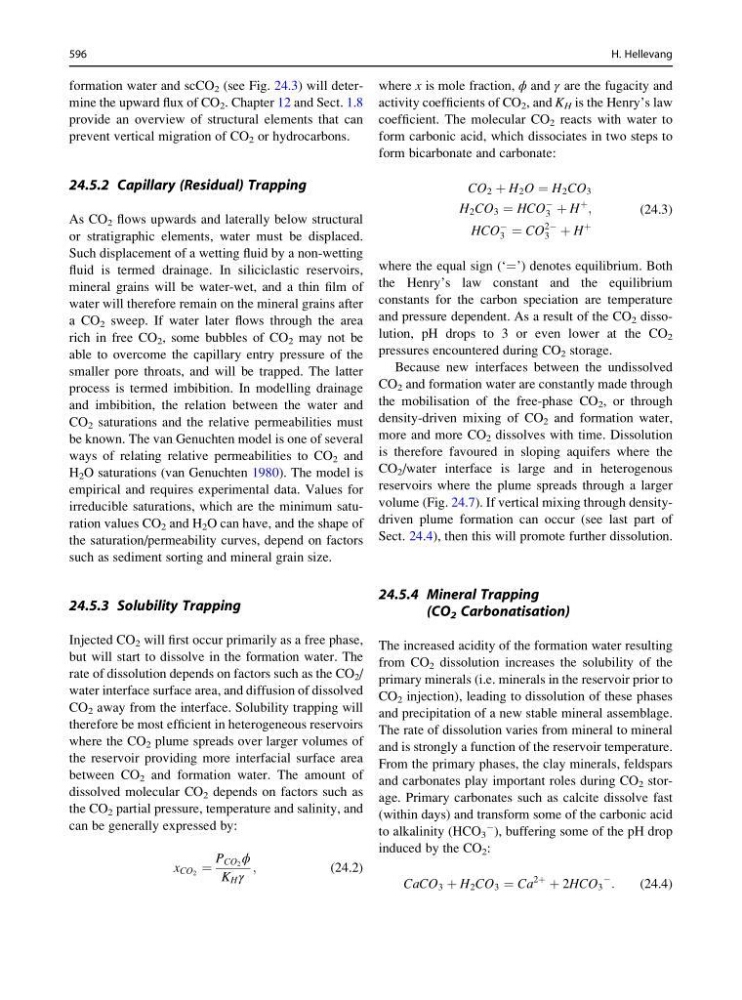
can be generally expressed by:
x CO 2 ¼
P CO 2 ϕ
K H γ
;
(24.2)
where x is mole fraction, ϕ and γ are the fugacity and
activity coefficients of CO 2 , and K H is the Henry’s law
coefficient. The molecular CO 2 reacts with water to
form carbonic acid, which dissociates in two steps to
form bicarbonate and carbonate:
CO 2 þ H 2 O ¼ H 2 CO 3
H 2 CO 3 ¼ HCO
À
3 þ H
þ
;
HCO
À
3 ¼ CO
2À
3 þ H
þ
(24.3)
where the equal sign (‘¼’) denotes equilibrium. Both
the Henry’s law constant and the equilibrium
constants for the carbon speciation are temperature
and pressure dependent. As a result of the CO 2 dissolution, pH drops to 3 or even lower at the CO 2
pressures encountered during CO 2 storage.
Because new interfaces between the undissolved
CO 2 and formation water are constantly made through
the mobilisation of the free-phase CO 2 , or through
density-driven mixing of CO 2 and formation water,
more and more CO 2 dissolves with time. Dissolution
is therefore favoured in sloping aquifers where the
CO 2 /water interface is large and in heterogenous
reservoirs where the plume spreads through a larger
volume (Fig. 24.7). If vertical mixing through densitydriven plume formation can occur (see last part of
Sect. 24.4), then this will promote further dissolution.
24.5.4 Mineral Trapping
(CO 2 Carbonatisation)
The increased acidity of the formation water resulting
from CO 2 dissolution increases the solubility of the
primary minerals (i.e. minerals in the reservoir prior to
CO 2 injection), leading to dissolution of these phases
and precipitation of a new stable mineral assemblage.
The rate of dissolution varies from mineral to mineral
and is strongly a function of the reservoir temperature.
From the primary phases, the clay minerals, feldspars
and carbonates play important roles during CO 2 storage. Primary carbonates such as calcite dissolve fast
(within days) and transform some of the carbonic acid
to alkalinity (HCO 3
À ), buffering some of the pH drop
induced by the CO 2 :
CaCO 3 þ H 2 CO 3 ¼ Ca
2þ
þ 2HCO 3
À
:
(24.4)
596
H. Hellevang
provide an overview of structural elements that can
prevent vertical migration of CO 2 or hydrocarbons.
24.5.2 Capillary (Residual) Trapping
As CO 2 flows upwards and laterally below structural
or stratigraphic elements, water must be displaced.
Such displacement of a wetting fluid by a non-wetting
fluid is termed drainage. In siliciclastic reservoirs,
mineral grains will be water-wet, and a thin film of
water will therefore remain on the mineral grains after
a CO 2 sweep. If water later flows through the area
rich in free CO 2 , some bubbles of CO 2 may not be
able to overcome the capillary entry pressure of the
smaller pore throats, and will be trapped. The latter
process is termed imbibition. In modelling drainage
and imbibition, the relation between the water and
CO 2 saturations and the relative permeabilities must
be known. The van Genuchten model is one of several
ways of relating relative permeabilities to CO 2 and
H 2 O saturations (van Genuchten 1980). The model is
empirical and requires experimental data. Values for
irreducible saturations, which are the minimum saturation values CO 2 and H 2 O can have, and the shape of
the saturation/permeability curves, depend on factors
such as sediment sorting and mineral grain size.
24.5.3 Solubility Trapping
Injected CO 2 will first occur primarily as a free phase,
but will start to dissolve in the formation water. The
rate of dissolution depends on factors such as the CO 2 /
water interface surface area, and diffusion of dissolved
CO 2 away from the interface. Solubility trapping will
therefore be most efficient in heterogeneous reservoirs
where the CO 2 plume spreads over larger volumes of
the reservoir providing more interfacial surface area
between CO 2 and formation water. The amount of
dissolved molecular CO 2 depends on factors such as
the CO 2 partial pressure, temperature and salinity, and
can be generally expressed by:
x CO 2 ¼
P CO 2 ϕ
K H γ
;
(24.2)
where x is mole fraction, ϕ and γ are the fugacity and
activity coefficients of CO 2 , and K H is the Henry’s law
coefficient. The molecular CO 2 reacts with water to
form carbonic acid, which dissociates in two steps to
form bicarbonate and carbonate:
CO 2 þ H 2 O ¼ H 2 CO 3
H 2 CO 3 ¼ HCO
À
3 þ H
þ
;
HCO
À
3 ¼ CO
2À
3 þ H
þ
(24.3)
where the equal sign (‘¼’) denotes equilibrium. Both
the Henry’s law constant and the equilibrium
constants for the carbon speciation are temperature
and pressure dependent. As a result of the CO 2 dissolution, pH drops to 3 or even lower at the CO 2
pressures encountered during CO 2 storage.
Because new interfaces between the undissolved
CO 2 and formation water are constantly made through
the mobilisation of the free-phase CO 2 , or through
density-driven mixing of CO 2 and formation water,
more and more CO 2 dissolves with time. Dissolution
is therefore favoured in sloping aquifers where the
CO 2 /water interface is large and in heterogenous
reservoirs where the plume spreads through a larger
volume (Fig. 24.7). If vertical mixing through densitydriven plume formation can occur (see last part of
Sect. 24.4), then this will promote further dissolution.
24.5.4 Mineral Trapping
(CO 2 Carbonatisation)
The increased acidity of the formation water resulting
from CO 2 dissolution increases the solubility of the
primary minerals (i.e. minerals in the reservoir prior to
CO 2 injection), leading to dissolution of these phases
and precipitation of a new stable mineral assemblage.
The rate of dissolution varies from mineral to mineral
and is strongly a function of the reservoir temperature.
From the primary phases, the clay minerals, feldspars
and carbonates play important roles during CO 2 storage. Primary carbonates such as calcite dissolve fast
(within days) and transform some of the carbonic acid
to alkalinity (HCO 3
À ), buffering some of the pH drop
induced by the CO 2 :
CaCO 3 þ H 2 CO 3 ¼ Ca
2þ
þ 2HCO 3
À
:
(24.4)
596
H. Hellevang