

This appears to be quite limited. However, as pores
dry out, additional brine may be brought in by capillary suction and osmotic pressure differences, leading to further salt precipitation. Dissolution of CO 2
into water affects the storage operation on both short
and long time-scales. First, dissolved CO 2 reacts with
water and forms carbonic acid, and the pH may drop
to 3 or even lower depending on the buffer capacity
and CO 2 pressure. This results in dissolution of the
minerals present in the reservoir and formation of
new secondary phases. In hundreds to thousands of
years, these mineral reactions may form carbonates,
immobilising CO 2 for long time spans (see next
section).
A second effect of dissolved CO 2 is that it
increases the density of the water. The solubility of
CO 2 at 100 bars and 37
C in a solution of normal
seawater salinity (~0.5 mol NaCl per kg water (kgw))
is approximately 1.1 mol/kgw. At full CO 2 saturation, density is about 1,034 kg/m
3 , which is 1.6%
higher than the solution without CO 2 (about
1,018 kg/m
3 ). It has been suggested that the density
contrast between CO 2 -saturated formation water and
normal brine may result in convection cells, making
the heavier CO 2 -charged solutions sink downwards,
and bringing ‘fresh’ brine upwards which increases
the dissolution rate of the scCO 2 (Elenius and Gasda
2013). Viewed in the light of earlier studies on the
possibility of density currents in stratified and vertically heterogeneous sandstones (Bjørlykke et al.
1988), conclusions on the extent of such mixing
still have to be taken with caution. Moreover, the
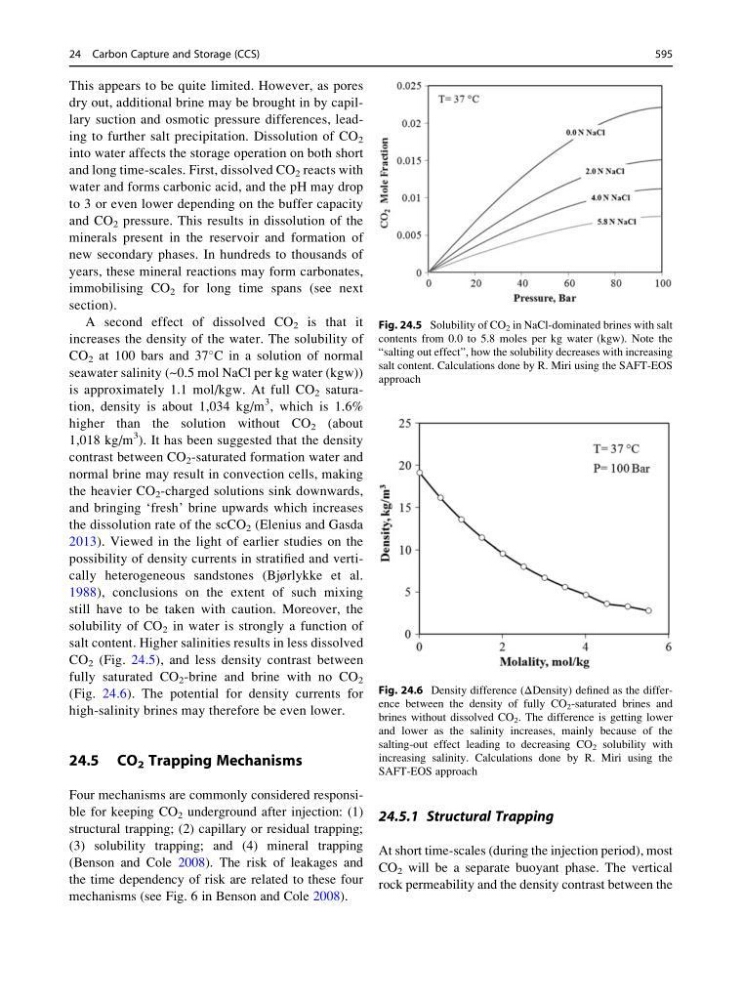
solubility of CO 2 in water is strongly a function of
salt content. Higher salinities results in less dissolved
CO 2 (Fig. 24.5), and less density contrast between
fully saturated CO 2 -brine and brine with no CO 2
(Fig. 24.6). The potential for density currents for
high-salinity brines may therefore be even lower.
24.5 CO 2 Trapping Mechanisms
Four mechanisms are commonly considered responsible for keeping CO 2 underground after injection: (1)
structural trapping; (2) capillary or residual trapping;
(3) solubility trapping; and (4) mineral trapping
(Benson and Cole 2008). The risk of leakages and
the time dependency of risk are related to these four
mechanisms (see Fig. 6 in Benson and Cole 2008).
24.5.1 Structural Trapping
At short time-scales (during the injection period), most
CO 2 will be a separate buoyant phase. The vertical
rock permeability and the density contrast between the
Fig. 24.5 Solubility of CO 2 in NaCl-dominated brines with salt
contents from 0.0 to 5.8 moles per kg water (kgw). Note the
“salting out effect”, how the solubility decreases with increasing
salt content. Calculations done by R. Miri using the SAFT-EOS
approach
Fig. 24.6 Density difference (ΔDensity) defined as the difference between the density of fully CO 2 -saturated brines and
brines without dissolved CO 2 . The difference is getting lower
and lower as the salinity increases, mainly because of the
salting-out effect leading to decreasing CO 2 solubility with
increasing salinity. Calculations done by R. Miri using the
SAFT-EOS approach
24 Carbon Capture and Storage (CCS)
595
dry out, additional brine may be brought in by capillary suction and osmotic pressure differences, leading to further salt precipitation. Dissolution of CO 2
into water affects the storage operation on both short
and long time-scales. First, dissolved CO 2 reacts with
water and forms carbonic acid, and the pH may drop
to 3 or even lower depending on the buffer capacity
and CO 2 pressure. This results in dissolution of the
minerals present in the reservoir and formation of
new secondary phases. In hundreds to thousands of
years, these mineral reactions may form carbonates,
immobilising CO 2 for long time spans (see next
section).
A second effect of dissolved CO 2 is that it
increases the density of the water. The solubility of
CO 2 at 100 bars and 37
C in a solution of normal
seawater salinity (~0.5 mol NaCl per kg water (kgw))
is approximately 1.1 mol/kgw. At full CO 2 saturation, density is about 1,034 kg/m
3 , which is 1.6%
higher than the solution without CO 2 (about
1,018 kg/m
3 ). It has been suggested that the density
contrast between CO 2 -saturated formation water and
normal brine may result in convection cells, making
the heavier CO 2 -charged solutions sink downwards,
and bringing ‘fresh’ brine upwards which increases
the dissolution rate of the scCO 2 (Elenius and Gasda
2013). Viewed in the light of earlier studies on the
possibility of density currents in stratified and vertically heterogeneous sandstones (Bjørlykke et al.
1988), conclusions on the extent of such mixing
still have to be taken with caution. Moreover, the
solubility of CO 2 in water is strongly a function of
salt content. Higher salinities results in less dissolved
CO 2 (Fig. 24.5), and less density contrast between
fully saturated CO 2 -brine and brine with no CO 2
(Fig. 24.6). The potential for density currents for
high-salinity brines may therefore be even lower.
24.5 CO 2 Trapping Mechanisms
Four mechanisms are commonly considered responsible for keeping CO 2 underground after injection: (1)
structural trapping; (2) capillary or residual trapping;
(3) solubility trapping; and (4) mineral trapping
(Benson and Cole 2008). The risk of leakages and
the time dependency of risk are related to these four
mechanisms (see Fig. 6 in Benson and Cole 2008).
24.5.1 Structural Trapping
At short time-scales (during the injection period), most
CO 2 will be a separate buoyant phase. The vertical
rock permeability and the density contrast between the
Fig. 24.5 Solubility of CO 2 in NaCl-dominated brines with salt
contents from 0.0 to 5.8 moles per kg water (kgw). Note the
“salting out effect”, how the solubility decreases with increasing
salt content. Calculations done by R. Miri using the SAFT-EOS
approach
Fig. 24.6 Density difference (ΔDensity) defined as the difference between the density of fully CO 2 -saturated brines and
brines without dissolved CO 2 . The difference is getting lower
and lower as the salinity increases, mainly because of the
salting-out effect leading to decreasing CO 2 solubility with
increasing salinity. Calculations done by R. Miri using the
SAFT-EOS approach
24 Carbon Capture and Storage (CCS)
595