

from the CO 2 injection and formation water
mobilisation. For extensive reservoir units such as the
Utsira Sand, pressure is dispersed through a large volume and pressure build-up is minimal, and the
injectivity is therefore very high. The Tuba ˚en Formation at Snøhvit, on the other hand, is divided into
pressure compartments by steep faults with low permeability and hydraulic conductivity, resulting in rapid
pressure build-up (Pham et al. 2011). Hydraulic conductivity depends on the permeability of the reservoir
and the viscosity of the fluid, with high permeabilities
(and low viscosities) favouring water mobilisation and
preventing pressure build-up.
A storage deposit must in addition to injectivity
have sufficient capacity. If pressure build-up is not
considered, CO 2 storage capacity for saline aquifers
can be estimated by the following relationship (see
CO 2 Storage Atlas Norwegian Sea, 2012):
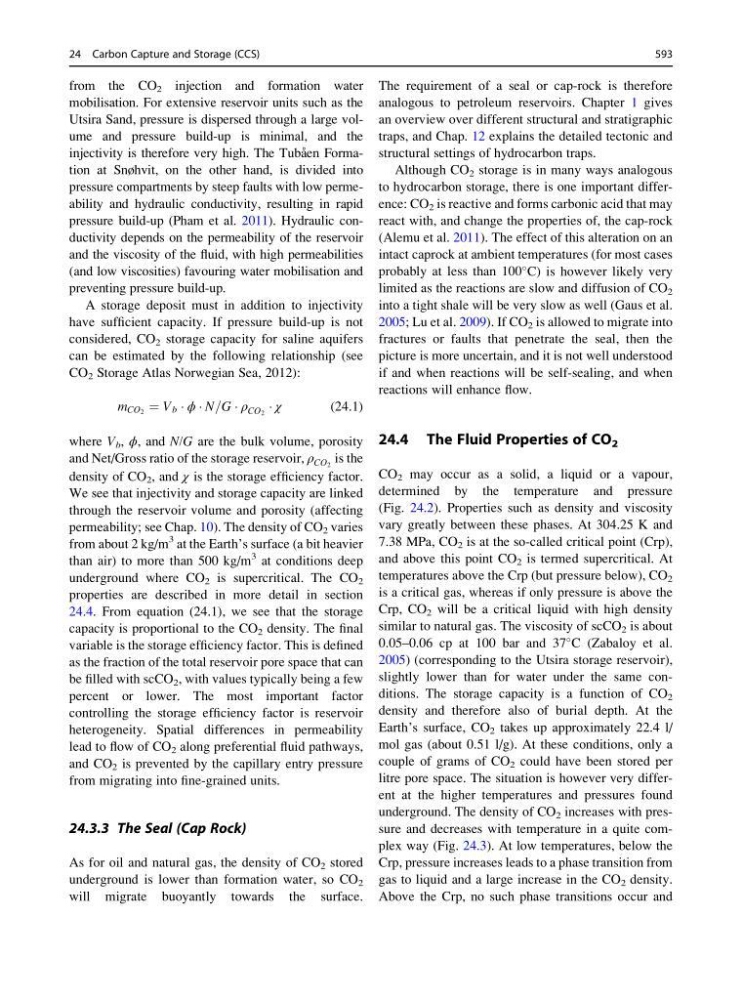
m CO 2 ¼ V b Á ϕ Á N=G Á ρ CO 2 Á χ
(24.1)
where V b , ϕ, and N/G are the bulk volume, porosity
and Net/Gross ratio of the storage reservoir, ρ CO 2 is the
density of CO 2 , and χ is the storage efficiency factor.
We see that injectivity and storage capacity are linked
through the reservoir volume and porosity (affecting
permeability; see Chap. 10). The density of CO 2 varies
from about 2 kg/m
3 at the Earth’s surface (a bit heavier
than air) to more than 500 kg/m
3 at conditions deep
underground where CO 2 is supercritical. The CO 2
properties are described in more detail in section
24.4. From equation (24.1), we see that the storage
capacity is proportional to the CO 2 density. The final
variable is the storage efficiency factor. This is defined
as the fraction of the total reservoir pore space that can
be filled with scCO 2 , with values typically being a few
percent or lower. The most important factor
controlling the storage efficiency factor is reservoir
heterogeneity. Spatial differences in permeability
lead to flow of CO 2 along preferential fluid pathways,
and CO 2 is prevented by the capillary entry pressure
from migrating into fine-grained units.
24.3.3 The Seal (Cap Rock)
As for oil and natural gas, the density of CO 2 stored
underground is lower than formation water, so CO 2
will migrate buoyantly towards the surface.
The requirement of a seal or cap-rock is therefore
analogous to petroleum reservoirs. Chapter 1 gives
an overview over different structural and stratigraphic
traps, and Chap. 12 explains the detailed tectonic and
structural settings of hydrocarbon traps.
Although CO 2 storage is in many ways analogous
to hydrocarbon storage, there is one important difference: CO 2 is reactive and forms carbonic acid that may
react with, and change the properties of, the cap-rock
(Alemu et al. 2011). The effect of this alteration on an
intact caprock at ambient temperatures (for most cases
probably at less than 100
C) is however likely very
limited as the reactions are slow and diffusion of CO 2
into a tight shale will be very slow as well (Gaus et al.
2005; Lu et al. 2009). If CO 2 is allowed to migrate into
fractures or faults that penetrate the seal, then the
picture is more uncertain, and it is not well understood
if and when reactions will be self-sealing, and when
reactions will enhance flow.
24.4 The Fluid Properties of CO 2
CO 2 may occur as a solid, a liquid or a vapour,
determined by the temperature and pressure
(Fig. 24.2). Properties such as density and viscosity
vary greatly between these phases. At 304.25 K and
7.38 MPa, CO 2 is at the so-called critical point (Crp),
and above this point CO 2 is termed supercritical. At
temperatures above the Crp (but pressure below), CO 2
is a critical gas, whereas if only pressure is above the
Crp, CO 2 will be a critical liquid with high density
similar to natural gas. The viscosity of scCO 2 is about
0.05–0.06 cp at 100 bar and 37
C (Zabaloy et al.
2005) (corresponding to the Utsira storage reservoir),
slightly lower than for water under the same conditions. The storage capacity is a function of CO 2
density and therefore also of burial depth. At the
Earth’s surface, CO 2 takes up approximately 22.4 l/
mol gas (about 0.51 l/g). At these conditions, only a
couple of grams of CO 2 could have been stored per
litre pore space. The situation is however very different at the higher temperatures and pressures found
underground. The density of CO 2 increases with pressure and decreases with temperature in a quite complex way (Fig. 24.3). At low temperatures, below the
Crp, pressure increases leads to a phase transition from
gas to liquid and a large increase in the CO 2 density.
Above the Crp, no such phase transitions occur and
24 Carbon Capture and Storage (CCS)
593
mobilisation. For extensive reservoir units such as the
Utsira Sand, pressure is dispersed through a large volume and pressure build-up is minimal, and the
injectivity is therefore very high. The Tuba ˚en Formation at Snøhvit, on the other hand, is divided into
pressure compartments by steep faults with low permeability and hydraulic conductivity, resulting in rapid
pressure build-up (Pham et al. 2011). Hydraulic conductivity depends on the permeability of the reservoir
and the viscosity of the fluid, with high permeabilities
(and low viscosities) favouring water mobilisation and
preventing pressure build-up.
A storage deposit must in addition to injectivity
have sufficient capacity. If pressure build-up is not
considered, CO 2 storage capacity for saline aquifers
can be estimated by the following relationship (see
CO 2 Storage Atlas Norwegian Sea, 2012):
m CO 2 ¼ V b Á ϕ Á N=G Á ρ CO 2 Á χ
(24.1)
where V b , ϕ, and N/G are the bulk volume, porosity
and Net/Gross ratio of the storage reservoir, ρ CO 2 is the
density of CO 2 , and χ is the storage efficiency factor.
We see that injectivity and storage capacity are linked
through the reservoir volume and porosity (affecting
permeability; see Chap. 10). The density of CO 2 varies
from about 2 kg/m
3 at the Earth’s surface (a bit heavier
than air) to more than 500 kg/m
3 at conditions deep
underground where CO 2 is supercritical. The CO 2
properties are described in more detail in section
24.4. From equation (24.1), we see that the storage
capacity is proportional to the CO 2 density. The final
variable is the storage efficiency factor. This is defined
as the fraction of the total reservoir pore space that can
be filled with scCO 2 , with values typically being a few
percent or lower. The most important factor
controlling the storage efficiency factor is reservoir
heterogeneity. Spatial differences in permeability
lead to flow of CO 2 along preferential fluid pathways,
and CO 2 is prevented by the capillary entry pressure
from migrating into fine-grained units.
24.3.3 The Seal (Cap Rock)
As for oil and natural gas, the density of CO 2 stored
underground is lower than formation water, so CO 2
will migrate buoyantly towards the surface.
The requirement of a seal or cap-rock is therefore
analogous to petroleum reservoirs. Chapter 1 gives
an overview over different structural and stratigraphic
traps, and Chap. 12 explains the detailed tectonic and
structural settings of hydrocarbon traps.
Although CO 2 storage is in many ways analogous
to hydrocarbon storage, there is one important difference: CO 2 is reactive and forms carbonic acid that may
react with, and change the properties of, the cap-rock
(Alemu et al. 2011). The effect of this alteration on an
intact caprock at ambient temperatures (for most cases
probably at less than 100
C) is however likely very
limited as the reactions are slow and diffusion of CO 2
into a tight shale will be very slow as well (Gaus et al.
2005; Lu et al. 2009). If CO 2 is allowed to migrate into
fractures or faults that penetrate the seal, then the
picture is more uncertain, and it is not well understood
if and when reactions will be self-sealing, and when
reactions will enhance flow.
24.4 The Fluid Properties of CO 2
CO 2 may occur as a solid, a liquid or a vapour,
determined by the temperature and pressure
(Fig. 24.2). Properties such as density and viscosity
vary greatly between these phases. At 304.25 K and
7.38 MPa, CO 2 is at the so-called critical point (Crp),
and above this point CO 2 is termed supercritical. At
temperatures above the Crp (but pressure below), CO 2
is a critical gas, whereas if only pressure is above the
Crp, CO 2 will be a critical liquid with high density
similar to natural gas. The viscosity of scCO 2 is about
0.05–0.06 cp at 100 bar and 37
C (Zabaloy et al.
2005) (corresponding to the Utsira storage reservoir),
slightly lower than for water under the same conditions. The storage capacity is a function of CO 2
density and therefore also of burial depth. At the
Earth’s surface, CO 2 takes up approximately 22.4 l/
mol gas (about 0.51 l/g). At these conditions, only a
couple of grams of CO 2 could have been stored per
litre pore space. The situation is however very different at the higher temperatures and pressures found
underground. The density of CO 2 increases with pressure and decreases with temperature in a quite complex way (Fig. 24.3). At low temperatures, below the
Crp, pressure increases leads to a phase transition from
gas to liquid and a large increase in the CO 2 density.
Above the Crp, no such phase transitions occur and
24 Carbon Capture and Storage (CCS)
593