

surrounding rocks. Reservoir sandstones that are
surrounded by low permeability shales will have a
very low supply of water (water drive) and the
pressure will therefore drop faster during production. This is particularly true when reservoir
sandstones are offset laterally by faults. In most
cases the permeability of shales is so low as to be
almost irrelevant in the time span during which
petroleum is produced from a field. However, if
the reservoir is part of a thick sandstone sequence,
the pressure support provided from a larger sand
volume may be very significant. If we only consider the water phase, the pressure drop in a sandstone reservoir is a function of the volume of
sandstone in communication with the reservoir.
21.5 Meteoric Water Drive
Reservoirs connected to an aquifer that is part of the
meteoric water flow system will experience very little
drop in pressure during production because the produced petroleum is quickly replaced by meteoric water
from the aquifer.
While the supply of meteoric water may be relatively fast, compaction-driven water flow is many
orders of magnitude lower and can be ignored.
In a closed system the response to production and
the associated reduction in reservoir pressure is a
function of the compressibility of the water (C w ), the
compressibility of the oil (C o ) and the compressibility
of the gas (C g ). There will also be changes in the
reservoir volume (porosity) because reduced fluid
pressure will result in higher effective stresses, but
this response will normally be rather small unless the
reduction is sufficiently large to cause mechanical
compaction with grain crushing.
When the pressure is reduced there will be an
expansion of both the water and the petroleum in the
reservoir, but this is relatively small.
21.6 Gas Expansion Drive
Gas has a high compressibility and if free gas is
present in the reservoir this gas phase will expand as
the pressure is reduced. The pressure drop relative to
the volume of oil produced will therefore be relatively
small. In addition, gas that was originally in solution in
the oil will bubble out as a separate phase and add to
the gas drive.
21.7 Compaction Drive
If the fluid pressure is reduced, the increase in effective stress may cause mechanical compaction, reducing the pore volume. While this will also contribute to
the maintenance of high pressure, it may damage the
reservoir by grain crushing and closing fractures (if
present). In the Ekofisk Field, however, the compaction of the reservoir provides a drive that enhances
recovery of the oil.
21.8 Water Injection
Water is injected into the reservoir to replace the
produced petroleum and thus maintain high pressure
in the reservoir. It will also help to maintain the pressure gradients towards the production wells. Injected
water will follow the most permeable layers at the base
of sandstones because it is denser than oil. Injection
of water to displace oil or gas is called “immiscible
replacement” because oil is not soluble in water.
Water will displace oil found in pockets (depressions)
against low permeability shales (Fig. 21.13b).
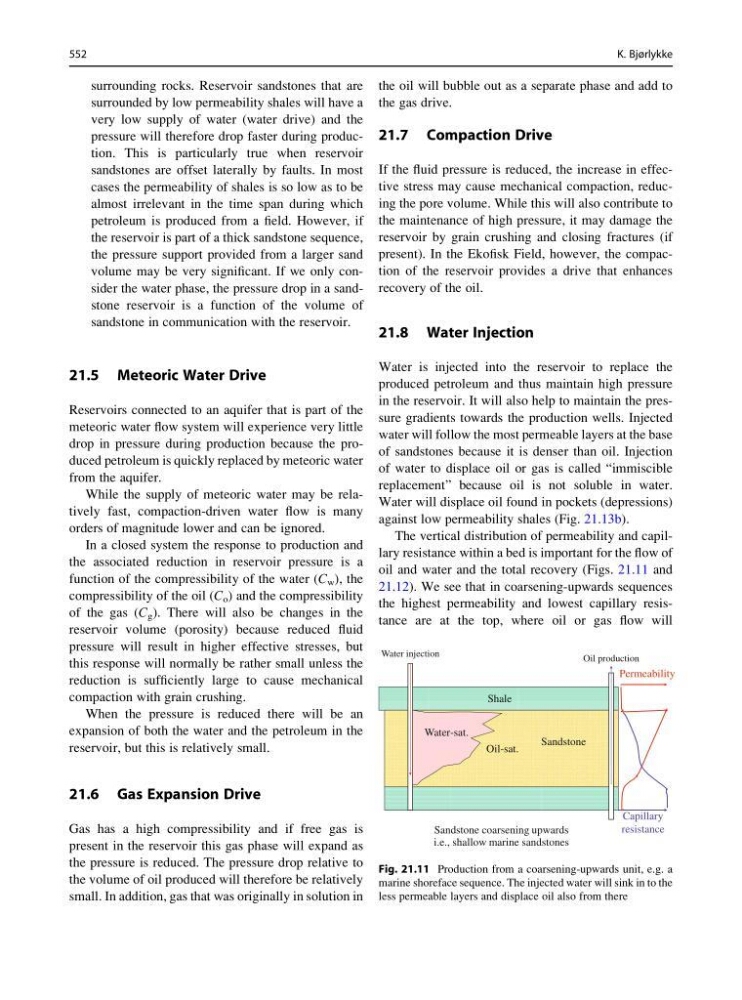
The vertical distribution of permeability and capillary resistance within a bed is important for the flow of
oil and water and the total recovery (Figs. 21.11 and
21.12). We see that in coarsening-upwards sequences
the highest permeability and lowest capillary resistance are at the top, where oil or gas flow will
Shale
Oil-sat.
Permeability
Capillary
resistance
Water injection
Water-sat.
Oil production
Sandstone
Sandstone coarsening upwards
i.e., shallow marine sandstones
Fig. 21.11 Production from a coarsening-upwards unit, e.g. a
marine shoreface sequence. The injected water will sink in to the
less permeable layers and displace oil also from there
552
K. Bjørlykke
surrounded by low permeability shales will have a
very low supply of water (water drive) and the
pressure will therefore drop faster during production. This is particularly true when reservoir
sandstones are offset laterally by faults. In most
cases the permeability of shales is so low as to be
almost irrelevant in the time span during which
petroleum is produced from a field. However, if
the reservoir is part of a thick sandstone sequence,
the pressure support provided from a larger sand
volume may be very significant. If we only consider the water phase, the pressure drop in a sandstone reservoir is a function of the volume of
sandstone in communication with the reservoir.
21.5 Meteoric Water Drive
Reservoirs connected to an aquifer that is part of the
meteoric water flow system will experience very little
drop in pressure during production because the produced petroleum is quickly replaced by meteoric water
from the aquifer.
While the supply of meteoric water may be relatively fast, compaction-driven water flow is many
orders of magnitude lower and can be ignored.
In a closed system the response to production and
the associated reduction in reservoir pressure is a
function of the compressibility of the water (C w ), the
compressibility of the oil (C o ) and the compressibility
of the gas (C g ). There will also be changes in the
reservoir volume (porosity) because reduced fluid
pressure will result in higher effective stresses, but
this response will normally be rather small unless the
reduction is sufficiently large to cause mechanical
compaction with grain crushing.
When the pressure is reduced there will be an
expansion of both the water and the petroleum in the
reservoir, but this is relatively small.
21.6 Gas Expansion Drive
Gas has a high compressibility and if free gas is
present in the reservoir this gas phase will expand as
the pressure is reduced. The pressure drop relative to
the volume of oil produced will therefore be relatively
small. In addition, gas that was originally in solution in
the oil will bubble out as a separate phase and add to
the gas drive.
21.7 Compaction Drive
If the fluid pressure is reduced, the increase in effective stress may cause mechanical compaction, reducing the pore volume. While this will also contribute to
the maintenance of high pressure, it may damage the
reservoir by grain crushing and closing fractures (if
present). In the Ekofisk Field, however, the compaction of the reservoir provides a drive that enhances
recovery of the oil.
21.8 Water Injection
Water is injected into the reservoir to replace the
produced petroleum and thus maintain high pressure
in the reservoir. It will also help to maintain the pressure gradients towards the production wells. Injected
water will follow the most permeable layers at the base
of sandstones because it is denser than oil. Injection
of water to displace oil or gas is called “immiscible
replacement” because oil is not soluble in water.
Water will displace oil found in pockets (depressions)
against low permeability shales (Fig. 21.13b).
The vertical distribution of permeability and capillary resistance within a bed is important for the flow of
oil and water and the total recovery (Figs. 21.11 and
21.12). We see that in coarsening-upwards sequences
the highest permeability and lowest capillary resistance are at the top, where oil or gas flow will
Shale
Oil-sat.
Permeability
Capillary
resistance
Water injection
Water-sat.
Oil production
Sandstone
Sandstone coarsening upwards
i.e., shallow marine sandstones
Fig. 21.11 Production from a coarsening-upwards unit, e.g. a
marine shoreface sequence. The injected water will sink in to the
less permeable layers and displace oil also from there
552
K. Bjørlykke