

will drop fairly quickly during production. The rate of
pressure reduction is thus a function of the volume of
sandstones connected to the oil-saturated reservoir. If
the sandstone volume is large or if it is communicating
with siltstones and sandy shale with significant permeability, there will be more pressure support to the
reservoir during production. Changes in the reservoir
pressure may also cause changes in the petroleum
phase (gas/oil ratio, formation of condensate etc.).
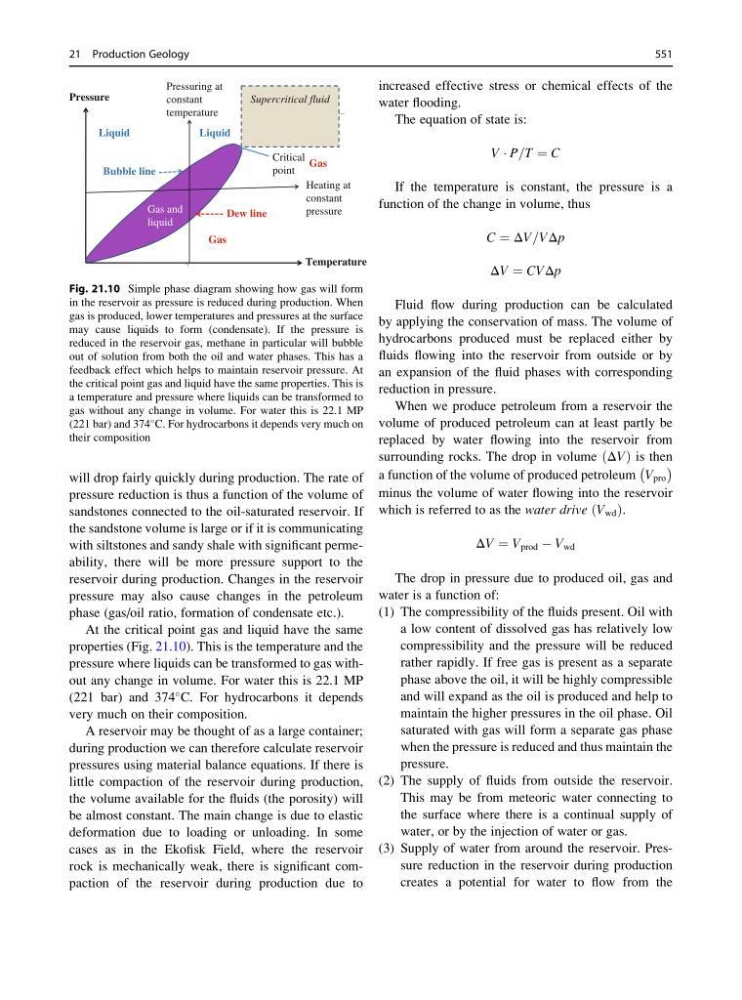
At the critical point gas and liquid have the same
properties (Fig. 21.10). This is the temperature and the
pressure where liquids can be transformed to gas without any change in volume. For water this is 22.1 MP
(221 bar) and 374
C. For hydrocarbons it depends
very much on their composition.
A reservoir may be thought of as a large container;
during production we can therefore calculate reservoir
pressures using material balance equations. If there is
little compaction of the reservoir during production,
the volume available for the fluids (the porosity) will
be almost constant. The main change is due to elastic
deformation due to loading or unloading. In some
cases as in the Ekofisk Field, where the reservoir
rock is mechanically weak, there is significant compaction of the reservoir during production due to
increased effective stress or chemical effects of the
water flooding.
The equation of state is:
V Á P=T ¼ C
If the temperature is constant, the pressure is a
function of the change in volume, thus
C ¼ ΔV=VΔp
ΔV ¼ CVΔp
Fluid flow during production can be calculated
by applying the conservation of mass. The volume of
hydrocarbons produced must be replaced either by
fluids flowing into the reservoir from outside or by
an expansion of the fluid phases with corresponding
reduction in pressure.
When we produce petroleum from a reservoir the
volume of produced petroleum can at least partly be
replaced by water flowing into the reservoir from
surrounding rocks. The drop in volume ΔV
ð Þ is then
a function of the volume of produced petroleum V pro
À
Á
minus the volume of water flowing into the reservoir
which is referred to as the water drive V wd
ð
Þ.
ΔV ¼ V prod À V wd
The drop in pressure due to produced oil, gas and
water is a function of:
(1) The compressibility of the fluids present. Oil with
a low content of dissolved gas has relatively low
compressibility and the pressure will be reduced
rather rapidly. If free gas is present as a separate
phase above the oil, it will be highly compressible
and will expand as the oil is produced and help to
maintain the higher pressures in the oil phase. Oil
saturated with gas will form a separate gas phase
when the pressure is reduced and thus maintain the
pressure.
(2) The supply of fluids from outside the reservoir.
This may be from meteoric water connecting to
the surface where there is a continual supply of
water, or by the injection of water or gas.
(3) Supply of water from around the reservoir. Pressure reduction in the reservoir during production
creates a potential for water to flow from the
Gas
Liquid
Critical
point
Gas and
liquid
Pressure
Temperature
Bubble line
Dew line
Heating at
constant
pressure
Pressuring at
constant
temperature
Supercritical fluid
Gas
Liquid
Fig. 21.10 Simple phase diagram showing how gas will form
in the reservoir as pressure is reduced during production. When
gas is produced, lower temperatures and pressures at the surface
may cause liquids to form (condensate). If the pressure is
reduced in the reservoir gas, methane in particular will bubble
out of solution from both the oil and water phases. This has a
feedback effect which helps to maintain reservoir pressure. At
the critical point gas and liquid have the same properties. This is
a temperature and pressure where liquids can be transformed to
gas without any change in volume. For water this is 22.1 MP
(221 bar) and 374
C. For hydrocarbons it depends very much on
their composition
21 Production Geology
551
pressure reduction is thus a function of the volume of
sandstones connected to the oil-saturated reservoir. If
the sandstone volume is large or if it is communicating
with siltstones and sandy shale with significant permeability, there will be more pressure support to the
reservoir during production. Changes in the reservoir
pressure may also cause changes in the petroleum
phase (gas/oil ratio, formation of condensate etc.).
At the critical point gas and liquid have the same
properties (Fig. 21.10). This is the temperature and the
pressure where liquids can be transformed to gas without any change in volume. For water this is 22.1 MP
(221 bar) and 374
C. For hydrocarbons it depends
very much on their composition.
A reservoir may be thought of as a large container;
during production we can therefore calculate reservoir
pressures using material balance equations. If there is
little compaction of the reservoir during production,
the volume available for the fluids (the porosity) will
be almost constant. The main change is due to elastic
deformation due to loading or unloading. In some
cases as in the Ekofisk Field, where the reservoir
rock is mechanically weak, there is significant compaction of the reservoir during production due to
increased effective stress or chemical effects of the
water flooding.
The equation of state is:
V Á P=T ¼ C
If the temperature is constant, the pressure is a
function of the change in volume, thus
C ¼ ΔV=VΔp
ΔV ¼ CVΔp
Fluid flow during production can be calculated
by applying the conservation of mass. The volume of
hydrocarbons produced must be replaced either by
fluids flowing into the reservoir from outside or by
an expansion of the fluid phases with corresponding
reduction in pressure.
When we produce petroleum from a reservoir the
volume of produced petroleum can at least partly be
replaced by water flowing into the reservoir from
surrounding rocks. The drop in volume ΔV
ð Þ is then
a function of the volume of produced petroleum V pro
À
Á
minus the volume of water flowing into the reservoir
which is referred to as the water drive V wd
ð
Þ.
ΔV ¼ V prod À V wd
The drop in pressure due to produced oil, gas and
water is a function of:
(1) The compressibility of the fluids present. Oil with
a low content of dissolved gas has relatively low
compressibility and the pressure will be reduced
rather rapidly. If free gas is present as a separate
phase above the oil, it will be highly compressible
and will expand as the oil is produced and help to
maintain the higher pressures in the oil phase. Oil
saturated with gas will form a separate gas phase
when the pressure is reduced and thus maintain the
pressure.
(2) The supply of fluids from outside the reservoir.
This may be from meteoric water connecting to
the surface where there is a continual supply of
water, or by the injection of water or gas.
(3) Supply of water from around the reservoir. Pressure reduction in the reservoir during production
creates a potential for water to flow from the
Gas
Liquid
Critical
point
Gas and
liquid
Pressure
Temperature
Bubble line
Dew line
Heating at
constant
pressure
Pressuring at
constant
temperature
Supercritical fluid
Gas
Liquid
Fig. 21.10 Simple phase diagram showing how gas will form
in the reservoir as pressure is reduced during production. When
gas is produced, lower temperatures and pressures at the surface
may cause liquids to form (condensate). If the pressure is
reduced in the reservoir gas, methane in particular will bubble
out of solution from both the oil and water phases. This has a
feedback effect which helps to maintain reservoir pressure. At
the critical point gas and liquid have the same properties. This is
a temperature and pressure where liquids can be transformed to
gas without any change in volume. For water this is 22.1 MP
(221 bar) and 374
C. For hydrocarbons it depends very much on
their composition
21 Production Geology
551