

In pores containing two fluid phases, the permeability of one of the fluid phases is expressed as the
relative permeability (k r ). This is the permeability
with two fluid phases divided by the permeability
with only one fluid phase. In the case of oil and water:
k r ¼ k oþw =k w
The relative permeability is a function of the percentage of each fluid phase in the pore space and also
of the wetting properties (wetting angle) of the phases.
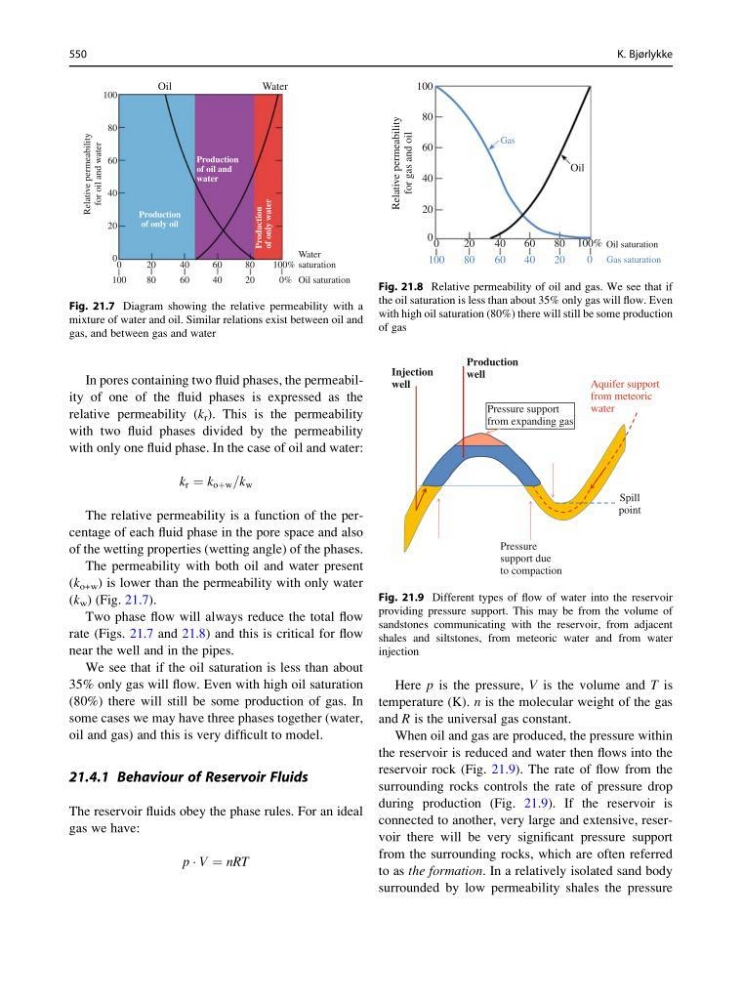
The permeability with both oil and water present
(k o+w ) is lower than the permeability with only water
(k w ) (Fig. 21.7).
Two phase flow will always reduce the total flow
rate (Figs. 21.7 and 21.8) and this is critical for flow
near the well and in the pipes.
We see that if the oil saturation is less than about
35% only gas will flow. Even with high oil saturation
(80%) there will still be some production of gas. In
some cases we may have three phases together (water,
oil and gas) and this is very difficult to model.
21.4.1 Behaviour of Reservoir Fluids
The reservoir fluids obey the phase rules. For an ideal
gas we have:
p Á V ¼ nRT
Here p is the pressure, V is the volume and T is
temperature (K). n is the molecular weight of the gas
and R is the universal gas constant.
When oil and gas are produced, the pressure within
the reservoir is reduced and water then flows into the
reservoir rock (Fig. 21.9). The rate of flow from the
surrounding rocks controls the rate of pressure drop
during production (Fig. 21.9). If the reservoir is
connected to another, very large and extensive, reservoir there will be very significant pressure support
from the surrounding rocks, which are often referred
to as the formation. In a relatively isolated sand body
surrounded by low permeability shales the pressure
0
100
20
80
0
20
40
60
80
100
Oil
Water
Production
of only oil
Production
of only water
Production
of oil and
water
40
60
60
40
80
20
100%
0 % Oil saturation
Relative permeability
for oil and water
saturation
Water
Fig. 21.7 Diagram showing the relative permeability with a
mixture of water and oil. Similar relations exist between oil and
gas, and between gas and water
0
20
40
60
80
100
0
100
20
80
40
60
60
40
80
20
100%
0
Oil
Relative permeability
for gas and oil
Gas saturation
Gas
Oil saturation
Fig. 21.8 Relative permeability of oil and gas. We see that if
the oil saturation is less than about 35% only gas will flow. Even
with high oil saturation (80%) there will still be some production
of gas
Injection
well
Production
well
Spill
point
Aquifer support
from meteoric
water
Pressure
support due
to compaction
Pressure support
from expanding gas
Fig. 21.9 Different types of flow of water into the reservoir
providing pressure support. This may be from the volume of
sandstones communicating with the reservoir, from adjacent
shales and siltstones, from meteoric water and from water
injection
550
K. Bjørlykke
relative permeability (k r ). This is the permeability
with two fluid phases divided by the permeability
with only one fluid phase. In the case of oil and water:
k r ¼ k oþw =k w
The relative permeability is a function of the percentage of each fluid phase in the pore space and also
of the wetting properties (wetting angle) of the phases.
The permeability with both oil and water present
(k o+w ) is lower than the permeability with only water
(k w ) (Fig. 21.7).
Two phase flow will always reduce the total flow
rate (Figs. 21.7 and 21.8) and this is critical for flow
near the well and in the pipes.
We see that if the oil saturation is less than about
35% only gas will flow. Even with high oil saturation
(80%) there will still be some production of gas. In
some cases we may have three phases together (water,
oil and gas) and this is very difficult to model.
21.4.1 Behaviour of Reservoir Fluids
The reservoir fluids obey the phase rules. For an ideal
gas we have:
p Á V ¼ nRT
Here p is the pressure, V is the volume and T is
temperature (K). n is the molecular weight of the gas
and R is the universal gas constant.
When oil and gas are produced, the pressure within
the reservoir is reduced and water then flows into the
reservoir rock (Fig. 21.9). The rate of flow from the
surrounding rocks controls the rate of pressure drop
during production (Fig. 21.9). If the reservoir is
connected to another, very large and extensive, reservoir there will be very significant pressure support
from the surrounding rocks, which are often referred
to as the formation. In a relatively isolated sand body
surrounded by low permeability shales the pressure
0
100
20
80
0
20
40
60
80
100
Oil
Water
Production
of only oil
Production
of only water
Production
of oil and
water
40
60
60
40
80
20
100%
0 % Oil saturation
Relative permeability
for oil and water
saturation
Water
Fig. 21.7 Diagram showing the relative permeability with a
mixture of water and oil. Similar relations exist between oil and
gas, and between gas and water
0
20
40
60
80
100
0
100
20
80
40
60
60
40
80
20
100%
0
Oil
Relative permeability
for gas and oil
Gas saturation
Gas
Oil saturation
Fig. 21.8 Relative permeability of oil and gas. We see that if
the oil saturation is less than about 35% only gas will flow. Even
with high oil saturation (80%) there will still be some production
of gas
Injection
well
Production
well
Spill
point
Aquifer support
from meteoric
water
Pressure
support due
to compaction
Pressure support
from expanding gas
Fig. 21.9 Different types of flow of water into the reservoir
providing pressure support. This may be from the volume of
sandstones communicating with the reservoir, from adjacent
shales and siltstones, from meteoric water and from water
injection
550
K. Bjørlykke