

21.2 Determination of Petroleum
Reserves
When an exploration well has detected oil an estimate
must be made of the reserves that can be produced.
In many cases additional wells (appraisal wells) are
needed before the full extent of the field and its financial viability for production can be determined.
The total initial volume of oil in the reservoir is
called the volume of oil in place (V p ).
The percentage of that oil which can be produced is
called recovery or the recovery factor.
The volume of rock above the oil/water contact
(OWC) and below the cap rock, V r , is determined by
3D seismic and data from the wells. This requires that
the (OWC) is correctly defined, but it may not be
visible on the seismic records, nor necessarily be at
the same depth throughout the reservoir.
Good reservoir intervals are often called pay zones,
whereas the tight zones are called non-pay zones.
Intervals (layers) where the porosity is low (<10%)
and the permeability below a few milli Darcy (mD)
may not be capable of producing significant amounts
of oil even if they lie above the oil/water contact. In
fractured rocks (e.g. fractured limestones) oil can be
produced at very much lower porosities. The ratio
between the volume of reservoir rocks (N) that possess
sufficient reservoir quality to produce significant
amounts of oil (pay), and the total volume (G), is
called net to gross (N/G). We then need to estimate
the average porosity (φ a ).
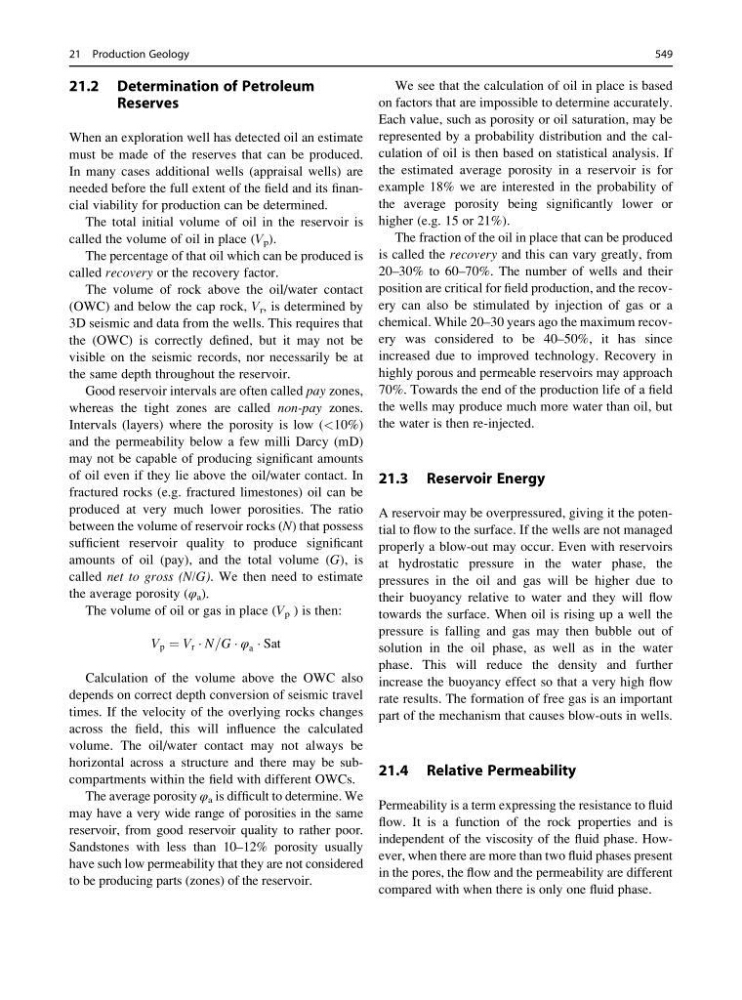
The volume of oil or gas in place (V p ) is then:
V p ¼ V r Á N=G Á φ a Á Sat
Calculation of the volume above the OWC also
depends on correct depth conversion of seismic travel
times. If the velocity of the overlying rocks changes
across the field, this will influence the calculated
volume. The oil/water contact may not always be
horizontal across a structure and there may be subcompartments within the field with different OWCs.
The average porosity φ a is difficult to determine. We
may have a very wide range of porosities in the same
reservoir, from good reservoir quality to rather poor.
Sandstones with less than 10–12% porosity usually
have such low permeability that they are not considered
to be producing parts (zones) of the reservoir.
We see that the calculation of oil in place is based
on factors that are impossible to determine accurately.
Each value, such as porosity or oil saturation, may be
represented by a probability distribution and the calculation of oil is then based on statistical analysis. If
the estimated average porosity in a reservoir is for
example 18% we are interested in the probability of
the average porosity being significantly lower or
higher (e.g. 15 or 21%).
The fraction of the oil in place that can be produced
is called the recovery and this can vary greatly, from
20–30% to 60–70%. The number of wells and their
position are critical for field production, and the recovery can also be stimulated by injection of gas or a
chemical. While 20–30 years ago the maximum recovery was considered to be 40–50%, it has since
increased due to improved technology. Recovery in
highly porous and permeable reservoirs may approach
70%. Towards the end of the production life of a field
the wells may produce much more water than oil, but
the water is then re-injected.
21.3 Reservoir Energy
A reservoir may be overpressured, giving it the potential to flow to the surface. If the wells are not managed
properly a blow-out may occur. Even with reservoirs
at hydrostatic pressure in the water phase, the
pressures in the oil and gas will be higher due to
their buoyancy relative to water and they will flow
towards the surface. When oil is rising up a well the
pressure is falling and gas may then bubble out of
solution in the oil phase, as well as in the water
phase. This will reduce the density and further
increase the buoyancy effect so that a very high flow
rate results. The formation of free gas is an important
part of the mechanism that causes blow-outs in wells.
21.4 Relative Permeability
Permeability is a term expressing the resistance to fluid
flow. It is a function of the rock properties and is
independent of the viscosity of the fluid phase. However, when there are more than two fluid phases present
in the pores, the flow and the permeability are different
compared with when there is only one fluid phase.
21 Production Geology
549
Reserves
When an exploration well has detected oil an estimate
must be made of the reserves that can be produced.
In many cases additional wells (appraisal wells) are
needed before the full extent of the field and its financial viability for production can be determined.
The total initial volume of oil in the reservoir is
called the volume of oil in place (V p ).
The percentage of that oil which can be produced is
called recovery or the recovery factor.
The volume of rock above the oil/water contact
(OWC) and below the cap rock, V r , is determined by
3D seismic and data from the wells. This requires that
the (OWC) is correctly defined, but it may not be
visible on the seismic records, nor necessarily be at
the same depth throughout the reservoir.
Good reservoir intervals are often called pay zones,
whereas the tight zones are called non-pay zones.
Intervals (layers) where the porosity is low (<10%)
and the permeability below a few milli Darcy (mD)
may not be capable of producing significant amounts
of oil even if they lie above the oil/water contact. In
fractured rocks (e.g. fractured limestones) oil can be
produced at very much lower porosities. The ratio
between the volume of reservoir rocks (N) that possess
sufficient reservoir quality to produce significant
amounts of oil (pay), and the total volume (G), is
called net to gross (N/G). We then need to estimate
the average porosity (φ a ).
The volume of oil or gas in place (V p ) is then:
V p ¼ V r Á N=G Á φ a Á Sat
Calculation of the volume above the OWC also
depends on correct depth conversion of seismic travel
times. If the velocity of the overlying rocks changes
across the field, this will influence the calculated
volume. The oil/water contact may not always be
horizontal across a structure and there may be subcompartments within the field with different OWCs.
The average porosity φ a is difficult to determine. We
may have a very wide range of porosities in the same
reservoir, from good reservoir quality to rather poor.
Sandstones with less than 10–12% porosity usually
have such low permeability that they are not considered
to be producing parts (zones) of the reservoir.
We see that the calculation of oil in place is based
on factors that are impossible to determine accurately.
Each value, such as porosity or oil saturation, may be
represented by a probability distribution and the calculation of oil is then based on statistical analysis. If
the estimated average porosity in a reservoir is for
example 18% we are interested in the probability of
the average porosity being significantly lower or
higher (e.g. 15 or 21%).
The fraction of the oil in place that can be produced
is called the recovery and this can vary greatly, from
20–30% to 60–70%. The number of wells and their
position are critical for field production, and the recovery can also be stimulated by injection of gas or a
chemical. While 20–30 years ago the maximum recovery was considered to be 40–50%, it has since
increased due to improved technology. Recovery in
highly porous and permeable reservoirs may approach
70%. Towards the end of the production life of a field
the wells may produce much more water than oil, but
the water is then re-injected.
21.3 Reservoir Energy
A reservoir may be overpressured, giving it the potential to flow to the surface. If the wells are not managed
properly a blow-out may occur. Even with reservoirs
at hydrostatic pressure in the water phase, the
pressures in the oil and gas will be higher due to
their buoyancy relative to water and they will flow
towards the surface. When oil is rising up a well the
pressure is falling and gas may then bubble out of
solution in the oil phase, as well as in the water
phase. This will reduce the density and further
increase the buoyancy effect so that a very high flow
rate results. The formation of free gas is an important
part of the mechanism that causes blow-outs in wells.
21.4 Relative Permeability
Permeability is a term expressing the resistance to fluid
flow. It is a function of the rock properties and is
independent of the viscosity of the fluid phase. However, when there are more than two fluid phases present
in the pores, the flow and the permeability are different
compared with when there is only one fluid phase.
21 Production Geology
549