

few metres. Since the pores in the reservoir rock usually also contain some water, the percentage of oil or
gas in the pores is called the oil saturation or the gas
saturation.
The petroleum saturation depends on the composition of the petroleum phase and its surface properties,
on the mineral surfaces and on the pressure difference
between the petroleum and the water phase. This pressure difference increases with increasing height above
the OWC due to the lower density of the hydrocarbon
column (Fig. 21.4b). As a result, petroleum will enter
smaller pores higher up in the reservoir, and the degree
of petroleum saturation there will be higher if everything else remains constant.
Most sandstone reservoirs are water-wet and this
means that the minerals are lined with a thin layer of
water. The smallest pores, i.e. between clay minerals
or along the contacts between quartz grains, will then
be filled with water. The percentage of water in the
pores (water saturation) may be from 80 to 90% in
well-sorted sandstones to 50–60% in sandstones with
higher clay content. Also clay minerals formed during
diagenesis (kaolinite, chlorite and illite) will have
rather low water saturation if the system is water-wet
because oil can not enter into the smaller pores due to
capillary forces. The gas saturation will normally be
higher. In reservoirs with biodegraded heavy oil, however, the wetting angle is normally more oil-wet.
In carbonate reservoirs the wetting angle is normally higher than in sandstone reservoirs but it may
vary as a function of the composition of both the oil
and the porewater.
In the Ekofisk Field it has been shown that injection
of seawater has changed the wetting angle towards a
more water-wet system, thus contributing to a higher
recovery. This is probably due to the effect of the high
sulphate and Mg
++ concentrations in the seawater
which change the surface charge of the carbonate
minerals.
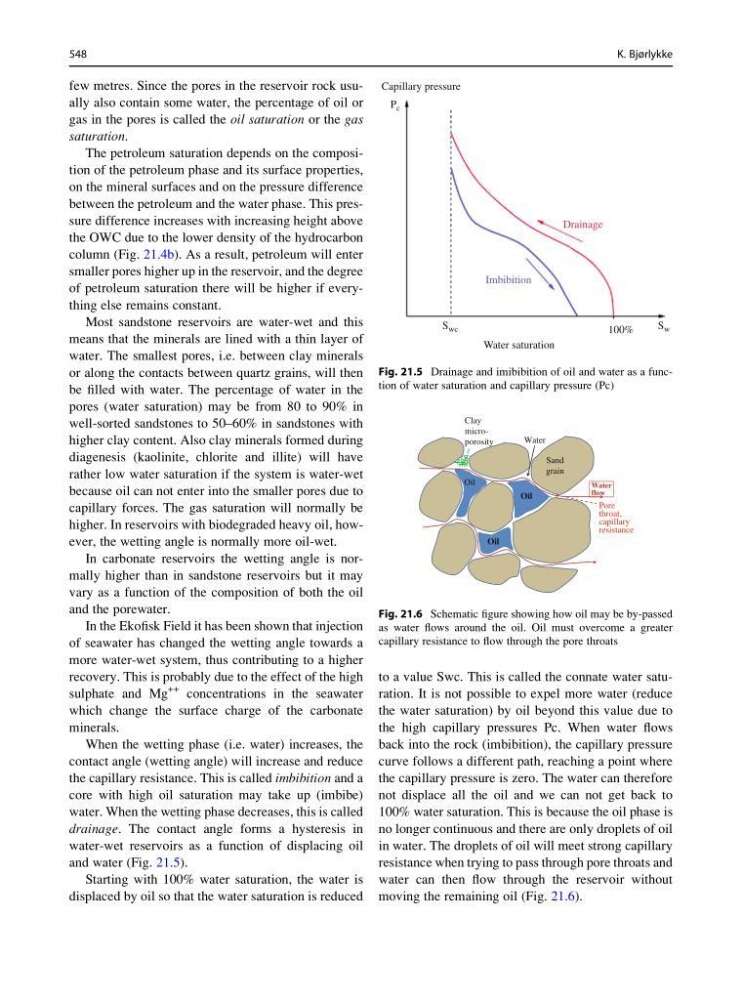
When the wetting phase (i.e. water) increases, the
contact angle (wetting angle) will increase and reduce
the capillary resistance. This is called imbibition and a
core with high oil saturation may take up (imbibe)
water. When the wetting phase decreases, this is called
drainage. The contact angle forms a hysteresis in
water-wet reservoirs as a function of displacing oil
and water (Fig. 21.5).
Starting with 100% water saturation, the water is
displaced by oil so that the water saturation is reduced
to a value Swc. This is called the connate water saturation. It is not possible to expel more water (reduce
the water saturation) by oil beyond this value due to
the high capillary pressures Pc. When water flows
back into the rock (imbibition), the capillary pressure
curve follows a different path, reaching a point where
the capillary pressure is zero. The water can therefore
not displace all the oil and we can not get back to
100% water saturation. This is because the oil phase is
no longer continuous and there are only droplets of oil
in water. The droplets of oil will meet strong capillary
resistance when trying to pass through pore throats and
water can then flow through the reservoir without
moving the remaining oil (Fig. 21.6).
S wc
P c
Capillary pressure
S w
100%
Water saturation
Imbibition
Drainage
Fig. 21.5 Drainage and imibibition of oil and water as a function of water saturation and capillary pressure (Pc)
Oil
Water
flow
Oil
Oil
Sand
grain
Clay
microporosity
Pore
throat,
capillary
resistance
Water
Fig. 21.6 Schematic figure showing how oil may be by-passed
as water flows around the oil. Oil must overcome a greater
capillary resistance to flow through the pore throats
548
K. Bjørlykke
gas in the pores is called the oil saturation or the gas
saturation.
The petroleum saturation depends on the composition of the petroleum phase and its surface properties,
on the mineral surfaces and on the pressure difference
between the petroleum and the water phase. This pressure difference increases with increasing height above
the OWC due to the lower density of the hydrocarbon
column (Fig. 21.4b). As a result, petroleum will enter
smaller pores higher up in the reservoir, and the degree
of petroleum saturation there will be higher if everything else remains constant.
Most sandstone reservoirs are water-wet and this
means that the minerals are lined with a thin layer of
water. The smallest pores, i.e. between clay minerals
or along the contacts between quartz grains, will then
be filled with water. The percentage of water in the
pores (water saturation) may be from 80 to 90% in
well-sorted sandstones to 50–60% in sandstones with
higher clay content. Also clay minerals formed during
diagenesis (kaolinite, chlorite and illite) will have
rather low water saturation if the system is water-wet
because oil can not enter into the smaller pores due to
capillary forces. The gas saturation will normally be
higher. In reservoirs with biodegraded heavy oil, however, the wetting angle is normally more oil-wet.
In carbonate reservoirs the wetting angle is normally higher than in sandstone reservoirs but it may
vary as a function of the composition of both the oil
and the porewater.
In the Ekofisk Field it has been shown that injection
of seawater has changed the wetting angle towards a
more water-wet system, thus contributing to a higher
recovery. This is probably due to the effect of the high
sulphate and Mg
++ concentrations in the seawater
which change the surface charge of the carbonate
minerals.
When the wetting phase (i.e. water) increases, the
contact angle (wetting angle) will increase and reduce
the capillary resistance. This is called imbibition and a
core with high oil saturation may take up (imbibe)
water. When the wetting phase decreases, this is called
drainage. The contact angle forms a hysteresis in
water-wet reservoirs as a function of displacing oil
and water (Fig. 21.5).
Starting with 100% water saturation, the water is
displaced by oil so that the water saturation is reduced
to a value Swc. This is called the connate water saturation. It is not possible to expel more water (reduce
the water saturation) by oil beyond this value due to
the high capillary pressures Pc. When water flows
back into the rock (imbibition), the capillary pressure
curve follows a different path, reaching a point where
the capillary pressure is zero. The water can therefore
not displace all the oil and we can not get back to
100% water saturation. This is because the oil phase is
no longer continuous and there are only droplets of oil
in water. The droplets of oil will meet strong capillary
resistance when trying to pass through pore throats and
water can then flow through the reservoir without
moving the remaining oil (Fig. 21.6).
S wc
P c
Capillary pressure
S w
100%
Water saturation
Imbibition
Drainage
Fig. 21.5 Drainage and imibibition of oil and water as a function of water saturation and capillary pressure (Pc)
Oil
Water
flow
Oil
Oil
Sand
grain
Clay
microporosity
Pore
throat,
capillary
resistance
Water
Fig. 21.6 Schematic figure showing how oil may be by-passed
as water flows around the oil. Oil must overcome a greater
capillary resistance to flow through the pore throats
548
K. Bjørlykke