

During production the capillary resistance from finegrained sand will be greater, due to the small pore
throats. In fine-grained sandstones or siltstones with
small pores, water is drawn (imbibed) upwards due
to capillary forces. The difference in OWC which is
recorded on the resistivity logs may be as much as a
Water-wet
Mineral surface
θ
θ
Mineral surface
Oil-wet
Oil
droplet
Oil
droplet
Water
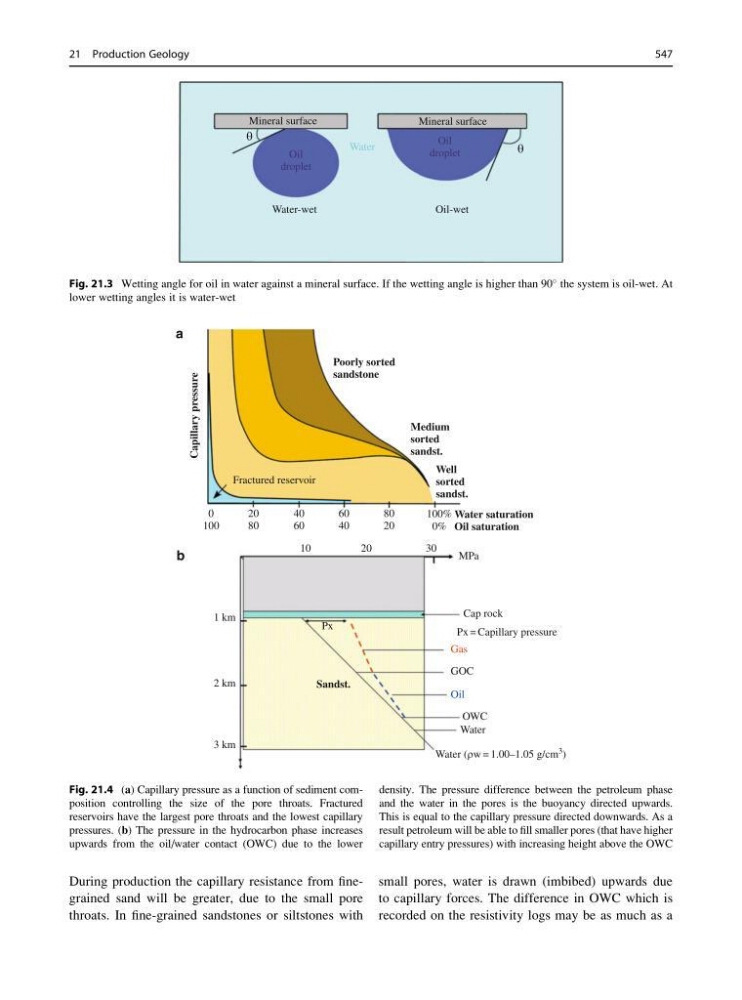
Fig. 21.3 Wetting angle for oil in water against a mineral surface. If the wetting angle is higher than 90
the system is oil-wet. At
lower wetting angles it is water-wet
3 km
2 km
Sandst.
Px
1 km
0
100
Fractured reservoir
20
80
40
60
10
20
30
MPa
Cap rock
Gas
Oil
GOC
OWC
Water
Water (ρw = 1.00–1.05 g/cm
3 )
Px = Capillary pressure
60
40
80
20
Water saturation
Oil saturation
Well
sorted
sandst.
Medium
sorted
sandst.
Poorly sorted
sandstone
Capillary pressure
b
a
0%
100%
Fig. 21.4 (a) Capillary pressure as a function of sediment composition controlling the size of the pore throats. Fractured
reservoirs have the largest pore throats and the lowest capillary
pressures. (b) The pressure in the hydrocarbon phase increases
upwards from the oil/water contact (OWC) due to the lower
density. The pressure difference between the petroleum phase
and the water in the pores is the buoyancy directed upwards.
This is equal to the capillary pressure directed downwards. As a
result petroleum will be able to fill smaller pores (that have higher
capillary entry pressures) with increasing height above the OWC
21 Production Geology
547
throats. In fine-grained sandstones or siltstones with
small pores, water is drawn (imbibed) upwards due
to capillary forces. The difference in OWC which is
recorded on the resistivity logs may be as much as a
Water-wet
Mineral surface
θ
θ
Mineral surface
Oil-wet
Oil
droplet
Oil
droplet
Water
Fig. 21.3 Wetting angle for oil in water against a mineral surface. If the wetting angle is higher than 90
the system is oil-wet. At
lower wetting angles it is water-wet
3 km
2 km
Sandst.
Px
1 km
0
100
Fractured reservoir
20
80
40
60
10
20
30
MPa
Cap rock
Gas
Oil
GOC
OWC
Water
Water (ρw = 1.00–1.05 g/cm
3 )
Px = Capillary pressure
60
40
80
20
Water saturation
Oil saturation
Well
sorted
sandst.
Medium
sorted
sandst.
Poorly sorted
sandstone
Capillary pressure
b
a
0%
100%
Fig. 21.4 (a) Capillary pressure as a function of sediment composition controlling the size of the pore throats. Fractured
reservoirs have the largest pore throats and the lowest capillary
pressures. (b) The pressure in the hydrocarbon phase increases
upwards from the oil/water contact (OWC) due to the lower
density. The pressure difference between the petroleum phase
and the water in the pores is the buoyancy directed upwards.
This is equal to the capillary pressure directed downwards. As a
result petroleum will be able to fill smaller pores (that have higher
capillary entry pressures) with increasing height above the OWC
21 Production Geology
547