

If the wetting angle is more than 90
the oil/water
contact in the pipe will be below the general OWC,
which means the oil is drawn downwards because it is
preferentially wetting the inside of the pipe (Fig. 21.2);
with lower wetting angles the OWC is raised.
The pores in a reservoir rock are usually filled with
some water in addition to the oil or gas. If we submerge a very thin pipe (e.g. of glass) in oil and water,
the water will rise above the oil/water contact. This
capillary rise is a function of the radius of the pipe bore
(R) and the wetting angle (θ).
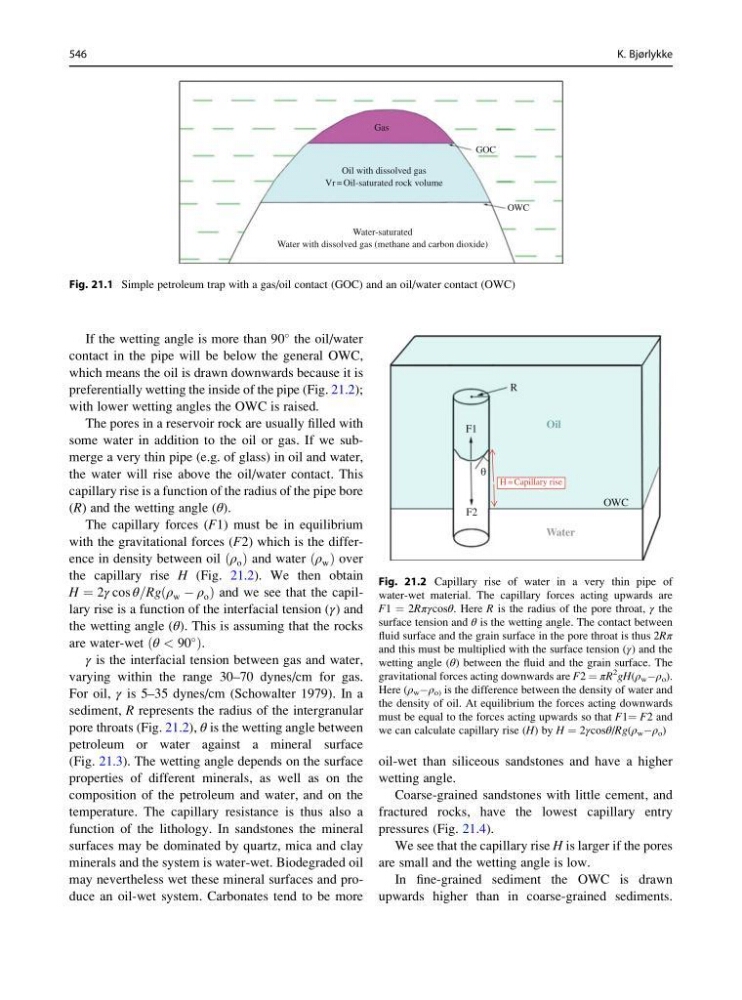
The capillary forces (F1) must be in equilibrium
with the gravitational forces (F2) which is the difference in density between oil ρ o
ð Þ and water ρ w
ð Þ over
the capillary rise H (Fig. 21.2). We then obtain
H ¼ 2γ cos θ=Rg ρ w À ρ o
ð
Þand we see that the capillary rise is a function of the interfacial tension (γ) and
the wetting angle (θ). This is assuming that the rocks
are water-wet θ < 90
ð
Þ .
γ is the interfacial tension between gas and water,
varying within the range 30–70 dynes/cm for gas.
For oil, γ is 5–35 dynes/cm (Schowalter 1979). In a
sediment, R represents the radius of the intergranular
pore throats (Fig. 21.2), θ is the wetting angle between
petroleum or water against a mineral surface
(Fig. 21.3). The wetting angle depends on the surface
properties of different minerals, as well as on the
composition of the petroleum and water, and on the
temperature. The capillary resistance is thus also a
function of the lithology. In sandstones the mineral
surfaces may be dominated by quartz, mica and clay
minerals and the system is water-wet. Biodegraded oil
may nevertheless wet these mineral surfaces and produce an oil-wet system. Carbonates tend to be more
oil-wet than siliceous sandstones and have a higher
wetting angle.
Coarse-grained sandstones with little cement, and
fractured rocks, have the lowest capillary entry
pressures (Fig. 21.4).
We see that the capillary rise H is larger if the pores
are small and the wetting angle is low.
In fine-grained sediment the OWC is drawn
upwards higher than in coarse-grained sediments.
Gas
Oil with dissolved gas
Vr = Oil-saturated rock volume
Water-saturated
Water with dissolved gas (methane and carbon dioxide)
GOC
OWC
Fig. 21.1 Simple petroleum trap with a gas/oil contact (GOC) and an oil/water contact (OWC)
OWC
F2
F1
R
θ
Water
Oil
H = Capillary rise
Fig. 21.2 Capillary rise of water in a very thin pipe of
water-wet material. The capillary forces acting upwards are
F1 ¼ 2Rπγcosθ. Here R is the radius of the pore throat, γ the
surface tension and θ is the wetting angle. The contact between
fluid surface and the grain surface in the pore throat is thus 2Rπ
and this must be multiplied with the surface tension (γ) and the
wetting angle (θ) between the fluid and the grain surface. The
gravitational forces acting downwards are F2 ¼ πR
2
gH(ρ w Àρ o ).
Here (ρ w Àρ o) is the difference between the density of water and
the density of oil. At equilibrium the forces acting downwards
must be equal to the forces acting upwards so that F1¼ F2 and
we can calculate capillary rise (H) by H ¼ 2γcosθ/Rg(ρ w Àρ o )
546
K. Bjørlykke
the oil/water
contact in the pipe will be below the general OWC,
which means the oil is drawn downwards because it is
preferentially wetting the inside of the pipe (Fig. 21.2);
with lower wetting angles the OWC is raised.
The pores in a reservoir rock are usually filled with
some water in addition to the oil or gas. If we submerge a very thin pipe (e.g. of glass) in oil and water,
the water will rise above the oil/water contact. This
capillary rise is a function of the radius of the pipe bore
(R) and the wetting angle (θ).
The capillary forces (F1) must be in equilibrium
with the gravitational forces (F2) which is the difference in density between oil ρ o
ð Þ and water ρ w
ð Þ over
the capillary rise H (Fig. 21.2). We then obtain
H ¼ 2γ cos θ=Rg ρ w À ρ o
ð
Þand we see that the capillary rise is a function of the interfacial tension (γ) and
the wetting angle (θ). This is assuming that the rocks
are water-wet θ < 90
ð
Þ .
γ is the interfacial tension between gas and water,
varying within the range 30–70 dynes/cm for gas.
For oil, γ is 5–35 dynes/cm (Schowalter 1979). In a
sediment, R represents the radius of the intergranular
pore throats (Fig. 21.2), θ is the wetting angle between
petroleum or water against a mineral surface
(Fig. 21.3). The wetting angle depends on the surface
properties of different minerals, as well as on the
composition of the petroleum and water, and on the
temperature. The capillary resistance is thus also a
function of the lithology. In sandstones the mineral
surfaces may be dominated by quartz, mica and clay
minerals and the system is water-wet. Biodegraded oil
may nevertheless wet these mineral surfaces and produce an oil-wet system. Carbonates tend to be more
oil-wet than siliceous sandstones and have a higher
wetting angle.
Coarse-grained sandstones with little cement, and
fractured rocks, have the lowest capillary entry
pressures (Fig. 21.4).
We see that the capillary rise H is larger if the pores
are small and the wetting angle is low.
In fine-grained sediment the OWC is drawn
upwards higher than in coarse-grained sediments.
Gas
Oil with dissolved gas
Vr = Oil-saturated rock volume
Water-saturated
Water with dissolved gas (methane and carbon dioxide)
GOC
OWC
Fig. 21.1 Simple petroleum trap with a gas/oil contact (GOC) and an oil/water contact (OWC)
OWC
F2
F1
R
θ
Water
Oil
H = Capillary rise
Fig. 21.2 Capillary rise of water in a very thin pipe of
water-wet material. The capillary forces acting upwards are
F1 ¼ 2Rπγcosθ. Here R is the radius of the pore throat, γ the
surface tension and θ is the wetting angle. The contact between
fluid surface and the grain surface in the pore throat is thus 2Rπ
and this must be multiplied with the surface tension (γ) and the
wetting angle (θ) between the fluid and the grain surface. The
gravitational forces acting downwards are F2 ¼ πR
2
gH(ρ w Àρ o ).
Here (ρ w Àρ o) is the difference between the density of water and
the density of oil. At equilibrium the forces acting downwards
must be equal to the forces acting upwards so that F1¼ F2 and
we can calculate capillary rise (H) by H ¼ 2γcosθ/Rg(ρ w Àρ o )
546
K. Bjørlykke