

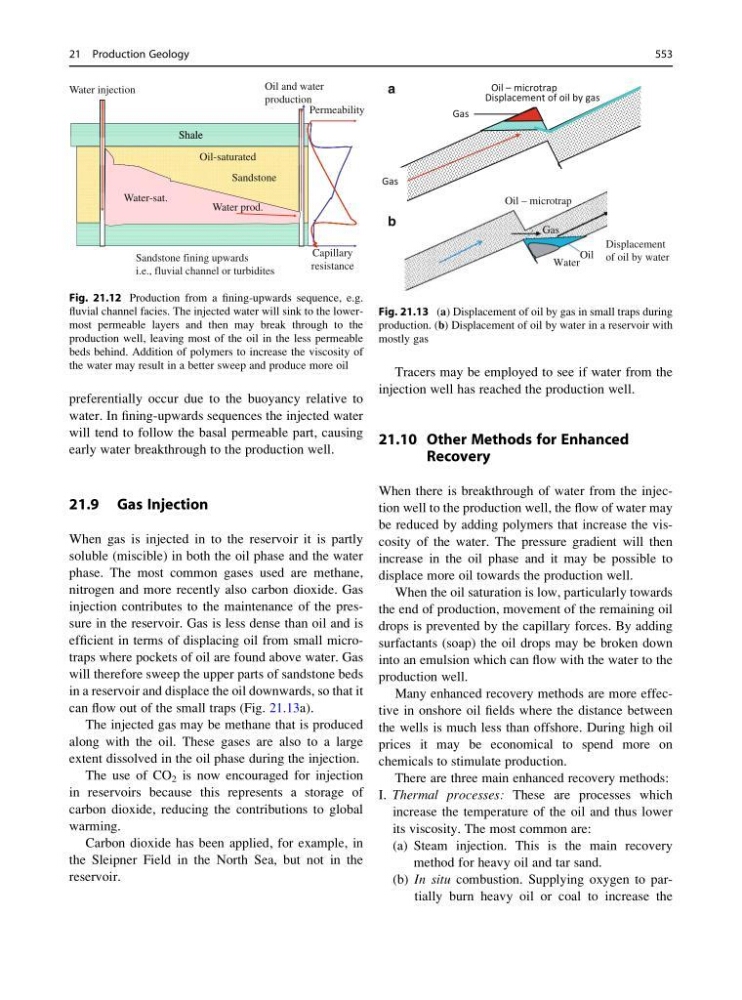
preferentially occur due to the buoyancy relative to
water. In fining-upwards sequences the injected water
will tend to follow the basal permeable part, causing
early water breakthrough to the production well.
21.9 Gas Injection
When gas is injected in to the reservoir it is partly
soluble (miscible) in both the oil phase and the water
phase. The most common gases used are methane,
nitrogen and more recently also carbon dioxide. Gas
injection contributes to the maintenance of the pressure in the reservoir. Gas is less dense than oil and is
efficient in terms of displacing oil from small microtraps where pockets of oil are found above water. Gas
will therefore sweep the upper parts of sandstone beds
in a reservoir and displace the oil downwards, so that it
can flow out of the small traps (Fig. 21.13a).
The injected gas may be methane that is produced
along with the oil. These gases are also to a large
extent dissolved in the oil phase during the injection.
The use of CO 2 is now encouraged for injection
in reservoirs because this represents a storage of
carbon dioxide, reducing the contributions to global
warming.
Carbon dioxide has been applied, for example, in
the Sleipner Field in the North Sea, but not in the
reservoir.
Tracers may be employed to see if water from the
injection well has reached the production well.
21.10 Other Methods for Enhanced
Recovery
When there is breakthrough of water from the injection well to the production well, the flow of water may
be reduced by adding polymers that increase the viscosity of the water. The pressure gradient will then
increase in the oil phase and it may be possible to
displace more oil towards the production well.
When the oil saturation is low, particularly towards
the end of production, movement of the remaining oil
drops is prevented by the capillary forces. By adding
surfactants (soap) the oil drops may be broken down
into an emulsion which can flow with the water to the
production well.
Many enhanced recovery methods are more effective in onshore oil fields where the distance between
the wells is much less than offshore. During high oil
prices it may be economical to spend more on
chemicals to stimulate production.
There are three main enhanced recovery methods:
I. Thermal processes: These are processes which
increase the temperature of the oil and thus lower
its viscosity. The most common are:
(a) Steam injection. This is the main recovery
method for heavy oil and tar sand.
(b) In situ combustion. Supplying oxygen to partially burn heavy oil or coal to increase the
Permeability
Water injection
Oil and water
production
Shale Shale
Oil-saturated
Sandstone
Water-sat.
Water prod.
Capillary
resistance
Sandstone fining upwards
i.e., fluvial channel or turbidites
Fig. 21.12 Production from a fining-upwards sequence, e.g.
fluvial channel facies. The injected water will sink to the lowermost permeable layers and then may break through to the
production well, leaving most of the oil in the less permeable
beds behind. Addition of polymers to increase the viscosity of
the water may result in a better sweep and produce more oil
Oil – microtrap
Gas
Displacement
of oil by water
Water
Oil
a
b
Oil – microtrap
Displacement of oil by gas
Gas
Gas
Fig. 21.13 (a) Displacement of oil by gas in small traps during
production. (b) Displacement of oil by water in a reservoir with
mostly gas
21 Production Geology
553
water. In fining-upwards sequences the injected water
will tend to follow the basal permeable part, causing
early water breakthrough to the production well.
21.9 Gas Injection
When gas is injected in to the reservoir it is partly
soluble (miscible) in both the oil phase and the water
phase. The most common gases used are methane,
nitrogen and more recently also carbon dioxide. Gas
injection contributes to the maintenance of the pressure in the reservoir. Gas is less dense than oil and is
efficient in terms of displacing oil from small microtraps where pockets of oil are found above water. Gas
will therefore sweep the upper parts of sandstone beds
in a reservoir and displace the oil downwards, so that it
can flow out of the small traps (Fig. 21.13a).
The injected gas may be methane that is produced
along with the oil. These gases are also to a large
extent dissolved in the oil phase during the injection.
The use of CO 2 is now encouraged for injection
in reservoirs because this represents a storage of
carbon dioxide, reducing the contributions to global
warming.
Carbon dioxide has been applied, for example, in
the Sleipner Field in the North Sea, but not in the
reservoir.
Tracers may be employed to see if water from the
injection well has reached the production well.
21.10 Other Methods for Enhanced
Recovery
When there is breakthrough of water from the injection well to the production well, the flow of water may
be reduced by adding polymers that increase the viscosity of the water. The pressure gradient will then
increase in the oil phase and it may be possible to
displace more oil towards the production well.
When the oil saturation is low, particularly towards
the end of production, movement of the remaining oil
drops is prevented by the capillary forces. By adding
surfactants (soap) the oil drops may be broken down
into an emulsion which can flow with the water to the
production well.
Many enhanced recovery methods are more effective in onshore oil fields where the distance between
the wells is much less than offshore. During high oil
prices it may be economical to spend more on
chemicals to stimulate production.
There are three main enhanced recovery methods:
I. Thermal processes: These are processes which
increase the temperature of the oil and thus lower
its viscosity. The most common are:
(a) Steam injection. This is the main recovery
method for heavy oil and tar sand.
(b) In situ combustion. Supplying oxygen to partially burn heavy oil or coal to increase the
Permeability
Water injection
Oil and water
production
Shale Shale
Oil-saturated
Sandstone
Water-sat.
Water prod.
Capillary
resistance
Sandstone fining upwards
i.e., fluvial channel or turbidites
Fig. 21.12 Production from a fining-upwards sequence, e.g.
fluvial channel facies. The injected water will sink to the lowermost permeable layers and then may break through to the
production well, leaving most of the oil in the less permeable
beds behind. Addition of polymers to increase the viscosity of
the water may result in a better sweep and produce more oil
Oil – microtrap
Gas
Displacement
of oil by water
Water
Oil
a
b
Oil – microtrap
Displacement of oil by gas
Gas
Gas
Fig. 21.13 (a) Displacement of oil by gas in small traps during
production. (b) Displacement of oil by water in a reservoir with
mostly gas
21 Production Geology
553